What Is a College Match School? A Student's Guide

A college match school is defined as an institution where your academic credentials align closely with the school’s typical admitted student profile, giving you a realistic and strong chance of admission. The college matching process goes beyond gut feeling. It uses measurable criteria, including GPA, standardized test scores, graduation rates, employment outcomes, and net cost after aid, to identify schools where you are likely to thrive. Tools like the College Scorecard and institutional data from the National Center for Education Statistics give students and parents the evidence they need to make confident, outcome-based decisions. At Top College Coach, we guide families through this process every day.
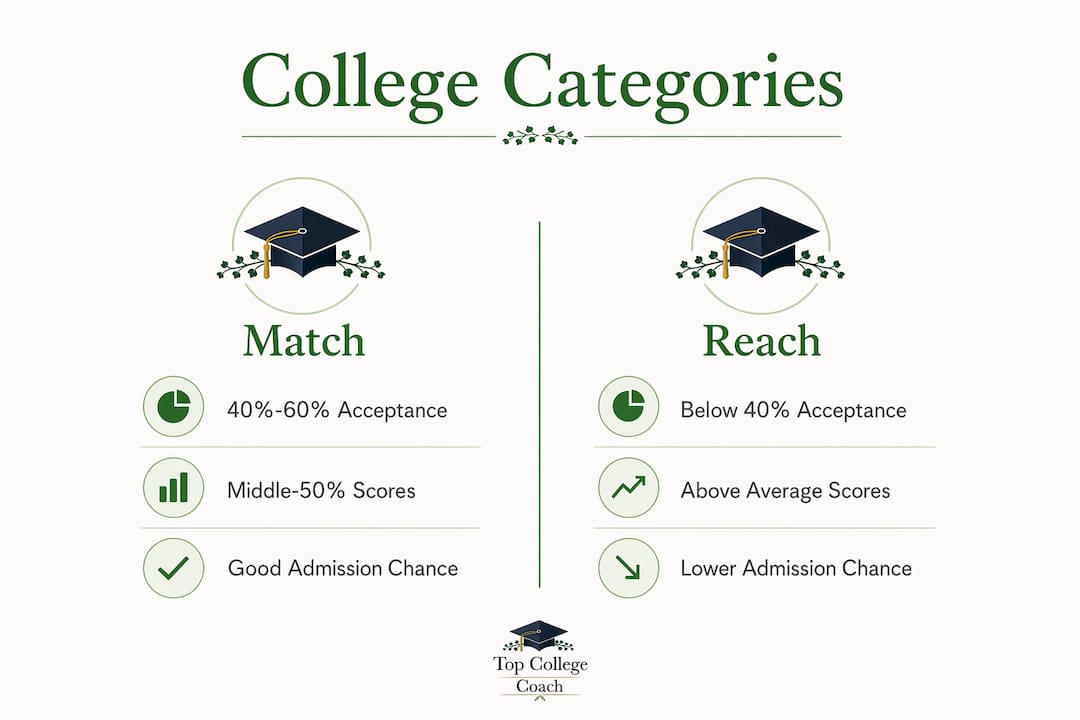
What is a college match school and how is it defined?
A college match school is an institution where your academic profile falls within the middle range of enrolled students, making admission a realistic outcome rather than a long shot or a certainty. The industry term for this category is “match school,” and it sits between a reach school (where your profile falls below the typical admitted student) and a safety school (where your profile exceeds it).
The clearest signal of a match school is the middle-50% score range. Colleges publish the SAT and ACT scores of the middle 50% of their enrolled class. If your scores land within or near that range, the school qualifies as a match on that metric. Your GPA should also fall within the school’s reported range for admitted students, which most colleges publish on their Common Data Set.

Acceptance rates between 40%–60% with middle-50% SAT/ACT scores aligned to your profile are the clearest indicators of a match school. That range reflects a school where competition is real but not overwhelming. A school with a 15% acceptance rate is almost always a reach, regardless of your scores.
Understanding this definition matters because students who apply only to reach schools or only to safety schools set themselves up for disappointment or underperformance. A balanced list built around true match schools gives you the best combination of admission probability and academic fit.
Reach, match, and safety: how the categories compare
Category | Acceptance rate | Your GPA/test scores | Admission probability |
Reach | Below 30% | Below school’s middle 50% | Low to uncertain |
Match | 40%–60% | Within school’s middle 50% | Moderate to strong |
Safety | Above 70% | Above school’s middle 50% | High |
How do admissions criteria determine a college match school?
Admissions criteria go beyond raw numbers. Holistic admissions incorporates essays, extracurricular achievements, and letters of recommendation, meaning test scores alone do not guarantee admission even at a school that looks like a match on paper. A student with a 3.7 GPA and a 1250 SAT score may match a school statistically, but a weak personal essay or thin extracurricular record can shift the outcome.
This is why the college fit assessment process requires you to look at both quantitative and qualitative factors. On the quantitative side, compare your unweighted GPA and test scores to the school’s published middle-50% ranges. On the qualitative side, evaluate whether your extracurricular profile, intended major, and personal background align with what the school values.
Here is what to examine when assessing admissions criteria for a match school:
GPA alignment: Your unweighted GPA should fall within the school’s reported range for admitted students.
Test score range: Your SAT or ACT score should land within or near the school’s middle-50% band.
Acceptance rate: Target schools with acceptance rates between 40%–60% for the strongest match signal.
Holistic factors: Strong essays, meaningful extracurriculars, and authentic recommendations strengthen your case at any match school.
Demonstrated interest: Many match schools track campus visits, email inquiries, and application engagement as part of their review.
Pro Tip: If your scores fall just below a school’s middle-50% range, strong holistic factors can still make that school a realistic match. Do not disqualify a school based on one metric alone.
Why graduation rates and employment outcomes matter in college fit
Graduation rates and employment outcomes are the most honest measures of whether a college delivers on its promise. Students should prioritize colleges with four-year graduation rates above 60% and strong employment rates within six months of graduation when choosing match schools. A school with a 45% four-year graduation rate is telling you something important about the experience students actually have there.
Employment outcomes matter just as much. A school may have a strong reputation in your intended field, or it may send very few graduates into that career path. The College Scorecard, maintained by the U.S. Department of Education, publishes earnings data and field-specific outcomes for graduates of most institutions. That data belongs in every college fit assessment.
Affordability is the third pillar of outcome-based matching. Net cost after all grants and scholarships is a far better affordability measure than sticker price. A school with a $70,000 sticker price and $40,000 in aid can cost less than a $45,000 school with no aid at all. That comparison changes the entire financial picture.
Success metric | What to look for | Where to find it |
Four-year graduation rate | Above 60% | College Scorecard, Common Data Set |
Employment rate | Strong outcomes within 6 months | College Scorecard, institutional reports |
Net cost after aid | Lower than sticker price | Net price calculator, FAFSA estimates |
Median earnings (10 years out) | Aligned with intended career | College Scorecard |
Pro Tip: College rankings measure reputation, not outcomes. A school ranked 80th nationally with a 75% graduation rate and strong career placement often serves students better than a ranked-50th school with a 52% graduation rate and high average debt.
Choosing based on concrete career outcomes, affordability, and academic support leads to better long-term success than focusing on prestige alone. That insight should anchor every college selection conversation.
How to balance academic, social, and financial factors in college matching
A true college match requires alignment across three dimensions: academic environment, social fit, and financial reality. Ignoring any one of them creates risk. Students who choose a school purely on academic reputation sometimes find the environment too competitive or too isolating. Students who choose on social fit alone sometimes end up at schools that do not support their academic trajectory.
Academic support programs, including tutoring centers, manageable class sizes, and accessible faculty, contribute significantly to whether a school is a true match. Students who are not in the top tier of a school’s admitted class benefit most from these resources. A school that looks like a match on paper but offers minimal academic support may not be a match in practice.
Social fit is subjective, but it is real. Campus culture, geographic location, size, and student community all affect whether you will feel at home and stay enrolled. Visit campuses when possible, attend virtual information sessions, and talk to current students. These conversations reveal things that no brochure will tell you.
Follow these steps to evaluate holistic fit:
Assess academic environment. Review class sizes, student-to-faculty ratios, and availability of tutoring or writing centers.
Evaluate social fit. Research campus culture, student organizations, and geographic setting relative to your preferences.
Calculate true cost. Use each school’s net price calculator to estimate your actual annual cost after grants and scholarships.
Compare debt load. Estimate total borrowing over four years and compare it to expected starting salaries in your intended field.
Check retention rates. A high first-year retention rate signals that students are satisfied and supported enough to return.
Pro Tip: The most common mistake families make is ignoring financial fit until after acceptance letters arrive. Run net price calculations before you apply, not after. It saves enormous stress and keeps your options open.
Prestige often correlates with higher debt and more competitive environments, which do not suit every student. Lower-ranked schools with strong outcomes can be the better choice for many students.
What practical steps can students take to find their match schools?
Finding your match schools starts with knowing your own academic profile precisely. Pull your unweighted GPA, your most recent SAT or ACT scores, and your intended major. These three data points are your baseline for every comparison you make.
From there, use these steps to build your list:
Use the College Scorecard. Search schools by graduation rate, earnings, and net price. Filter by your intended field of study to see field-specific outcomes.
Review each school’s Common Data Set. This free document, published annually by most colleges, contains middle-50% GPA and test score ranges, acceptance rates, and financial aid data.
Run net price calculators. Every federally funded college is required to publish a net price calculator. Use it for every school on your list before finalizing your applications.
Build a balanced list. A balanced college list includes 2–3 reach schools, 3–4 match schools, and 2–3 safety schools. That structure protects you from over-relying on selective or mismatched institutions.
Reassess after test prep. If your SAT or ACT score improves significantly, your match schools may shift. Rerun your comparisons after each official test sitting.
Consult a college admissions counselor. A professional with experience in the college admissions process can identify match schools you may have overlooked and flag schools that look like matches but carry hidden risks.
Best-fit colleges increasingly emphasize academic and social support, not just rankings. A true match means you will thrive academically with faculty engagement and the resources you need to succeed. That standard should guide every school you add to your list.
Families who want to choose the right colleges in 2026 need to treat this as a research project, not a wish list. The students who build the strongest lists are the ones who combine honest self-assessment with hard data.
Key Takeaways
A college match school is defined by academic profile alignment, measurable success metrics, and financial fit, not by name recognition or rankings.
Point | Details |
Define match by data | Compare your GPA and test scores to each school’s middle-50% range and acceptance rate. |
Prioritize graduation rates | Target schools with four-year graduation rates above 60% for the strongest outcome signal. |
Use net cost, not sticker price | A school’s real cost after aid often differs dramatically from its published tuition. |
Balance your college list | Apply to 2–3 reach, 3–4 match, and 2–3 safety schools to protect your options. |
Evaluate holistic fit | Academic support, social environment, and career outcomes matter as much as admission odds. |
Why I tell every family to ignore the rankings first
My honest take on college matching is this: the rankings conversation is the one that costs families the most time and the most money. I have worked with hundreds of students who spent months chasing schools they had seen on a list, only to discover that the school’s graduation rate was below 55%, the average debt load was staggering, and the career outcomes in their intended field were mediocre at best.
Families often over-prioritize prestige, which correlates with higher debt and competitive pressure. That pressure does not suit every student, and the debt follows them for a decade. The students I have seen thrive most consistently are the ones who chose schools where they were in the middle of the academic pack, not the bottom. They got more faculty attention, more scholarship money, and more opportunities to lead on campus.
The social fit question is also underrated. I have watched students transfer out of “prestigious” schools after one semester because the campus culture felt wrong. A transfer costs time, money, and momentum. Getting the social fit right the first time is worth far more than a name on a diploma.
My advice is simple: start with the College Scorecard and the Common Data Set, not with a magazine ranking. Build your list from data, then layer in your gut feeling about campus culture. That sequence produces better outcomes than any other approach I have seen.
— Randy Pryor
How Top College Coach helps you find your true match schools
Identifying your match schools is one of the most consequential decisions of your academic life. Top College Coach works directly with students and parents to build data-driven college lists that reflect each student’s real academic profile, financial situation, and career goals.

Our counselors review your GPA, test scores, extracurricular record, and intended major to identify schools where you have a genuine chance of admission and a strong environment for success. We use the College Scorecard, institutional data, and years of admissions experience to flag schools that look like matches but carry hidden risks. Every student we work with leaves with a balanced, personalized list and an application strategy built to maximize results. If you are ready to build a college list grounded in real data, contact Top College Coach today for a consultation.
FAQ
What makes a school a match vs. a reach school?
A match school accepts students whose GPA and test scores fall within its middle-50% range, while a reach school’s admitted profile sits above yours. Acceptance rates between 40%–60% are the clearest signal of a true match.
How many match schools should be on a college list?
A well-built list includes 3–4 match schools alongside 2–3 reach and 2–3 safety schools. That balance protects you from over-relying on any one category.
Do test scores alone determine if a school is a match?
Test scores are one factor, but holistic admissions also weighs essays, extracurriculars, and recommendations. A strong application can make a borderline match school a realistic target.
What is the QuestBridge National College Match?
The QuestBridge National College Match is a program that offers high-achieving, low-income students early admission with full four-year scholarships to selective partner colleges. It is a separate program from the general match school concept, targeting a specific demographic.
Should I use college rankings to find my match schools?
Rankings measure reputation, not personal fit or outcomes. Use the College Scorecard and each school’s Common Data Set to assess graduation rates, net cost, and career outcomes instead.
Recommended
Comments