3.9 vs 3.6: How Counselors Read Weighted and Unweighted GPA

Colleges consider both weighted and unweighted GPAs, but neither number decides admission on its own. Admissions officers read your GPA next to your school profile and transcript, so the label matters far less than the pattern behind it: how hard your courses were, and whether your grades climbed or slipped over four years. This guide walks through both formulas, worked calculation examples, how admissions offices actually interpret them, and what Top College Coach tells families when it’s time to choose between an easier A and a harder B.
Weighted vs. unweighted:
Colleges interpret weighted GPAs with caution due to varying weighting policies, making comparisons across schools unreliable without context from the school profile.
A weighted GPA of 4.5 or above generally indicates multiple AP or honors courses, but actual course rigor and grades matter more than the reported number.
Admission officers prioritize course difficulty, grade trends, and overall school context over raw GPA numbers when evaluating applicants.
Improving GPA significantly in senior year through targeted efforts can influence admissions, but colleges review final transcripts after decisions.
When listing GPA on applications, always report the official school-reported figures and avoid recalculating or inflating numbers, especially if space is limited.
Table of Contents
Weighted vs Unweighted GPA: The Core Definitions
An unweighted GPA treats every class the same. An A is a 4.0 whether it’s earned in AP Chemistry or gym class, and the scale caps at 4.0 no matter how many advanced courses you take.
A weighted GPA adds extra points for tougher coursework, which is why you’ll see students report numbers like 4.3 or 4.6. The logic: an A in AP Biology should count for more than an A in a standard-level elective, because the workload and content depth aren’t comparable.
There’s no federal or state standard that dictates how weighting works, which is exactly why comparing two applicants’ weighted GPAs across different high schools can be misleading. Common patterns include:
Unweighted 4.0 scale: A = 4.0, B = 3.0, C = 2.0, regardless of course level.
Weighted 4.5 scale: Honors courses add roughly 0.5 points to the unweighted value.
Weighted 5.0 scale: AP, IB, and dual enrollment courses often add a full point.
Hybrid or district-specific scales: Some schools weight only AP/IB, others include honors, and some cap the total number of weighted points a transcript can carry.
Because schools report whether their GPA is weighted or unweighted directly on the transcript or school profile, admissions readers rarely mistake one for the other. What they can’t always assume is that a 4.4 from one school means the same thing as a 4.4 from the next town over.
How to Calculate Each GPA (With Worked Examples)
The math itself is simple once you know the point values. Here’s how letter grades typically translate under each system.
Letter Grade | Unweighted Points | Weighted Points (Honors, +0.5) | Weighted Points (AP/IB/DE, +1 point) |
A | 4.0 | 4.5 | 5.0 |
B | 3.0 | 3.5 | 4.0 |
C | 2.0 | 2.5 | 3.0 |
D | 1.0 | 1.5 | 2.0 |
F | 0.0 | 0.0 | 0.0 |
To calculate your GPA by hand:
List every course and its letter grade for the term or year you’re calculating.
Convert each grade to points using the unweighted column for a standard GPA, or the appropriate weighted column for honors, AP, IB, or dual enrollment courses.
Add all the points together, then divide by the number of courses (or credits, if your school weights by credit hours rather than course count).
Repeat separately for weighted and unweighted values if your school reports both.
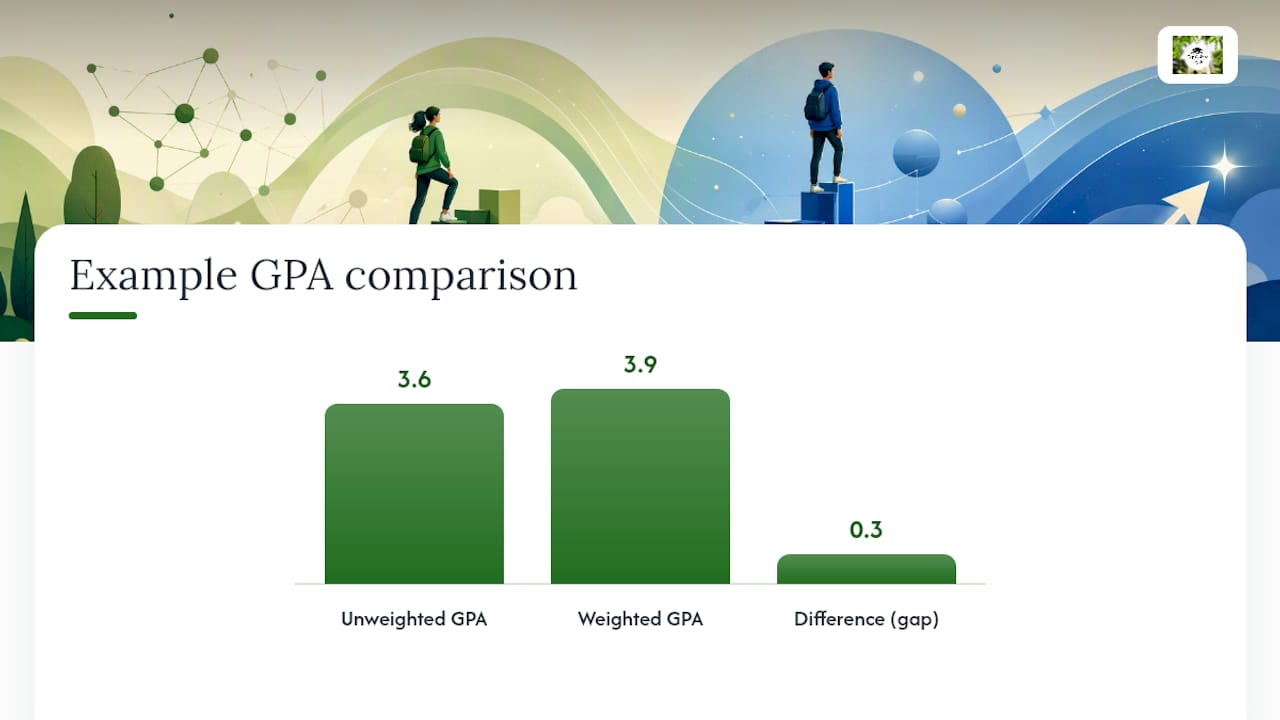
Say a student takes five classes: AP English (A), Honors Chemistry (B), Precalculus (A), Spanish III (B), and Gym (A).
Unweighted: (4.0 + 3.0 + 4.0 + 3.0 + 4.0) ÷ 5 = 3.6
Weighted: (5.0 + 3.5 + 4.0 + 3.0 + 4.0) ÷ 5 = 3.9
That 0.3-point gap comes entirely from the AP and honors bumps, and it grows fast once a student is carrying four or five weighted courses a year. College Transitions’ conversion tables show the most common district practice adds 0.5 for honors and a full point for AP, IB, or dual enrollment, though some districts cap the total weighted bonus per semester regardless of how many advanced classes a student takes.
Credit load matters too. A year-long AP course typically carries more weight in a cumulative GPA than a single-semester elective, so two students with the same letter grades can still post different GPAs if their course credits don’t match.
How U.S. Colleges Actually Read Your GPA
Admissions offices rarely take a GPA at face value, no matter which scale your school uses.
Every high school submits a school profile alongside your application, a document that spells out the school’s grading scale, weighting policy, AP/IB offerings, and how the senior class performed overall. This profile gives admissions readers the context to interpret your 3.8 or your 4.5 correctly, because they can see whether your school weights at all, and how steep the curve is if it does.
Some colleges go a step further and recalculate GPAs on their own internal scale. The University of California system, for instance, uses its own GPA calculation that counts only specific “a-g” coursework and applies its own honors point system, which means the GPA on your transcript and the GPA a UC campus actually evaluates can differ. Because the Common App and most colleges request full transcripts and school reports, readers see the raw data, not just a summary number.
By the Numbers: NACAC lists grades in college prep courses and strength of curriculum among the most heavily weighted factors in admission decisions, ranking above test scores at many selective institutions.
Beyond the raw number, admissions readers are trained to look for:
Course rigor relative to what’s available at your specific high school, not some abstract national standard.
Grade trends across four years, since an upward trajectory often reads better than a flat 3.9 that never wavered.
Senior-year performance, which colleges see through mid-year and final transcripts even after admission decisions.
Where your grades fall in the school’s overall distribution, since a B+ average at an intensely competitive school can carry different weight than the same average elsewhere.
Shemmassian Consulting’s admissions research backs this up directly: readers weigh course rigor and grade trends more heavily than whether the GPA itself was labeled weighted or unweighted.
What “Good” GPA Ranges Look Like by Selectivity
The number that counts as competitive shifts dramatically depending on where you’re applying, which is why chasing a single magic GPA target rarely makes sense.
Highly selective schools (Ivy League, Top 20 nationally ranked universities): Most admitted students post unweighted GPAs near the upper end of the scale and weighted GPAs above 4.0 on a 5.0 scale, typically ranking in the top percent of their class.
Selective schools (strong flagship state universities, well-regarded private colleges): Admitted students commonly have unweighted GPAs well above average, often placing in the top quarter of their class.
Less selective and open-enrollment schools: Unweighted GPAs in the low 3.0s and above are frequently sufficient, with far more flexibility on course rigor.
Percentile framing matters more than the raw digits. A 3.85 that lands a student in the top 5 percent of a rigorous school often reads stronger to an admissions officer than a 4.0 that ranks in the middle of a less competitive one. Scholarship programs frequently set hard cutoffs, too. Many merit scholarship programs and state-run tuition programs require a minimum unweighted GPA (often 3.0 or 3.5) as a baseline eligibility filter before other criteria even get considered, so a student sitting just below the line can lose access to real money over a fraction of a point.
Counselor Advice: Balancing Rigor and Grades
Every counseling season, Top College Coach sees the same dilemma play out: should a student take the AP course they’ll struggle in, or the honors version where an A is nearly guaranteed? The honest answer depends on the student, not a universal rule.
Our counselors use a strengths-first framework when building a course plan with families:
Start with what the student is genuinely good at. Load rigor into subjects where the student has a track record, not where they’re hoping to catch up.
Check the teacher and the workload before committing. Two sections of the same AP class can have wildly different homework loads depending on who teaches them.
Cap the AP count rather than maximizing it. Five APs with three B’s rarely outperforms three APs with three A’s in an admissions reader’s eyes.
Choose depth over breadth. A student who takes AP courses in a coherent area of interest tells a clearer story than one who’s scattered across every subject offered.
Consider dual enrollment where it fits. Many colleges view dual enrollment coursework favorably since it demonstrates college-level performance, and it can sometimes transfer for credit, which AP scores don’t always do.
Pro Tip: Bring your school’s actual AP/honors offerings to your first counselor meeting. A rigor decision made in the abstract is far less useful than one built around the specific courses and teachers available at your school.
Our guide to what colleges look for in applicants walks through how this rigor-versus-grades tradeoff fits into the bigger admissions picture, and our breakdown of how AP courses factor into admissions decisions digs deeper into when an AP course actually moves the needle.
Raising Your GPA Before Application Season
If your GPA needs a lift before senior fall, timing determines what’s realistic.
Use office hours and grade contracts now. Many teachers offer specific ways to recover points on individual assignments; ask before the semester ends, not after.
Get targeted tutoring for your weakest subject, since raising a C to a B in one class often moves the cumulative GPA more than spreading effort thin across five classes.
Retake a course if your school allows grade replacement. Check your school’s specific policy first, since some average the two grades rather than replacing the original.
Add a dual enrollment class strategically if your school offers it, since a strong college-level grade can boost weighted GPA while also building a transcript story.
Prioritize junior year and the first semester of senior year, since these are the grades most colleges see before making a decision.
Pro Tip: Colleges do see final senior transcripts after decisions are made, and a significant drop can trigger a follow-up letter, or in rare cases, a rescinded offer. Our detailed strategies for boosting GPA junior year and our explainer on how senior-year grades affect admissions both walk through this timeline in more detail.
Class Rank and Scholarship Impact
Weighting policy shapes class rank far more than most families expect. A school that weights AP courses heavily will naturally push its most rigorous students to the top of the class rank list, while a school that doesn’t weight at all might rank a straight-A student in an easier track above a B+ student carrying five APs.

This creates real downstream effects for scholarships. Many state and institutional scholarship programs use class rank or GPA percentile, not raw GPA, as an eligibility trigger, which means the same academic performance can qualify a student at one school and miss the cutoff at another purely because of local weighting policy. Merit aid committees at selective private universities tend to look past class rank toward the transcript itself, since they already know rank isn’t comparable across districts. Public flagship universities and state scholarship programs, on the other hand, often lean on rank more heavily because they’re processing thousands of applications from schools they can’t individually evaluate in depth.
The practical takeaway: if your school ranks students, ask your counselor how weighting affects your position, and don’t assume a modest rank tells the whole story to every school on your list.
Where Both GPA Systems Fall Short
Neither GPA format captures everything an admissions officer wants to know, and both have real blind spots worth understanding.
Unweighted GPA can’t distinguish between a 4.0 built on AP courses and a 4.0 built on the easiest schedule a school offers. That’s precisely why colleges request transcripts and school profiles rather than trusting the number alone.
Weighted GPA has the opposite problem: it can reward course selection over mastery. A weighted GPA over 4.0 isn’t reliably comparable between schools because weighting formulas vary so widely, and a student who piles on APs without the readiness to handle them can end up worse off than one who chose fewer, stronger courses. CollegeVine’s admissions research makes a similar point: taking on too much rigor and watching grades slide can actually hurt an application more than a slightly less ambitious schedule with strong performance throughout.
Both systems also struggle to capture growth. A student who started high school poorly and finished strong can end up with a GPA that undersells their trajectory, which is one reason admissions readers look at grade trends separately rather than relying on the cumulative number alone.
How to List Your GPA on Applications
Most college applications, including the Common App, ask for both weighted and unweighted GPA when your school reports both, so you generally don’t have to choose one over the other. List exactly what your school profile provides, using the same figures and decimal precision your registrar uses on the official transcript.
On a resume or a section of an application that only has room for one number, list the unweighted GPA and note the weighted figure in parentheses if space allows, since unweighted numbers are universally comparable while weighted ones require the reader to already understand your school’s scale. Never inflate or recalculate your own GPA using a different scale than your school officially reports. Admissions offices cross-check the number against your transcript, and a mismatch raises questions you don’t want asked.
If you’re unsure which format your school uses, ask your counselor directly rather than guessing, since some schools only calculate unweighted GPA internally and add weighting purely for class rank purposes.
Get a Transcript Review From Top College Coach
Reading your own transcript the way an admissions officer will is hard to do objectively, especially when your student’s course plan is already set for the year. Top College Coach offers something a general guidance counselor rarely has time for: a one-on-one transcript review from advisors who’ve worked directly with Ivy League and Top 20 admissions standards, mapped against your student’s actual school profile and grading policy.

Our free admissions strategy session covers exactly what this article walks through, applied to your student’s real transcript: which courses are pulling weight, where rigor should increase or ease off, and a junior-to-senior year timeline built around your target colleges. Visit Top College Coach to book a session and get a course plan that’s actually built around your student’s transcript, not a generic checklist.
Sources
FAQ
Is a 4.0 GPA Weighted or Unweighted?
A 4.0 is almost always the top score on an unweighted scale. On most weighted scales, a 4.0 reflects a strong but not maximum GPA, since weighted scales typically run higher, often up to 4.5 or 5.0.
Is a 3.97 Weighted GPA Good?
A weighted GPA above 4.0 is generally strong, but its competitiveness depends on your school’s weighting formula and the rigor behind it. At most schools, it places a student well within range for selective and highly selective colleges when paired with a rigorous course load.
Do Colleges Prefer Weighted or Unweighted GPAs?
Colleges don’t prefer one over the other. Most review both figures alongside your transcript and school profile, and some, like the University of California, recalculate GPA on their own internal scale regardless of what your school reports.
What Does a 4.2 Weighted GPA Convert to Unweighted?
There’s no fixed formula, since it depends entirely on how many honors or AP courses factored into a weighted GPA and how your specific school weights them. The only reliable conversion is one your school counselor calculates from your actual transcript.
Recommended
Comments