Top 20 Colleges in America: 2026 Student & Parent Guide

The notable top colleges in America are widely considered to include MIT, Princeton, Harvard, Stanford, Yale, Columbia, University of Chicago, and others frequently featured in rankings. These rankings reflect a composite view of selectivity, graduation rates, post-graduation outcomes, and net-cost signals drawn from US News, Forbes, Niche, and College Scorecard/IPEDS data. One important note: these rankings shift year to year as publishers update their weightings, so treat this list as a strong starting point, not a permanent verdict. Detailed snapshots for each school follow below, using acceptance rate, net-cost context, graduation signal, and a one-line fit reason so you can compare at a glance.
Table of Contents
What does each top-ranked college actually look like for you?
The table below gives you a fast, scannable comparison across the dimensions that matter most for your application decision. Acceptance rates and graduation rates are drawn from College Scorecard/IPEDS and institutional data; net-cost notes reflect typical need-based aid patterns. Use this as your first filter, then dig deeper into the schools that catch your eye.

| Rank | School | Location |
Acceptance rates vary among these highly selective colleges and graduation rates are generally high, with many schools providing strong need-based financial aid programs. These factors, along with program strength and culture, are key considerations for applicants.
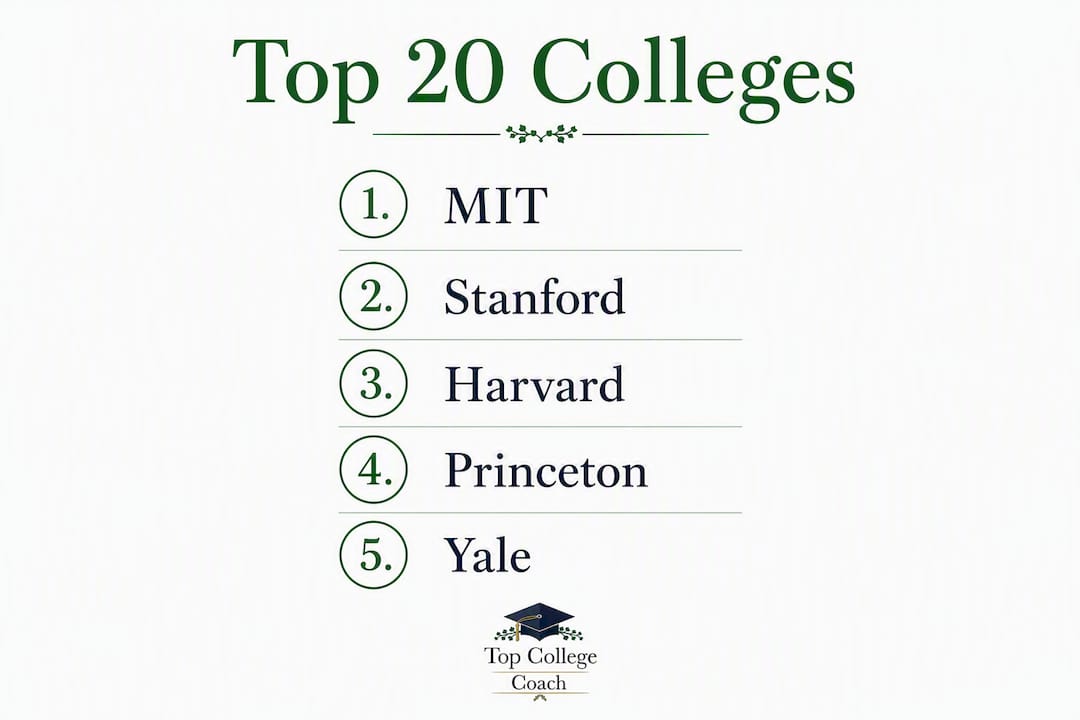
A few patterns worth noting. The most selective colleges in this group, MIT, Caltech, Harvard, Princeton, and Stanford, all sit below 5% acceptance, which means selectivity alone tells you very little about whether you will get in. What matters more is how well your academic profile, extracurricular trajectory, and intended major align with what each school actually values. UC Berkeley and Michigan stand apart as flagship public universities: their in-state net costs are dramatically lower, but out-of-state students face a very different financial picture.

How this Top 20 list was compiled and why rankings differ
This list reflects a composite view of four core signals: selectivity, four-year graduation rate, post-graduation outcomes (employment and earnings), and net-cost context. No single ranking source captures all of these well, so we cross-referenced US News & World Report, Forbes, Niche, and College Scorecard/IPEDS data to build a picture that prioritizes what actually affects students after graduation, not just institutional prestige.
Rankings measure what publishers choose to measure. US News weights peer assessment and faculty resources heavily. Forbes leans toward alumni earnings and student debt. Niche incorporates student reviews and campus life. The Times Higher Education ranking emphasizes research output. A school ranked #7 by one publisher might appear at #12 in another because the underlying formula is different, not because the school changed. Families who treat any single list as definitive are making decisions on incomplete information.
The data sources we drew from:
ACT college planning resources: — Practical filters for campus size, accreditation, and program availability.
Two honest limitations. First, program-level outcomes can vary enormously within a single university. For example, different majors at the same institution can lead to very different earnings trajectories, though institutional rankings treat all degrees equally. Second, year-to-year movement of one or two positions is almost always noise, not signal. A school that drops from #8 to #10 has not become a worse place to learn.
How to use the Top 20 list when building your application strategy
The most common mistake families make is treating the T20 list as a shopping cart: pick the highest-ranked schools you can reach and apply. A smarter approach uses the Likely/Target/Reach framework to convert the list into a balanced slate that preserves your ambition while protecting against the unpredictability of highly selective admissions.
Here is how to build that slate:
Identify your Reach schools. These are programs where your GPA and test scores fall below the median of recently admitted students, or where acceptance rates are generally very low. Consider schools in the upper tier as potential Reach options if appropriate.
Identify your Target schools. Your academic profile sits within the middle range of admitted students, with moderate acceptance rates. Some well-known public universities often function as Targets for strong applicants, depending on major and residency.
Identify your Likely schools. Your credentials comfortably exceed the median admitted student for these schools, and acceptance rates are higher. These schools should still excite you and be places where you will thrive.
Answer three data-driven questions for every school on your list, including how their academic support services fit your learning needs. What are the employment and earnings outcomes for your intended major specifically? What is the actual net cost after financial aid for your family’s income band? Does this school’s academic support structure fit how you learn? These three questions cut through prestige bias faster than any ranking.
Run the net price calculator for every school. Every institution receiving federal aid is required to provide one. BigFuture and individual school websites host these tools. A school with a $78,000 sticker price may cost your family less than a school with a $55,000 sticker price once aid is factored in.
Research campus programs, not just rankings. Visit or attend a virtual information session. Identify two or three specific labs, research centers, or faculty whose work connects to your interests. Reference them in your essays. Admissions officers at T20 schools read thousands of applications from students with near-perfect credentials; demonstrated intellectual fit is what separates them.
Use the Georgia Tech College Planning Guide worksheets to map your top five must-haves and formally sort your list into Likely/Target/Reach buckets. The structured format forces clarity that a spreadsheet alone rarely delivers.
Pro Tip: To quickly gauge undergraduate research access at any T20 school, search “[school name] undergraduate research opportunities program” and look for a dedicated office or UROP. Schools with a named, staffed program, like MIT’s UROP, place undergraduates in labs from freshman year. Schools without one often reserve research access for juniors and seniors, which matters enormously if research experience is part of your post-graduation plan.
Randy Pryor, College Admissions Counselor at Top College Coach, recommends that families complete this framework before submitting a single application. The slate you build in October should reflect both your aspirations and a clear-eyed read of your data.
Key takeaways — what the Top 20 list should and shouldn’t decide for you
T20 rankings are a useful starting signal, but fit, net cost, and program-level outcomes should drive your final application list, not rank position alone.
Use the Likely/Target/Reach balance — Even for strong candidates, T20 admissions is unpredictable. A balanced list with two or three Reach schools, three or four Target schools, and two or three Likely schools offers genuine choices when decisions arrive in April.
What a counselor actually does with a T20 list
When I work with a student and their family, the T20 list is never the destination. It is the starting point for a much more specific conversation. The first question I ask is always: which of these schools has the strongest program for what you want to study, and what does the net cost look like for your family? Those two answers immediately narrow a list of 20 to a list of 8 or 10, and from there we build a slate that is both ambitious and realistic.
The families who get the best outcomes are the ones who resist the pull of pure prestige and instead invest their application energy in the schools where their story, their academic profile, and their intended trajectory genuinely align. That alignment is what makes an application compelling, and it is what separates an acceptance from a waitlist at schools that receive tens of thousands of applications from equally qualified students.
How Top College Coach can help you build a winning application slate
Knowing the top-ranked colleges is one thing. Building an application strategy that gives you a real shot at getting in is another, and that is exactly where Top College Coach delivers. With a proven track record of helping students gain admission to Ivy League and T20 universities, the team offers private admissions counseling that goes well beyond a ranked list: personalized application strategy, essay coaching, interview preparation, and guidance from counselors who have reviewed applications from the inside.
Every engagement is built around your student’s specific strengths, intended major, and financial picture, not a generic checklist. Whether you are just starting to build your college list or you are deep into application season, the 2026 family guide to admissions counseling is a good first read. When you are ready to talk strategy, connect with Top College Coach to schedule a consultation.
Useful sources for rankings and institutional data
These are the primary data portals and planning resources cited in this article. Each one serves a specific purpose in your research process.
College Scorecard (U.S. Department of Education): The most authoritative public source for graduation rates, median earnings by institution, and net price by income band. Use it to look up outcomes for your intended major when field-level data is available.
BigFuture / College Board: Run net price calculators, view admissions profiles, and build a balanced college list. The College Board planning hub also offers a career quiz to help match your interests to programs.
ACT College Planning Resources: Practical filters for campus size, available majors, and accreditation. Confirms that every institution receiving federal aid must provide a net price calculator.
Georgia Tech College Planning Guide 2026 (PDF): Step-by-step worksheets for building a Likely/Target/Reach list, identifying your top five must-haves, and structuring your application timeline.
Business Insider — Hardest Colleges to Get Into: Useful context for acceptance-rate data across highly selective schools, with the important caveat that selectivity is an imperfect proxy for student outcomes.
Key Takeaways
The top 20 colleges in America are a powerful starting point, but your final application list should be driven by program fit, net cost, and a balanced Likely/Target/Reach slate, not rank position alone.
Point | Details |
Rankings are a starting point | Cross-reference US News, Forbes, Niche, and College Scorecard before finalizing your list. |
Net cost changes everything | Many T20 schools meet 100% of demonstrated need; run the net price calculator for every school before deciding. |
Use Likely/Target/Reach | A balanced slate of two or three Reach schools, three or four Target schools, and two or three Likely schools gives you the best mix of risk and opportunity. |
Program-level outcomes matter | Check College Scorecard earnings data by field; a school ranked #15 may lead your intended major. |
Top College Coach | Personalized counseling from Top College Coach helps translate a T20 list into a winning, balanced application strategy. |
Recommended
Comments