Why the Common App Essay Matters More Than You Think

The Common App essay matters because it turns your application from a set of numbers into a person admissions readers can imagine living and learning on their campus. That shift can tip a close decision in your favor. Your GPA and test scores tell a college what you’ve accomplished. The essay tells them who you are, how you think, and what you’ll add to a dorm, a classroom, or a lab. NACAC survey data summarized by GradPilot found that More than half of colleges rated the essay as moderately or considerably important in admissions decisions, with fewer than one in five calling it “considerably”.
That’s not universal, and we’ll get into where it matters most later. But if you’re a junior or senior staring at a blank Common App text box right now, here’s the single most useful thing to do with limited time: stop trying to write something impressive and start writing something true. A specific, honest story about a small moment beats a polished essay about a big accomplishment almost every time. Top College Coach has watched this play out across hundreds of applications, and the pattern holds.
Pro Tip: If you only have time to fix one thing before you submit, fix the voice. Read your essay aloud. If it sounds like an adult wrote it, or like a résumé bullet point got stretched into paragraphs, admissions readers will notice immediately.
Key Takeaways
The Common App essay works because it gives admissions officers the one thing a transcript can’t: a specific, reflective picture of who you are and what you’ll contribute.
Point | Details |
Voice beats polish | A specific, honest story in your own words outperforms a generic essay about an impressive achievement. |
The essay can tip close decisions | When academic profiles are similar, the essay is often the deciding factor between applicants. |
Save school names for supplements | Never mention a specific college inside your Common App essay; that content belongs in supplements. |
Start three to four months early | Rushed essays read as rushed; give yourself real time for brainstorming and revision. |
Feedback should sharpen, not replace | Good editing catches unclear sentences; it never rewrites your personality out of the draft. |
Guided coaching preserves your voice | Top College Coach helps students find and structure their real story without sanitizing it into something generic. |
Table of Contents
What Is the Common App Essay and Who Actually Reads It?
The Common App essay is a single personal statement, capped at 650 words, submitted once through the Common Application platform and sent to every member school on your list. You write it one time. It travels to as many colleges as you’re applying to that accept the Common App, which today numbers more than 900 institutions.
That reach matters more than most students realize. Because the same essay lands on desks at large public flagships, small liberal arts colleges, and highly selective research universities, it has to work broadly. A story loaded with inside jokes only your AP Literature class would get, or an essay that name-drops a specific college by name, signals that you didn’t think about the other 900 schools reading the same document.
Here’s who actually reads it once it lands in an admissions office:
First-round admissions officers, often reading 30 to 50 files a day during peak season
Committee readers, who weigh in on borderline or competitive cases
Alumni interviewers, at schools that use alumni networks for regional outreach
Faculty or department reviewers, at schools with specialized programs tied to your intended major
The essay prompts themselves are published fresh each cycle directly on commonapp.org, and that’s the only place you should confirm current wording, word counts, or formatting quirks before you submit. Guides like this one explain the strategy. The Common App itself sets the rules.
How Does the Essay Actually Influence Admissions Decisions?
Admissions officers read your essay looking for answers to three questions, whether or not they say so out loud: Who is this person? What will they contribute to our campus? Can they write?
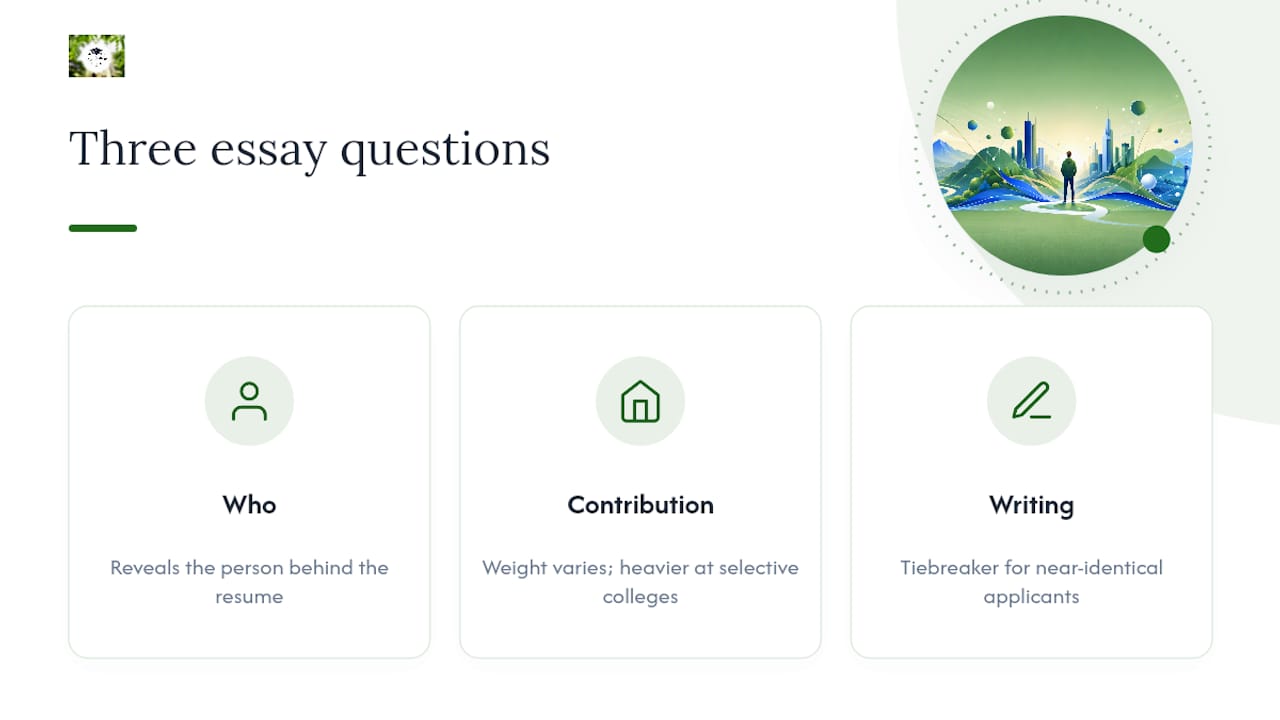
Everything else in your file, your transcript, your test scores, your activities list, answers a different set of questions. Only the essay answers these three. That’s why an essay that reads like a list of accomplishments falls flat. The reader already has your resume. They want the person behind it.
How much that person-behind-the-numbers question weighs depends heavily on the school. The NACAC data breaks down importance ratings across the 185 surveyed colleges: 18.9% called the essay “considerable,” 37.3% called it “moderate,” 26.5% called it “limited,” and 17.3% said it carries no real weight in their process. Some guidance sites describe the essay as accounting for roughly 25% of application weight at selective schools specifically, though that figure varies school by school and should be read as a rough signal rather than a fixed rule.
Selective private colleges and small liberal arts schools tend to lean on the essay harder than large public universities that admit primarily on GPA and test benchmarks. If you’re applying to a school with a low acceptance rate, assume your essay carries real weight. If you’re applying to a large state school with a formula-driven admit process, the essay still matters, but it’s less likely to be the deciding factor.
There are specific situations where the essay does far more heavy lifting than usual:
When two applicants have nearly identical GPAs, course rigor, and activity lists, the essay is often the only remaining variable an admissions committee can use to differentiate them. It’s also the primary tool for explaining a dip in grades, a gap year, or a nontraditional path, context that a transcript can’t provide on its own.
What the essay can’t do is rescue a genuinely weak academic record. If your GPA and coursework don’t meet a school’s baseline expectations, no essay, however well written, changes that math. Think of the essay as the tiebreaker and the context provider, not the compensator for gaps a transcript can’t hide.
What Should You Actually Write About?
Pick a topic using four filters: specificity, reflection, uniqueness of angle, and evidence of growth or consistent values. A topic passes the test if it lets you write about a moment or detail no one else could have written, not because the event itself is rare, but because your reaction to it is yours alone.
The essay exists to reveal what a transcript can’t, your judgment, your reaction to failure, the small decisions that expose your actual values. A dramatic topic isn’t required. A well-examined ordinary one usually works better.
Here’s the difference in practice:
Generic opening: “Ever since I was young, I have always loved helping others, which is why I want to study nursing.”
Specific opening: “The third time I dropped the suture kit, my grandmother’s hospice nurse didn’t flinch. She just handed me another one and said, ‘Again.’”
The second version puts the reader in a scene immediately. The first version could have been written by 10,000 other applicants.
Some practical dos and don’ts to keep in mind while drafting:
Do show a change in how you think, act, or see something, not just a change in circumstances.
Do use one specific scene or detail rather than summarizing months or years at once.
Don’t restate your resume in paragraph form. Your activities list already covers that ground.
Don’t name a specific college anywhere in this essay. Save that for your supplements.
Don’t manufacture a crisis or trauma you didn’t actually experience just because it sounds compelling.
If a piece of your story is genuinely tied to a specific school (a program, a professor, a campus resource), that belongs in your supplemental essays, not here. Save the Common App essay for material that’s true regardless of which school reads it.
How Should You Structure the Essay for Maximum Impact?
A strong Common App essay follows a simple shape: an opening that establishes voice and drops the reader into something concrete, a middle section that shows tension, development, or a shift in understanding, and a closing that reflects rather than summarizes.
Craft guidance from CollegeVine emphasizes opening with voice and concrete detail rather than a broad statement, and preferring self-aware reflection over a sweeping, tidy epiphany. That advice holds up. Readers can tell the difference between an insight you actually earned and one you bolted on because essays are “supposed to” end with growth.
Two structural approaches tend to work well:
Narrative structure: One extended story told in scene, with reflection woven through rather than saved entirely for the end.
Montage structure: Several shorter, seemingly unrelated moments that build toward a single theme, often used well by students whose defining trait shows up in small repeated habits rather than one big event.
A closing paragraph that simply announces “this experience taught me the value of perseverance” tells the reader nothing they couldn’t have guessed. A closing that connects a specific insight to how you plan to show up in a dorm, a lab, or a club is doing actual work.
Pro Tip: End your essay by connecting your reflection to something forward-looking, how this trait or lesson will show up when you’re navigating a hard problem set, a roommate conflict, or a new city for the first time. That forward pull is what separates a reflective closing from a nostalgic one.
One more thing worth saying plainly: adult editing can help or hurt depending on what it targets. A parent, teacher, or counselor who catches grammar errors and flags a confusing sentence is helping. One who rewrites your voice into something that sounds like a college brochure is erasing the exact thing admissions officers are trying to find. Feedback should sharpen your sentences, not replace them.
Common App Essay vs. Supplements: Where Should You Focus First?
Write your Common App essay before you touch a single supplement. It’s the broader, higher-stakes document, since it reaches every school on your list, while supplements are read only by the specific college that requires them.
The two serve different purposes. Your Common App essay should work at every school you’re applying to, regardless of size, region, or program. Supplements exist to answer a narrower question: why this specific school, or why this specific program. A strong supplement about a specialized engineering pipeline or a particular study-abroad track means nothing if your main essay is still unfinished.
A few rules of thumb for allocating your time:
Finish a solid draft of your Common App essay before starting any supplements, even for early-action deadlines.
Give supplements extra attention for your top three schools or any program with a highly specific application (art portfolios, conservatory auditions, direct-entry majors).
Don’t reuse Common App essay material inside a “why us” supplement. Redundant content signals you ran out of ideas.
If you’re short on drafting time, protect the Common App essay’s revision window first. A rushed supplement is recoverable. A rushed personal statement, read by every school on your list, is not.
Checking whether a target school even requires supplements, or which prompts it uses, is worth doing early. College Data’s directory of Common App colleges is a useful place to confirm each school’s specific application requirements before you plan your writing calendar.
What’s the Right Timeline for Drafting and Submitting?
Start brainstorming at least three to four months before your earliest deadline. Rushed essays read as rushed, and admissions readers who scan hundreds of files a season can tell the difference between a draft that’s been sat with and one finished the night before it was due.
Milestone | Suggested timing | Focus areas |
Brainstorming | 3-4 months before earliest deadline | Generate 5 possible topics; don’t commit yet |
First full draft | 2-3 months before deadline | Get the whole story on the page, even messy |
Structural revision | several weeks before deadline | Cut what doesn’t serve the story; strengthen the opening |
Feedback and line edits | a few weeks before deadline | Share with 2-3 trusted readers, not 10 |
Final proofread and submission | 1-2 weeks before deadline | Word count, prompt fit, formatting, no typos |
Before you hit submit, run through this checklist:
Confirm your word count sits close to the 650-word limit, since readers scan first for voice and specificity and a thin 400-word essay often reads as underdeveloped.
Reread the prompt you selected and confirm your essay actually answers it, not just relates to it loosely.
Check that your voice sounds like you, not like a thesaurus exercise.
Verify you haven’t named any specific colleges anywhere in the text.
Paste your essay into the actual Common App text box before your final deadline to check for formatting issues, since copy-paste from Google Docs or Word occasionally strips or garbles italics, em dashes, and special characters.
Pro Tip: Share your near-final draft with two or three readers, not ten. Ask each one a specific question: does this sound like me? Is there a moment where you wanted more detail? Where did you get bored? Vague requests like “let me know what you think” produce vague, unhelpful feedback.
What Do Strong Common App Essays Actually Look Like?
A few short examples illustrate the range of topics and approaches that tend to land well, without requiring a dramatic life event.

The humble anecdote: A student wrote about consistently being the last person picked for pickup basketball games in gym class, and what she noticed about how she started strategizing around her own limitations instead of resenting them. It works because the topic is small and honest, and the reflection is specific to her, not a generic lesson about perseverance.
The small decision with insight: A student described the exact moment he decided not to correct a customer who mispronounced his name at his part-time job, and unpacked what that daily choice revealed about code-switching and identity. It works because it zooms in on one decision rather than summarizing an entire experience of being bicultural.
The learning curve: A student wrote about failing to get a single robotics competition entry to function for three straight seasons before finally understanding a wiring concept her teammates had grasped months earlier. It works because she let the reader sit in the frustration before the resolution, rather than rushing to the triumphant ending.
The best essays don’t announce their lesson. They let a specific, well-rendered moment carry the weight, and trust the reader to arrive at the insight alongside the writer.
For students who want to study full-length annotated examples rather than short excerpts, College Essay Guy (run by Ethan Sawyer) maintains one of the more widely used libraries of complete essays with line-by-line breakdowns of what’s working in each one.
If you’re revising with a parent, counselor, or coach, the same rule from earlier applies here: preserve the sentences that sound like you, even the imperfect ones. Polish syntax. Don’t launder personality out of the draft.
Why the Essay-Writing Process Matters Beyond the Admissions Decision
Treating the essay as your own reflection, rather than a document an adult assembles for you, does more than improve your odds. The process is a genuine developmental milestone, often the first time a high schooler sits down and articulates, in their own words, what they’ve learned about themselves.
Students who approach the essay as their own reflective work, rather than gaming the system with what they assume admissions officers want to hear, tend to produce both stronger essays and a clearer sense of their own values by the time they finish.
That confidence-building effect is real even when it doesn’t show up on a decision letter. Students walk into college interviews, campus visits, and even freshman orientation with a sharper sense of how to talk about themselves, because they already did the hard work of figuring it out on paper.
If you’re stuck on where to start, try these three prompts, ten to fifteen minutes each, no editing allowed:
Write about the last time you changed your mind about something you’d believed for years. What caused the shift?
Describe a skill or interest you picked up almost by accident. Why did it stick when other things didn’t?
Write about a small failure from the last two years that you haven’t told many people about. What did you do right after it happened?
None of these prompts are essay topics on their own. They’re a way to surface material you’d never think to write about if you started with “what’s my most impressive achievement?”
What Admissions Counselors Actually See Going Wrong
Working with students across dozens of application cycles, the same handful of mistakes show up again and again. Most come from good intentions gone sideways.
The most common error is the over-sanitized voice, an essay so heavily edited by well-meaning parents or tutors that it reads like a corporate mission statement instead of a 17-year-old’s actual thoughts. Admissions officers read thousands of these files a year. They notice instantly when a sentence sounds like it came from a 45-year-old instead of the applicant.
The second is the generic essay that could belong to almost anyone: a broad statement about “passion for learning” or “love of helping others” with no specific scene, moment, or detail attached to it. The third is clichéd, over-dramatized reflection, treating a minor setback like a life-altering trauma because someone told the student essays need to show adversity.
A quick checklist of what to avoid:
Over-sanitized voice that erases personality in favor of “safe” language
Clichés like “this experience changed my life forever” without specific evidence of how
Name-dropping specific colleges, professors, or programs in the main essay
Manufactured drama that doesn’t match the actual scale of the experience described
There’s a real question of when to bring in paid help versus handling it solo. Good coaching doesn’t rewrite your voice. It asks better questions, catches structural problems you can’t see because you’re too close to the material, and pushes you toward specificity when your first draft is still vague. If a coach or editor hands back a draft that no longer sounds like you, that’s a sign to push back, not a sign the essay is finished.
How Top College Coach Helps Students Get This Right
Top College Coach gives you what a solo laptop session and a well-meaning relative can’t: a structured process for finding your actual story, guided by people who’ve read thousands of these essays and know exactly what selective admissions committees respond to.
Essay coaching through Top College Coach includes brainstorming sessions built around the reflection exercises that surface real material, draft feedback focused on sharpening structure and voice rather than replacing it, and a final polish pass that checks word count, prompt fit, and consistency before submission. The process also includes timeline management, so your essay isn’t competing for attention the week before an early-action deadline.
This kind of guided support tends to matter most for students with borderline academic profiles who need the essay to do real work, students applying to highly selective schools where the margin between similar applicants is thin, and students who genuinely don’t know where to start and need someone to help them find the story hiding in an ordinary week. If any of that sounds like where you are right now, start with a consultation at Top College Coach to talk through your essay strategy before your first deadline arrives.
Sources
FAQ
How important is the Common App essay?
Its importance varies by school, but NACAC survey data shows more than half of colleges surveyed rate it as moderately or considerably important, with selective and small liberal arts schools generally weighing it more heavily than large public universities.
What should you write about in your Common App essay?
Choose a specific, reflective topic that shows growth, judgment, or consistent values, ideally a small, well-examined moment rather than a broad summary of your accomplishments or activities.
Can the Common App essay be about anything?
Almost any topic can work as long as it’s specific, honest, and reveals something about your character, though you should avoid naming particular colleges and avoid simply restating your resume.
Do colleges actually read your Common App essay?
Yes. Admissions officers, committee readers, and sometimes alumni interviewers read the essay, looking specifically for who you are, what you’ll contribute, and whether you can write clearly.
How does the Common App essay compare to supplemental essays?
The Common App essay is broader and reaches every school on your list, so it should be finished first, while supplements are shorter, school-specific pieces you tackle once your main essay is solid.
Recommended
Comments