Best Small Colleges in America: 2026 Guide for Students
Updated: Aug 10

The best small colleges in America, ranked for 2026: California Institute of Technology (Caltech) for STEM research intensity, Williams College for liberal arts and financial aid generosity, Amherst College for academic flexibility, Swarthmore College for intellectual rigor, Pomona College for consortium breadth, Harvey Mudd College for engineering depth, Claremont McKenna College for economics and leadership, Bowdoin College for alumni outcomes, Wellesley College for women’s leadership, and Carleton College for teaching excellence. These picks are cross-checked against Niche’s 2026 Best Small Colleges, College Raptor’s Top 25, Academic Influence’s 2026 rankings, Forbes’ Top 50 Small Colleges, and Washington Monthly’s liberal arts rankings. Methodology is explained in full below.
Quick-scan shortlist:
Caltech — STEM research powerhouse with one of the lowest student–faculty ratios in the country
Williams College — elite liberal arts, all-grant financial aid model, exceptional mentorship
Amherst College — open curriculum, highly selective, strong postgraduate placement
Swarthmore College — academically intense, rigorous honors program, collaborative culture
Pomona College — liberal arts breadth amplified by Claremont Consortium cross-registration
Harvey Mudd College — engineering and applied science, strong technical placement
Davidson College — liberal arts culture, high graduation rates, strong alumni network, impressive student outcomes
Claremont McKenna College — economics, government, and leadership with consortium access
Bowdoin College — high graduation rates, strong alumni network, coastal Maine campus
Wellesley College — premier women’s college, notable alumnae network, strong outcomes
Carleton College — teaching-first culture, strong graduate school placement, Northfield, MN
Haverford College — collaborative honor-code culture, close faculty mentorship
Middlebury College — signature language and environmental programs, global focus
Key Takeaways
The best small colleges in America reward students who apply with specificity, depth, and a clear sense of fit rather than a generic pursuit of prestige.
Point | Details |
Top picks by consensus | Caltech, Williams, Amherst, Swarthmore, and Pomona appear most consistently across Niche, Forbes, Academic Influence, and College Consensus rankings. |
Fit beats ranking position | A student’s academic style, financial situation, and social needs should drive list-building before ranking position is considered. |
Financial aid varies widely | Williams’ all-grant model is exceptional; always run the Net Price Calculator and check Washington Monthly’s net price data before committing to a school. |
Small colleges reward specificity | Admissions essays and interviews should demonstrate deep, named engagement with specific programs, not broad enthusiasm for the school’s reputation. |
Top College Coach | Provides personalized essay coaching, interview prep, and application strategy for students targeting selective small colleges and Ivy League programs. |
Table of Contents
What counts as a ‘small college’ and why students choose them
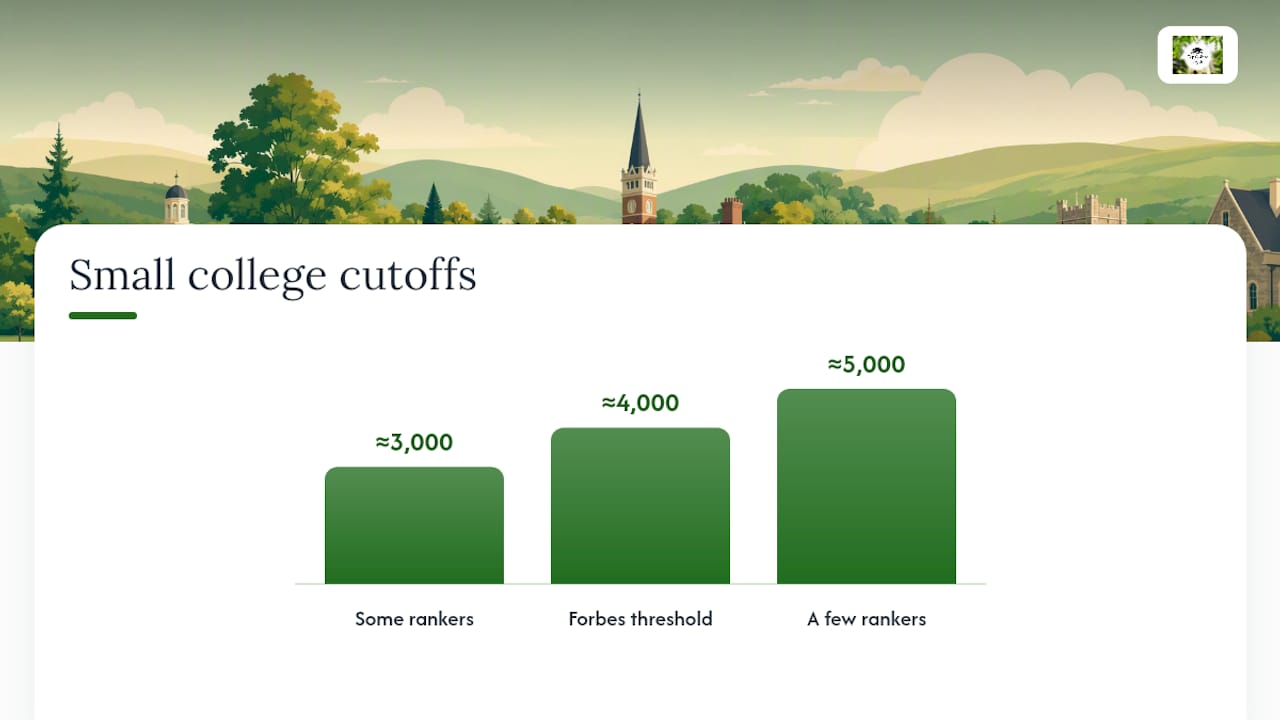
For this guide, “small college” means an institution with roughly 4,000 or fewer undergraduates, which is the threshold Forbes uses for its Top 50 Small Colleges list. Some rankers draw the line closer to 3,000; a few go as high as 5,000. The exact cutoff matters less than what the size produces: classes where a professor knows your name by week two, research opportunities that at large universities go only to graduate students, and a campus culture where your choices actually shape the community.
The practical advantages are real and measurable. Small colleges typically offer:
Lower student–faculty ratios, often low enough to permit more direct access to faculty mentors
Undergraduate-first research, where lab and fieldwork positions are not competed away by PhD students
Tight-knit campus culture, which tends to produce stronger alumni loyalty and more accessible networks after graduation
Consortium benefits at schools like the Claremont Colleges, where students cross-register across five campuses while keeping small-college advising and community
Holistic advising, with dedicated pre-professional advisors who know individual students rather than managing hundreds at a time
The tradeoff is real too. A small college with 1,800 undergraduates will offer fewer majors, fewer varsity sports, and a narrower social scene than a flagship state university. For students who thrive with structure, close relationships, and academic depth over breadth, that tradeoff is worth it. For students who want to reinvent themselves every semester across a sprawling campus, it may not be.
Pro Tip: Before visiting in person, use a school’s official virtual tour to evaluate lab facilities, residence halls, and campus layout. Caltech, for example, offers detailed virtual tours of its research facilities that give a genuine sense of the undergraduate research environment. Pair that with Niche student reviews to get the social and cultural picture alongside the academic one.
How this editorial ranking was built
This shortlist draws on five primary public data sources, cross-referenced to identify schools that appear consistently near the top across different methodologies.
Factor | Primary Source | What It Measures |
Overall ranking consensus | Niche, College Consensus, College Raptor | Aggregated student reviews, academic quality, and outcomes |
Student–faculty ratio | IPEDS / Academic Influence | Class size and faculty access |
Selectivity / acceptance rate | College Raptor, Niche | Admissions competitiveness (estimate; fluctuates annually) |
Net price / financial aid | Washington Monthly, college disclosures | Estimated annual cost after aid for typical families |
Career outcomes / earnings | Forbes, Washington Monthly | Median earnings after graduation, typical debt burden |
Signature academic strengths | College Consensus, institutional data | Departmental reputation and program depth |
The weighting prioritizes factors families actually use to make decisions: academic quality and fit first, then financial accessibility, then career outcomes. Prestige alone is not a ranking criterion here. A school that appears in the top tier of College Consensus’s best small colleges list but carries a high net price without proportionate aid generosity is noted honestly.
A few important limitations to keep in mind:
Acceptance rates fluctuate year to year. The figures cited here are editorial estimates based on recent cycles; always verify with the Common Data Set for the most current numbers.
Net price is an estimate. Washington Monthly’s figures are based on federal reporting and may not reflect your family’s specific financial situation. Use each school’s Net Price Calculator for a personalized estimate.
Rankings reflect consensus, not certainty. A school ranked 8th here is not objectively worse than one ranked 3rd. Use this list as a starting framework, not a final verdict.
Enrollment figures are approximate and sourced from IPEDS-derived data reported by Niche and College Raptor.
Top small colleges in America, ranked with key stats
The 33 schools below represent the full consensus field across Niche, College Raptor, Academic Influence, Forbes, Washington Monthly, and College Consensus. The comparison table covers the top 12 most consistently ranked schools; the remaining entries follow in prose with their key differentiators.
California Institute of Technology (Caltech) sits at the top of nearly every STEM-focused small college ranking, and for good reason. With roughly 950 undergraduates and a 3:1 student–faculty ratio, it offers research access that most universities reserve for doctoral students. The acceptance rate hovers around 3–4%, making it among the most selective institutions in the country. Caltech is the right choice if your student’s identity is built around scientific research, not a broad liberal arts exploration.
Williams College consistently earns its place at or near the top of liberal arts rankings. Its all-grant financial aid model means no student takes on loans to cover demonstrated financial need, which is a genuine differentiator in a field where many schools still package loans as part of aid awards. The 6:1 student–faculty ratio and strong postgraduate outcomes make it the benchmark against which other liberal arts colleges are often measured.
Amherst College pairs high selectivity with an unusually flexible open curriculum: no distribution requirements, which means students design their own academic path from day one. That freedom attracts intellectually self-directed students who know what they want to study. Strong postgraduate placement across law, medicine, and graduate programs reflects well on the advising infrastructure.
Swarthmore College is the choice for students who want to be academically challenged in a way that feels almost graduate-level. Its honors program, modeled on the Oxford tutorial system, places students in small seminars evaluated by external examiners. The campus culture is famously collaborative rather than competitive, which makes the intensity more sustainable.
Pomona College offers the best of both worlds: a small, intimate campus of roughly 1,800 students, plus cross-registration access to the other Claremont Colleges. That consortium model, highlighted by Forbes’ small college analysis, means Pomona students can take courses at Harvey Mudd, Claremont McKenna, Scripps, and Pitzer while keeping the advising and community of a small college.
Harvey Mudd College is the engineering counterpart to Pomona within the Claremont system. Its curriculum is deliberately intense, with a required core in math, science, and engineering before students specialize. Placement rates in technical fields and graduate programs are strong, and the school’s small size means undergraduates work directly alongside faculty on research projects.
Davidson College brings a strong honor-code culture and close student–faculty engagement to a highly-selective liberal arts setting with impressive undergraduate research opportunities. Davidson also offers 21 Division 1 sports in a school of just 2,000 students. With an average class size of just 16 students, and a strong alumni network, student outcomes are outstanding. On a per-capita basis, Davidson ranks #2 in Rhodes Scholars, and is in the top ten for Fulbright Scholars. The Wall Street Journal ranks Davidson as one of the top ten colleges in America.
Claremont McKenna College focuses on economics, government, and public affairs in a way that few small colleges match. Its internship and career placement networks are particularly strong for students heading into finance, policy, or consulting. Consortium access adds course depth without sacrificing the tight-knit campus feel.
Bowdoin College earns its reputation through consistently high graduation rates and alumni engagement. Located on the Maine coast, it attracts students who value both academic rigor and an outdoor, community-oriented campus life. Career outcomes relative to peers are strong, and the alumni network is notably accessible for a school of its size.
Wellesley College is the premier women’s college on this list, with an alumnae network that includes some of the most influential figures in American public life. Its academic reputation is strong across the sciences and humanities, and its location near Boston gives students access to internships, research, and cultural resources that many rural small colleges cannot match.
Carleton College is the Midwest’s answer to the New England liberal arts giants. Its teaching-first culture means professors are evaluated primarily on undergraduate instruction, not research output. Graduate school placement rates are high, particularly in PhD programs, and the campus community in Northfield, Minnesota has a reputation for intellectual warmth.
Haverford College runs on an honor code that students write and enforce themselves, which shapes the campus culture in a way that is hard to replicate. Classes are small, faculty mentorship is close, and the collaborative atmosphere means students help each other rather than compete. Its location in suburban Philadelphia gives access to city resources while maintaining a residential campus feel.
Middlebury College stands apart for its language programs, which are among the strongest at any undergraduate institution in the country. Its environmental studies program and Bread Lob School of English add further depth. Students interested in international careers or graduate work in languages, environmental policy, or global studies will find few better undergraduate homes.
The remaining schools: what sets each one apart
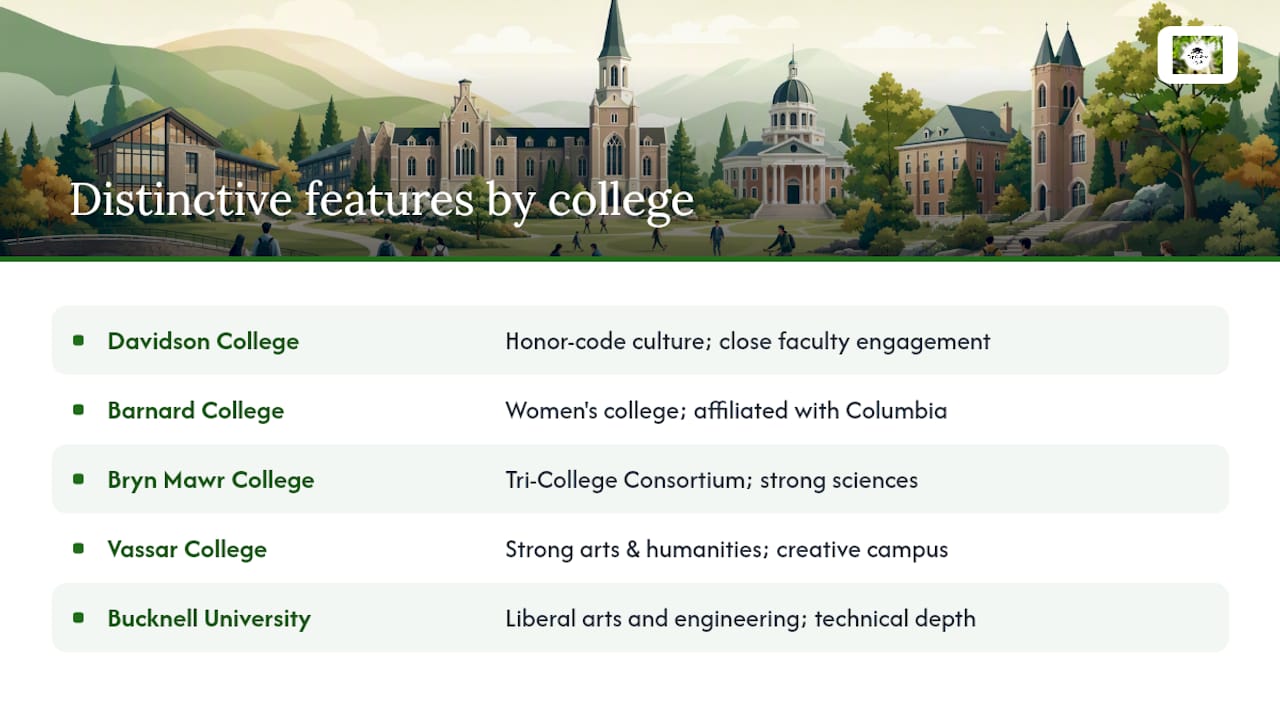
Barnard College (New York, NY) is a women’s college affiliated with Columbia University, giving students access to one of the world’s great research universities while maintaining a small, women-centered community. The New York City location is itself a resource.
Bryn Mawr College (Bryn Mawr, PA) is part of the Tri-College Consortium with Haverford and Swarthmore, offering cross-registration while maintaining its identity as a rigorous women’s college with particular strength in the sciences and humanities.
Vassar College (Poughkeepsie, NY) was one of the original Seven Sisters and now admits all genders. It has a strong arts and humanities reputation and a campus culture that values creative and interdisciplinary work.
Wesleyan University (Middletown, CT) sits at the intersection of liberal arts and research university. Its film studies and social sciences programs are nationally recognized, and it appears in Academic Influence’s top small college rankings for its academic output relative to size.
Colgate University (Hamilton, NY) offers strong liberal arts programs in a residential campus setting with a particularly engaged alumni network in business and finance.
Hamilton College (Clinton, NY) is known for its writing-intensive curriculum and strong outcomes in law and graduate school. Its open curriculum, like Amherst’s, gives students significant academic freedom.
Bates College (Lewiston, ME) was an early adopter of test-optional admissions and has a strong reputation for student research and community engagement. Its short-term module system adds academic variety.
Colby College (Waterville, ME) has invested heavily in research infrastructure and global programs. Its Colby Liberal Arts Consortium with Bates and Bowdoin strengthens academic resources across all three campuses.
Washington and Lee University (Lexington, VA) combines a strong liberal arts core with a well-regarded law school and a distinctive honor system. It appears in College Raptor’s top small college rankings for selectivity and outcomes.
Bucknell University (Lewisburg, PA) offers both liberal arts and engineering programs, making it a strong option for students who want technical depth without sacrificing humanities breadth.
Lafayette College (Easton, PA) similarly combines engineering and liberal arts in a small residential setting, with strong alumni connections in the Northeast.
Franklin W. Olin College of Engineering (Needham, MA) is one of the most distinctive schools on this list: a tiny, tuition-free engineering college with roughly 350 students that emphasizes project-based, collaborative learning. Admission is extraordinarily selective and the model is unlike any other school here.
The Cooper Union for the Advancement of Science and Art (New York, NY) has historically offered full-tuition scholarships to all admitted students, making it one of the most financially distinctive options for students in art, architecture, and engineering. Admission is highly competitive.
Babson College (Wellesley, MA) is the nation’s top-ranked entrepreneurship school. If your student’s goal is to build a company rather than join one, Babson’s curriculum and alumni network are purpose-built for that path.
College of the Holy Cross (Worcester, MA) is a Jesuit liberal arts college with strong pre-professional outcomes, particularly in law and medicine, and a tight alumni network.
Trinity University (San Antonio, TX) offers strong programs in the sciences and business in a residential setting with a notably generous financial aid program relative to its sticker price.
University of Richmond (Richmond, VA) combines liberal arts and business in a residential setting with one of the most generous financial aid programs among small private colleges.
Trinity College (CT) (Hartford, CT) has a strong urban engagement program and notable strengths in neuroscience and public policy.
Brandeis University (Waltham, MA) is a research university in a small-college package, with particular strength in the sciences, social justice-oriented programs, and a strong Jewish intellectual tradition.
Some liberal arts colleges also offer 3-2 engineering pathways or joint-degree arrangements with larger research universities, letting students earn a liberal arts degree and an engineering degree in five years. Swarthmore, Haverford, and several others have these arrangements, which is worth researching if your student is drawn to both humanities and technical fields.
How to choose the right small college and what admissions actually looks like
Choosing among top small colleges is less about ranking position and more about fit across five dimensions. Work through these questions before building your list:
Majors and academic structure: Does the school offer your student’s intended field? Does it use distribution requirements, an open curriculum, or a core? Amherst and Hamilton’s open curricula suit self-directed students; Caltech and Harvey Mudd’s structured cores suit students who want a defined path.
Research and hands-on opportunities: For STEM students, ask specifically whether undergraduates work in faculty labs from freshman year. For humanities students, ask about thesis requirements and independent study options.
Financial aid fit: Run the Net Price Calculator on every school’s website before building a final list. Washington Monthly’s liberal arts college rankings include net price and median earnings data that help families assess return on investment honestly.
Campus culture and social life: A school with 950 students (Caltech) feels fundamentally different from one with 2,800 (Middlebury). Use Niche student reviews to get unfiltered perspectives on social life, extracurriculars, and campus culture.
Career services and alumni networks: Ask specifically whether the career office has relationships with employers in your student’s target field. Claremont McKenna’s finance and consulting placement is well documented; Babson’s entrepreneurship network is purpose-built.
Admissions realities at selective small colleges
Small colleges conduct genuinely holistic reviews, and “fit” carries more weight here than at large research universities. Admissions officers at a school of 1,800 students are building a class, not processing applications. That means:
Demonstrated interest matters. Many small colleges track campus visits, virtual information sessions, and email contact. Showing genuine, specific interest in the school’s programs signals that you will enroll if admitted.
Recommendations carry real weight. A strong letter from a teacher who knows your student’s intellectual curiosity in depth can move an application in a way that a generic letter cannot. Choose recommenders who can speak to growth, not just achievement.
Early Decision is a genuine signal. At schools like Bowdoin, Middlebury, and Colgate, ED acceptance rates are meaningfully higher than regular decision rates. If a school is a clear first choice and the financial aid package is workable, ED is worth serious consideration.
Essays should demonstrate community contribution. At a small college, admissions officers are asking: “Will this student make our campus better?” Frame essays around what your student will add to a close-knit community, not just what they have achieved. Our college admissions advice resources go deeper on this framing.
Interviews are often available and worth requesting. At schools like Haverford and Davidson, alumni interviews are a meaningful part of the process. Prepare specific, thoughtful questions about the school’s programs, not generic ones.
Red flags to watch for: a high sticker price without a strong net price calculator result, a career services office with no employer relationships in your student’s target field, and acceptance rates that have risen sharply in recent years without a corresponding increase in enrollment (which can signal declining selectivity rather than growing accessibility).
For a deeper look at what admissions committees prioritize, our guide on what top colleges look for breaks down the holistic review process in detail.
Admissions counselor advice: practical tips from Top College Coach
Randy Pryor and the team at Top College Coach have guided students through the admissions process at Caltech, Williams, Swarthmore, and other highly selective small colleges. The pattern that separates admitted students from equally qualified ones is almost always the same: specificity of fit.
Here is the checklist we use with families targeting selective small colleges:
Identify your student’s “spike.” Small colleges are not looking for well-rounded generalists. They are building a well-rounded class. A student who has gone unusually deep in one area, whether that is original research, a creative portfolio, or a distinctive community project, stands out more than one who has done everything adequately.
Customize every essay to the specific school. “Why us?” essays at small colleges need to reference specific courses, professors, research labs, or programs by name. Vague enthusiasm reads as a form letter. Specific engagement reads as genuine interest.
Build your recommendation strategy early. Approach recommenders by the end of junior year, give them a “brag sheet” with specific examples of intellectual growth, and follow up. A teacher who has six months to write a letter writes a better letter than one who has six weeks.
Prepare for interviews with depth, not breadth. Admissions interviewers at small colleges are not checking boxes. They want to know what you think about, what you read, what problems you care about. Prepare two or three ideas you can discuss with genuine enthusiasm.
Use the summer productively. Research programs, independent projects, and meaningful work experience all strengthen applications. Our guide on summer admissions planning outlines exactly how to use the months before senior year.
Run financial aid scenarios before submitting. Do not fall in love with a school before you know whether the aid package is workable. Williams’ all-grant model is exceptional; many other schools still package loans. Know the difference before you apply.
Pro Tip: The most effective “Why us?” essays we see at Top College Coach connect a specific academic interest to a named professor’s research or a specific program, then explain how the student’s own work builds on or relates to it. That level of specificity takes research, but it signals exactly the kind of intellectual engagement small colleges are selecting for.
“The secret to a compelling small-college application is not a longer activity list. It is a clearer story about who you are, what you care about, and why this specific community is where that story continues.” Read more about the secret of college admissions and how counselors approach fit-driven applications.
For families who want a structured approach to liberal arts admissions strategy, Top College Coach’s resources cover the full arc from list-building to final submission.
A strong application essay is also worth investing in. Our partners at David TC Tutoring Services offer a practical college application writing checklist and a detailed guide on why college essays matter in admissions that complement the strategic framing above.
What the rankings miss about small college selection
Most families approach small college rankings the way they approach a restaurant rating: higher number, better choice. That instinct is understandable, but it misses the most important variable in the decision.
A student who thrives at Caltech would be miserable at Middlebury, and vice versa. Not because one school is better, but because they are built for fundamentally different kinds of students. Caltech’s culture is built around scientific obsession and collaborative problem-solving under pressure. Middlebury’s is built around language, place, and global engagement. Both are exceptional. Neither is universally right.
The rankings also tend to reward prestige signals, selectivity chief among them, over the metrics that actually predict whether a student will graduate, find meaningful work, and feel the investment was worth it. Washington Monthly’s approach is a useful corrective: it weights net price, graduation rates, and post-graduation earnings alongside academic quality, which produces a meaningfully different list than pure prestige rankings. A school that appears in the top 20 of one list and the top 40 of another is not worse; it may simply serve a different kind of student better.
The practical implication: build your list from the inside out. Start with what your student genuinely needs, academically, socially, and financially, and then check which schools on the consensus shortlist match those needs. The ranked list is a starting point, not a destination.
Personalized coaching for selective small college applications
The schools on this list are genuinely hard to get into. Caltech’s acceptance rate sits around 3–4%. Williams, Amherst, and Swarthmore are all in single digits. Even schools further down the list, like Colby, Bates, and Bucknell, have grown more selective over the past decade. A strong GPA and test scores are necessary but not sufficient.
Top College Coach works with high-achieving students and their families to build applications that communicate fit, depth, and authentic story with the precision these schools require. Services include essay coaching tailored to small-college “Why us?” prompts, interview preparation with former admissions officers, recommendation strategy, and full application review. Every student gets a personalized plan built around their specific academic profile and target school list.
If your student is targeting any of the schools on this list, the time to start is now, well before senior year. Book a consultation with Top College Coach to map out a strategy built around your student’s strengths and the specific schools where they will thrive.
Sources
These are the primary ranking and data sources used in this guide, each suited to a different research purpose:
Recommended
Comments