Fit Thesis for Supplemental Essay Strategy at Selective U.S. Colleges

The strongest supplemental essay strategy is simple to name and hard to fake: write a one-sentence “fit thesis” that connects your genuine interest, the specific school, and your readiness, then prove it with two or three concrete, school-specific details drawn from your own activities. Everything else, the genre-matching, the research, the editing checklist, exists to help you do that efficiently across dozens of prompts without burning out.
Supplemental Essays
A strong supplemental essay relies on a clear fit thesis that links your interests, the school’s offerings, and your readiness, supported by two or three specific, school-related details.
Research should focus on departments, courses, programs, faculty, and student activities, aiming to gather concrete, citable information for each school with a simple, organized log.
An effective essay structure includes a brief anchor statement, two or three evidence examples tied to your activities, and a final line on your intended contribution or next steps.
Editing involves strictly answering each prompt clause, removing vague sentences, trimming filler, and ensuring your essay remains personalized and free of generic content or school misnaming.
Prioritize drafting longer, more selective-school essays first, allowing two to three hours per draft, and always test your fit thesis by swapping college names to confirm specificity.
Table of Contents
What Is Supplemental Essay Strategy, and Which Genre Are You Facing?
Supplemental essay strategy starts with recognizing that most prompts are not unique snowflakes. They cluster into a small set of recurring genres, and each genre is really asking a different question. Guides that map hundreds of college prompts have found the same five patterns show up again and again, which means you can build a reusable structure for each type rather than reinventing your approach for every school.
Here is what each genre actually wants from you:
Why this school: Proves you have done real research and can name specific reasons this campus fits you, not just prestige or weather.
Why this major: Traces a believable line from a past experience to a specific academic path, ideally naming a department or course sequence.
Community and identity: Asks how you will show up in shared spaces, dorms, clubs, seminars, and what perspective you bring.
Extracurricular elaboration: Wants depth on one commitment rather than a resume recap; admissions readers already have your activities list.
Short-answer lists: Tests whether you can be specific and voice-forward in a tight space, often 25 to 150 words.
The gap between a generic and a strong answer is usually one layer of specificity. A generic “why this school” line reads like “I love the vibrant community and beautiful campus.” A strong version tied to fit names a research lab, a professor’s course, or a club you would actually join and explains why it matters to your particular story. Admissions leaders have said as much directly: the Forbes roundup of admissions officers notes that supplements exist to test fit, and struggling to answer one honestly can be a sign the school itself isn’t the right match.
How Do You Research School-Specific Details Efficiently?
You cannot write a credible fit thesis without material, but you also cannot spend six hours per school reading admissions brochures. The fix is a research order that moves from general to specific and stops once you have enough.
Start at the department level. Find the academic department tied to your interest and skim its homepage for tone and priorities.
Move to the course catalog. Note two or three actual course titles or numbers you’d want to take, not just “interesting classes.”
Check program pages. Look for named tracks, dual-degree options, or research centers that don’t exist everywhere.
Read faculty bios. One professor whose research matches your interest is worth more than five generic mission-statement phrases.
Scan student news and clubs. Recent campus newspaper stories or a specific student organization show you’re looking at this year’s campus, not a decade-old brochure.
This sequence mirrors what admissions-focused guides recommend, and it works because it front-loads the sources most likely to hand you a concrete, citable detail rather than marketing copy. Aim to collect two to three strong “concrete nouns,” a course number, a lab name, a specific sequence, a named faculty member’s research area, per school. Three is the working number that guides suggest, and it’s enough to build a whole essay around without turning your draft into a list of trivia.
Pro Tip: Keep a simple research log for every school: paste the exact URL, copy the exact program or course name character for character, and jot one sentence on why it connects to you. Six months later, when you’re drafting essay number twenty, that log is the difference between five minutes of writing and an hour of re-googling.
What Is a Fit Thesis, and How Do You Structure Any Supplement Around It?
A fit thesis is one sentence that ties together three things: what you’re genuinely interested in, what this specific school offers that supports it, and why you’re ready to make use of it. Something like: “My two years running our school’s low-cost water-testing project make [Program Name]'s environmental engineering track, especially the field methods sequence taught through [Department], the natural next step.” Rice’s own admissions guidance frames the whole supplement as a conclusion, connecting your past activities to future goals, which is exactly what a fit thesis does in miniature.
Once you have that sentence, the essay skeleton barely changes no matter the prompt:
Anchor (one to two lines): State or imply your fit thesis right away.
Evidence (the bulk of your space): Two or three specific examples tied to real activities, projects, or moments that support the thesis.
Contribution or next step (one line): What you’ll actually do with this opportunity if admitted.
For a 250-word “why this school” essay, Rice’s guidance suggests spending no more than 10% of your words on setup, meaning roughly 25 words, before moving into evidence and connection. For short-answer prompts of 50 words or less, skip the anchor entirely and lead with your strongest concrete detail. For longer 250 to 400 word supplements, expand the evidence section into two distinct examples rather than one thin paragraph stretched too far.
How Do You Edit a Supplemental Essay Before You Submit It?
Editing supplemental essays rewards a repeatable sequence more than raw talent. Treat every draft the same way, and errors that cost you admissions attention get caught before they matter.
Paste the prompt and its word limit at the top of your document, then underline every clause in the question.
Write one clause of your draft that directly answers each underlined clause, so nothing gets skipped.
First editing pass, evidence and specificity: cut any sentence that could apply to a different applicant.
Second pass, economy of language: trim filler words until every sentence earns its place.
Third pass, voice and integrity check: confirm the essay still sounds like you, especially if AI tools or a well-meaning parent touched the draft.
Pro Tip: Do a “swap test” on every “why this school” essay: read it back and ask whether you could paste a different college’s name into the same paragraph without anyone noticing. If the answer is yes, your evidence isn’t specific enough yet.
Before you submit anything, run three mechanical checks: confirm your word count matches the printed unit (some portals count words, others characters), confirm formatting survived the copy-paste into the application portal, and do a final search of your own document for any other school’s name left over from an earlier draft. The Common App hosts many of these supplements, but limits vary school by school, so never assume a universal cap carries over from your personal statement.
What Mistakes Do Admissions Officers See Most Often?
Admissions readers see the same handful of errors across thousands of files, and each one has a specific fix.
Generic “why us” answers: The fix is the swap test described above; if it works for any school, rewrite it.
Answering the wrong verb: A prompt asking “how” gets answered with “what.” Underline clauses before drafting to catch this.
Recycled content across schools: Reusing an essay wholesale skips the tailoring step; keep one working draft per genre, but always swap in fresh concrete nouns.
Leaving in the wrong school’s name: A final search-and-check catches this embarrassing, entirely avoidable error.
On timing, prioritize by length and selectivity: draft your longest, most selective-school essays first, since they demand the deepest research, and save short-answer lists for last since they’re faster once your fit thesis is already written. A reasonable budget runs two to three hours per 250 to 400 word supplement across brainstorming, drafting, and editing, and roughly thirty minutes per short answer. If you’re still meaningfully rewriting an essay past your third full editing pass, that’s usually a sign the fit thesis was weak from the start, not that the prose needs more polish.
What a Counselor Actually Sees When Applying This Workflow
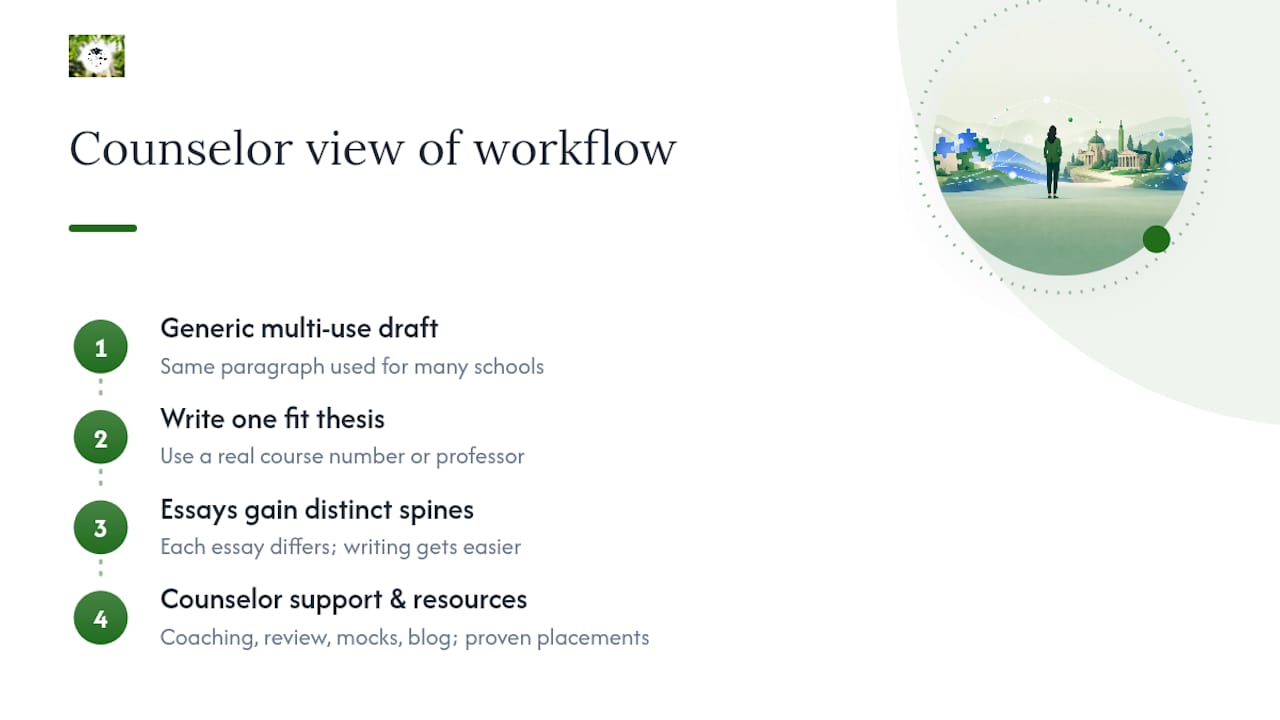
I’ve watched this play out the same way across dozens of files: a student sits down to write “why this college” for six or eight schools and produces six or eight versions of the same paragraph about campus culture and opportunity. The moment that changes is when they write one honest fit thesis sentence per school, built from a real course number or a professor’s name, and suddenly every essay has a different spine. The writing gets easier because the thinking got done first.
That’s the workflow Top College Coach applies with students directly, alongside application review from former admissions officers and mock interviews before decision season. It’s also why our blog resources exist: to give families a head start before they ever book a session, backed by a track record of placements at Ivy League and Top 20 universities and five-star client reviews.
— Randy Pryor
How Top College Coach Helps You Execute This Strategy
Top College Coach turns this entire framework, genre-matching, research logs, fit thesis, editing passes, into one-on-one guidance instead of a checklist you have to manage alone. Our essay coaching pairs you with counselors and former admissions officers who read your drafts the way an admissions committee will, catch the generic “why us” paragraph before it ships, and pressure-test your fit thesis against the school’s actual programs.
A free strategy session gets you a candid read on where your application stands right now, which schools’ prompts might expose weak fit, and which supplements deserve your time first. It’s a conversation, not a sales pitch: some students leave with a short list of fixes they can handle solo, others move into a paid coaching package for full essay-by-essay support, application review, and interview preparation. Either way, you’ll know your next move. Visit Top College Coach to see the full range of counseling services and book your session.
Sources
Rice University’s admissions blog explains the fit thesis concept straight from an admissions office. GradPilot breaks prompts into genres for efficient drafting. US College Data details the research workflow. U.S. News covers word-limit discipline, and Forbes gathers admissions leaders on authenticity. The Common App remains the platform where most of these supplements actually live.
FAQ
What are some good ideas for supplemental essay topics?
Anchor your topic in a concrete experience, a project, a role, a specific challenge, and connect it to a named course, program, or department at the school rather than writing about campus culture in general terms.
Do all Ivy League schools require supplemental essays?
Most Ivy League schools do require supplements beyond the Common App personal statement, though exact prompts and word limits vary by school and by year, so always confirm current requirements directly on each application portal.
Why are some colleges reducing or dropping supplemental essays?
Some schools have trimmed supplement requirements to reduce applicant burden and simplify review, but selective and Ivy League schools still tend to rely on supplements to assess fit, since Forbes reports admissions leaders view them as a key tool for evaluating genuine interest.
How many concrete details should a “why this school” essay include?
A few specific, school-specific details, including course numbers, program names, or faculty research areas, are enough to support a strong fit thesis without turning the essay into a list.
How long should I spend on each supplemental essay?
Budget two to three hours for a 250 to 400 word supplement and about thirty minutes per short answer, then stop revising once your fit thesis holds up to the swap test.
Recommended
Comments