Alumni Interviews in Admissions: What Students and Parents Need to Know

Alumni interviews rarely decide admission alone, but they can provide a meaningful nudge in close cases and give your application a human dimension that transcends test scores and GPA. The role of alumni interviews in admissions is best understood as a supplement, not a centerpiece: a well-executed interview can reinforce the qualities already visible in your essays and recommendations, while a poor one can raise questions that weren’t there before.
Here’s the honest picture:
When interviews carry more weight: Borderline applicants benefit most. If your file sits in the middle of a school’s competitive range, a strong report can tip the decision. Schools that explicitly track demonstrated interest also use interview participation as one signal of genuine enthusiasm.
When interviews carry less weight: Clear admits and clear denies are rarely moved by interview performance. If a school has no alumni network in your region, or uses interviews purely for informational purposes, the report plays a smaller role in the final decision.
If you can’t attend an optional interview: Declining rarely hurts you. Dartmouth confirms that a lack of an interview does not negatively affect your chances, and most schools with optional programs hold the same policy.
One more thing to keep in mind: interviewer reports are subjective snapshots. They are not numeric scores on a standardized rubric. Two interviewers can walk away from similar conversations with very different impressions, which is why the report supplements your file rather than overriding it.
Table of Contents
What does a typical alumni interview look like?
Most alumni interviews run 20–45 minutes and feel closer to a guided conversation than a formal interrogation. The tone is deliberately informal. You might meet at a coffee shop, a library, or a campus building, or you might connect over Zoom or a phone call. Since the pandemic, virtual formats have become standard at many schools, and some programs now offer them exclusively for applicants in regions with limited local alumni presence.
The structure varies by school and by interviewer, but most sessions follow a loose arc: the interviewer introduces themselves and their own college experience, asks you to share a bit about yourself, then moves through questions about your interests, goals, and reasons for applying. There is usually time at the end for your questions.
Application Round | Typical Interview Window | Common Formats |
Early Decision / Early Action | October–November | In-person, video |
Regular Decision | December–February | Video, phone, in-person |
Rolling Admissions | Varies by school | Video, phone |
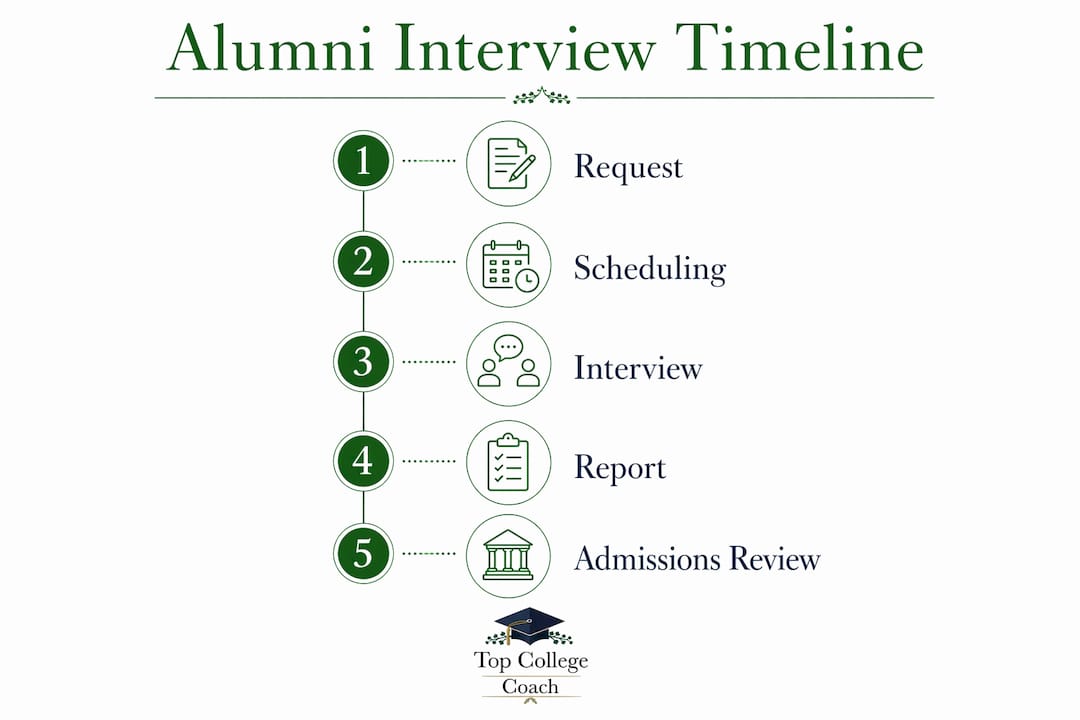
Dress one level above what you’d wear to school. For video interviews, test your camera, microphone, and background at least 24 hours in advance. For in-person meetings, arrive five minutes early and bring a copy of your resume in case the conversation calls for it.
Who conducts alumni interviews, and what do they know about you?
The short answer: less than you might think. Most alumni interviewers are volunteers coordinated through regional alumni committees. At Yale, for example, the Alumni Schools Committee matches applicants with local alumni based on geography and, when possible, shared interests. At some schools, current seniors or trained admissions staff conduct interviews for applicants in areas without alumni coverage.
What interviewers typically receive before your meeting:
Your name and contact information
Your city or region
Your intended major or area of interest
Basic logistics for scheduling
That’s usually it. Duke’s admissions program is explicit: alumni interviewers do not have access to your transcripts, essays, test scores, or letters of recommendation. Georgetown’s volunteer network operates similarly. This means you need to be ready to tell your story from scratch, even though you’ve already written it in your application.
Pro Tip: Prepare a 60-second version of your academic and extracurricular highlights that you can deliver naturally, as if the interviewer knows nothing about you. They probably don’t.

Interviewer training also varies widely. Some programs provide video modules, written guides, and checklists. Others offer minimal preparation. Because the process is volunteer-driven, the quality and consistency of reports differ from interviewer to interviewer. That variability is one reason admissions offices treat reports as qualitative context rather than definitive assessments.
How do admissions offices actually use interview reports?
After your interview, the alumni volunteer submits a short written report to the admissions office. That report becomes part of your application file, read alongside your essays, transcript, and recommendations. The Admissions Committee weighs the qualitative remarks in the report as one piece of a holistic review, not as a standalone verdict.
There are two broad types of alumni interviews, and they function differently:
Interview Type | How It’s Used | When It Applies |
Evaluative | Report read as part of the admissions decision; can influence borderline cases | Most selective universities (Yale, Georgetown, Duke) |
Informational | Primarily helps the applicant learn about the school; report has minimal decision weight | Schools with limited alumni networks or open-access programs |
Yale’s admissions team is candid about how reports function. Hannah Mendlowitz, director of the First-Year Process, has written that the most successful interview reports reinforce qualities about an applicant that were already apparent in the personal statement and teacher recommendations. Dara Norwood, a senior assistant director of Admissions for Yale College, put it plainly:
Jeremiah Quinlan, Yale’s dean of Undergraduate Admissions and Financial Aid, has described alumni interview reports as providing “invaluable insights to the Admissions Committee.” Georgetown’s admissions office notes that interviews rarely make or break an application, but the report does sit in your file and is read.
Three concrete scenarios where a report can shift outcomes:
Borderline applicants: A warm, specific report describing intellectual curiosity and maturity can tip a close decision toward admission.
Unexplained gaps or context: If something in your background needs clarification, a thoughtful interviewer can provide that context in their write-up.
Confirming essay themes: When your interview personality matches the voice in your personal statement, it builds credibility across the entire file.
How much influence should you realistically expect?
The honest answer is: moderate at best, minimal in most cases. Most alumni interview reports are positive, and they function more often to add texture than to reverse application weaknesses. A strong interview will not rescue a transcript that falls well below a school’s median range.
Where influence tends to land:
Clear admit: Interview has minimal impact. The file already speaks for itself.
Clear deny: A strong interview rarely overcomes significant academic gaps.
Borderline applicant: This is where the interview matters most. A specific, enthusiastic report can be the factor that moves a file from the waitlist to the admit pile.
Demonstrated-interest schools: At institutions that track engagement, the interview is one more data point confirming you’re genuinely interested, not just applying broadly.
The College Board’s counseling materials describe interview notes as part of the application file, reinforcing the idea that they contribute to a holistic review process rather than a binary judgment. Spend your prep time proportionally. If you’re a borderline applicant at a school you love, treat the interview seriously. If you’re a strong academic fit with a clear application narrative, a solid interview is enough.
How to prepare for your alumni interview
Preparation doesn’t mean scripting every answer. It means knowing your own story well enough to tell it naturally under mild pressure.
Do these things:
Research the interviewer’s background when it’s available (LinkedIn is fair game).
Refresh your memory on your own application highlights: activities, awards, a meaningful project.
Prepare 3–5 questions to ask the interviewer about their experience at the school.
Confirm logistics: location, parking, Zoom link, or phone number.
For video interviews, do a full tech check the day before.
Avoid these:
Reciting your resume line by line. The interviewer wants a conversation, not a performance.
Asking about your admission chances. It puts the interviewer in an impossible position.
Oversharing personal or family difficulties unless they directly explain something in your application.
Arguing about school policies or rankings.
Prep checklist (numbered):
Research the interviewer’s professional background and alma mater connection.
Build a 30–90 second story for each major activity using this structure: situation → action → result → reflection.
Write out 5 questions to ask the interviewer (avoid anything answered on the school’s website).
Run a tech and location check: camera, mic, background, or travel route.
Schedule 2–3 timed mock sessions with a parent, counselor, or trusted adult.
Do one final run-through the day before, focusing on pacing and eye contact.
Pro Tip: Record one of your mock sessions and watch it back. Most students are surprised by how often they say “um” or break eye contact. One viewing is worth three practice rounds.
For students building their broader application strategy, pairing interview prep with summer planning gives you richer stories to tell when the interview arrives.

Common alumni interview questions and how to answer them
Interviewers aren’t trying to trick you. They want to understand who you are beyond the application. The questions below appear across most selective-school interviews, and the goal isn’t a perfect answer. It’s an authentic, specific one.
Question | Key Talking Points | Target Duration |
Tell me about yourself. | Academic focus, one or two defining activities, what drives you | 60–90 seconds |
Why this college? | Specific programs, professors, or campus culture; connect to your goals | 45–60 seconds |
Describe a challenge you handled. | Situation, your action, what you learned; avoid vague generalities | 60 seconds |
What do you do outside of school? | One or two activities with depth; show genuine passion, not a list | 45–60 seconds |
What questions do you have for me? | Ask about their experience, what surprised them, what they’d do differently | 2–3 questions |
Tie every answer to something concrete: a specific project, a moment that changed your thinking, a class that opened a new interest. Generic answers (“I’m passionate about helping people”) land flat. Specific ones (“I spent last summer building a water-filtration prototype for a science competition”) create a memorable impression. The College Board’s interview guidance reinforces this: interviewers take notes, and specificity is what makes those notes worth reading.
When are interviews scheduled, and what if you don’t get one?
Timing follows the application calendar, but with real variation by school and region.
Early Decision / Early Action applicants typically receive interview invitations in October or November, with sessions completed before the decision deadline.
Regular Decision applicants usually see interview windows open in December and run through February, depending on alumni availability in their area.
Rolling admissions schools vary; check each school’s admissions page directly.
Dartmouth’s admissions office notes that interviews are prioritized where they provide added context, which means not every applicant receives an invitation. If you don’t get one, confirm that you were eligible (some schools only interview domestic applicants or those within certain regions), then check the school’s policy page. In most cases, the absence of an interview is neutral, not a negative signal.
If you need to reschedule, contact the alumni coordinator or interviewer promptly and politely. A brief thank-you email after the interview is appropriate and appreciated, though it won’t change the report that’s already been submitted. Keep it short: two or three sentences expressing genuine appreciation for their time.
Alumni interview programs have also shifted since 2023. Some schools have reduced or restructured their programs, and virtual formats have expanded significantly. Always verify the current format directly with the school before assuming in-person is expected.
Key Takeaways
Alumni interviews are a meaningful but not decisive part of the admissions process, most impactful for borderline applicants who can use a strong report to reinforce the themes already present in their application.
Point | Details |
Interviews rarely decide alone | They supplement your file; a strong report helps most in borderline cases, not clear admits or denies. |
Interviewers have limited file access | They typically see only your name, city, and intended major, so prepare to tell your full story aloud. |
Reports are qualitative, not scored | Admissions committees read them as context, not as a numeric rating that overrides other factors. |
Timing follows the application round | Early Decision interviews often run October–November; Regular Decision windows typically span December–February. |
Top College Coach can help you prepare | Mock interviews, story refinement, and targeted coaching give borderline applicants the best shot at a strong report. |
What most students get wrong about alumni interviews
The conventional wisdom says “just be yourself,” and while that’s not wrong, it’s incomplete. What students actually struggle with isn’t authenticity. It’s specificity under pressure.
The students who leave the strongest impressions aren’t the ones with the most impressive résumés. They’re the ones who can talk about one thing with genuine depth and connect it to why they want to spend four years at that particular school. A student who spent two years building a robotics club from scratch and can explain what that taught them about leadership, failure, and collaboration will outperform a student who lists twelve activities and can’t go deep on any of them.
The other common misstep is treating the interview as a one-way evaluation. Admissions officers at Georgetown and Yale both emphasize that the best interviews feel like two-way conversations. Asking the interviewer a thoughtful question about their own experience at the school does two things: it shows genuine interest, and it relaxes the dynamic in your favor. Students who prepare only answers and no questions often come across as passive.
One more thing worth saying: the subjectivity of the process is not a flaw to fear. It’s an opportunity. A numeric score can’t capture intellectual curiosity or warmth or the way you light up when you talk about something you love. The interview can. That’s why, for borderline applicants especially, it’s worth taking seriously.
Ready to walk into your interview with confidence?
Knowing the theory is one thing. Walking into that coffee shop or logging onto that Zoom call and actually performing well is another. At Top College Coach, we work with students one-on-one to build the kind of interview presence that leaves a lasting impression, whether you’re applying to an Ivy League program or a Top 20 university.
A typical interview-prep session covers mock interview practice with real-time feedback, story refinement using your actual application highlights, and a tailored question list built around your target schools. Students leave with tighter answers, more confidence, and a clear sense of what to say when the conversation goes somewhere unexpected. We’ve helped students across the country turn a good application into a great one, and the interview is often where that final piece clicks into place.
Schedule a free strategy session with Top College Coach and find out exactly how to make your interview count.
Useful sources and where to verify school-specific policies
Interview formats, availability, and timing vary by school and by admissions cycle. Always confirm the current policy directly on each school’s admissions page before scheduling or declining an interview.
Dartmouth Alumni Interview Program — timing windows, assignment policy, and what to expect
Duke Undergraduate Admissions: Alumni Interviews — interviewer access limits and report submission process
Georgetown University Alumni Interviews — volunteer network structure and how reports are used
Yale Daily News: How Alumni Interviews Impact Admissions — admissions officer and alumni committee perspectives
College Board: Admission Interview Tips — general interview process overview for counselors and students
Univyze Parent Resources — college planning tools and guidance for families navigating the admissions process
Practices vary by cycle and geography. A school that offered in-person interviews last year may shift to virtual this year, or pause the program entirely. Check the official admissions page for your target schools each fall before assuming availability.
Recommended
Comments