Refining Your College List: A Stepwise Guide

Cut your working list to a manageable number of balanced schools by scoring each one on career outcomes, net cost, and academic fit. That single move protects your time, your budget, and your odds. Right now, open a spreadsheet, list every school you’re considering, and mark each one as a reach, match, or likely. Then run one Net Price Calculator for your top school. That ten-minute exercise will tell you more than hours of browsing rankings.
Three filters to apply first:
Career outcomes in your intended major — does the program place graduates in roles you actually want?
Net cost after gift aid — not sticker price, but what your family will realistically pay each year
Academic fit — does the curriculum, faculty access, and program structure match how you learn?
Everything else in this guide builds on those three anchors.
Key Takeaways
Refining your college list comes down to scoring each school on net cost, career outcomes, and academic fit — then cutting decisively until you have 5–8 strong, balanced applications.
Point | Details |
Start with 15 schools | Apply five binary filters immediately to remove obvious mismatches before deep research begins. |
Balance reach, match, likely | Aim for 5–8 final applications with at least 1–2 safeties and 1–2 reaches per College Board guidance. |
Net cost beats sticker price | Run the Net Price Calculator for every school and count loans as cost when comparing four-year totals. |
Score before you cut | Use a 15-point scorecard (net cost, outcomes, fit, support, geography) to remove low-scoring schools objectively. |
Top College Coach | Offers personalized list review, scorecard assessment, and full application strategy for students targeting Ivy League and Top 20 schools. |
Table of Contents
How should you organize schools by reach, match, and likely?
[How do you research academic fit for your specific major?](#how-do-you-research-academic-fit-for-your-specific-majorhttpsunivyzecomhow-to-choose-the-right-college-major)
How do career outcomes and alumni networks affect your decision?
How much does location actually affect your college experience?
What admissions requirements should you check for each school?
How do you manage application deadlines without burning out?
How do you start refining your college list?
Start with a working pool of many schools, then apply quick binary filters to cut it to a manageable smaller list before any deep research begins. Admissions counselors consistently recommend starting broad so you don’t accidentally eliminate a great-fit school before you’ve looked closely.
Apply these five binary questions to every school on your initial list:
Does the school offer your intended major or a close equivalent?
Is the location geographically workable for your family?
Does the sticker price fall within a range where aid could make it affordable?
Does your GPA and test score profile overlap with the school’s admitted-class range?
Does the school’s size and setting (urban, suburban, rural) match your preferences?
Any school that fails two or more of these filters comes off the list immediately. You’re not being harsh — you’re being efficient.
Pro Tip: Check whether schools share Common App essay prompts or accept the same supplemental essays. Grouping schools with overlapping prompts can cut your writing workload significantly without reducing the quality of any single application.
For a fast affordability triage before you run full calculators, MyIntuition’s quick cost estimator gives families a rough sense of net price in under two minutes. Use it to flag obvious affordability mismatches early, then confirm with the official Net Price Calculator later.
How should you organize schools by reach, match, and likely?
Every school on your list belongs in one of three categories, and knowing which is which changes how you allocate your time and energy.
Reach: Your GPA and test scores fall below the school’s admitted-student range percentiles or the school’s acceptance rate is low.
Match (target): Your academic profile sits comfortably within the middle 50% of admitted students, and you have a realistic shot at admission.
Likely (safety): Your profile exceeds the school’s typical admitted range, and you’re confident you’d be accepted — and you’d genuinely enroll if it were your only offer.
The College Board counselors’ guidance recommends balancing your final list across all three tiers. A practical target is several strong final applications with at least one or two safeties and reaches. Applying to many schools rarely improves outcomes and often dilutes essay quality.
To classify each school accurately, pull data from the Common Data Set (search “[school name] Common Data Set” + the current year), the school’s admitted-class profile page, or College Board’s counselor pages. Look at the middle 50% GPA and test score ranges for admitted students, not averages.
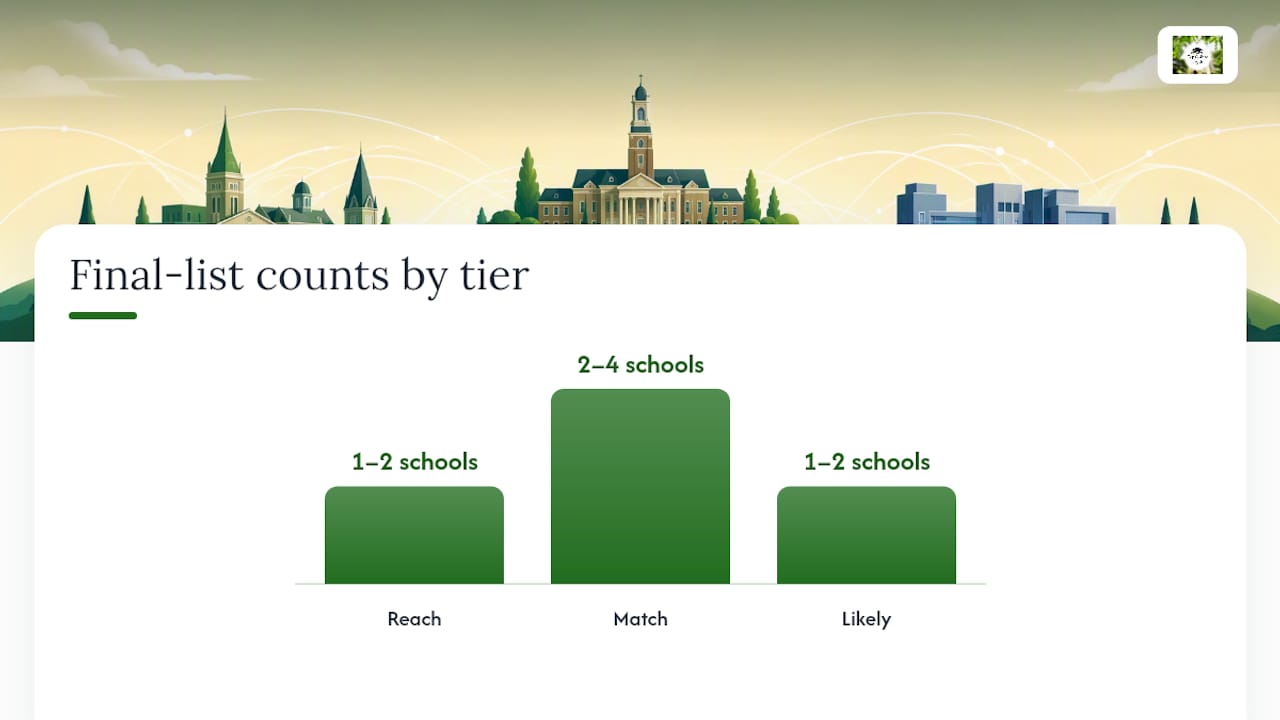
Category | Count on Final List | Where to Find Data |
Reach | 1–2 schools | Admitted-class profile, acceptance rate |
Match | 2–4 schools | Common Data Set, class profile pages |
Likely | 1–2 schools | Common Data Set, GPA/test percentiles |
How do you research academic fit for your specific major?
A school’s reputation in one field rarely transfers to another. A university ranked in the top 20 overall may have a mediocre engineering program and an exceptional film school. Program-level research is where most students lose time — and where the right research pays off most.
Three measurable checks to run for every school’s program:
Curriculum depth: Open the course catalog and read actual course descriptions, not just the major requirements list. Are the upper-division courses specific and rigorous, or are they broad survey courses?
Faculty access: Are undergraduates taught by tenure-track faculty, or primarily by graduate students and adjuncts? Department pages usually list faculty and their research areas.
Program outcomes: Does the department publish placement rates, internship partners, or graduate school acceptance data? If they don’t publish it, ask directly.
Pro Tip: Search “[school name] [your major] internship requirements” and “[school name] [your major] capstone project.” Schools that require structured internships or senior capstones tend to produce graduates with stronger portfolios and employer connections.
CollegeHelpGuide advises prioritizing measurable outcomes — program-level employment and earnings, net cost, and academic support — over prestige or rankings. That framing is worth keeping front of mind every time you’re tempted to keep a school on your list because of its name alone.
How do you evaluate the real cost of each college?
Sticker price is almost never what a family pays. Net price — what remains after grants and scholarships are subtracted — is the only number worth comparing across schools. The U.S. Department of Education’s net price guidance explains this distinction clearly and provides calculators for most institutions.
Step-by-step cost evaluation:
Run each school’s official Net Price Calculator (found on the school’s financial aid page).
Multiply the estimated annual net cost by four to get a four-year total.
When you receive aid letters, convert every offer to a four-year net cost — and count loans as cost, not aid.
Compare four-year net costs side by side, not annual sticker prices.
Red flags in aid packages to watch for:
Loan-heavy offers where grants cover less than half the gap between sticker price and your family’s expected contribution
Vague “work-study” amounts that aren’t guaranteed and depend on finding a campus job
Merit aid that requires maintaining a GPA threshold that’s higher than your current average
A practical rule of thumb: total student loan debt at graduation should ideally stay below the expected first-year salary in your intended field. If a school’s four-year net cost requires borrowing twice your projected starting salary, that cost gap is a decisive reason to remove it from your list.
Affordability check: Before finalizing any school on your list, run its Net Price Calculator and confirm the four-year net cost. Aid letters that lead with large numbers often bury loan amounts in the fine print — read every line.
How do campus visits help you narrow your list?
A campus visit — in-person or virtual — answers questions no website can. The Coalition for College admissions panel emphasizes that direct engagement with a campus, its students, and its academic environment is one of the most reliable ways to confirm or eliminate a school.
A practical visit plan for each school:
Sit in on a class in your intended department (most schools allow this with advance notice).
Attend an admitted-student session or information session to hear how the school talks about itself.
Walk the campus without a tour guide — dining halls, libraries, and study spaces reveal daily life.
Message or meet a current student in your major through the school’s student ambassador program.
For virtual visits, watch student-created content on YouTube and TikTok rather than the school’s official tour. Students show you the dorm bathrooms and the 11 PM library scene. The admissions office shows you the quad in perfect weather.
Pro Tip: If budget limits your travel, prioritize in-person visits for your top match and likely schools — the ones you’d actually attend. For reaches, a virtual session is often enough to confirm interest before you invest application fees.
A practical scorecard to cut your list decisively
Once you’ve done the research, you need a tool to make the final cuts without second-guessing yourself. Score each school on five dimensions, then remove the lowest scorers.
Scorecard (15 points total):
Net cost (4 pts): 4 = four-year net cost is manageable without excessive loans; 1 = cost requires borrowing well above projected starting salary
Career outcomes in major (4 pts): 4 = strong placement data, named employer partners, internship requirements; 1 = no published outcomes
Academic fit (4 pts): 4 = curriculum matches your learning style, faculty access is strong; 1 = program is weak or misaligned
Support services (2 pts): 2 = robust tutoring, advising, and career center; 1 = limited or hard to access
Distance/geography (1 pt): 1 = location works for your life; 0 = location is a genuine obstacle
School | Net Cost | Career Outcomes | Academic Fit | Support | Geography | Total |
School A | 4 | 4 | 3 | 2 | 1 | 14 |
School B | 2 | 3 | 4 | 2 | 1 | 12 |
School C | 1 | 2 | 2 | 1 | 0 | 6 |
School D | 3 | 4 | 4 | 2 | 1 | 14 |
In this example, School C scores a 6 and comes off the list. Schools A and D are strong candidates. School B stays if it fills a tier gap (for example, if it’s the only likely school on the list).
Schools that fail that test belong in the “remove” column, regardless of prestige.*

When does professional counseling actually help?
Paid admissions counseling adds the most measurable value in specific situations — not for every student, but for families navigating complexity.
Scenarios where a counselor earns their fee:
Your academic profile is nontraditional (a gap year, a GPA dip, or a late major pivot) and you need help framing your narrative
You’re applying to highly selective schools where essay strategy and demonstrated interest carry real weight
Financial aid appeals or CSS Profile strategy is part of your plan
You’re an international student navigating U.S. admissions for the first time
Your school counselor manages hundreds of students and has limited time for one-on-one strategy
Questions to ask any counselor on a first call:
What does your process look like from list-building to submission?
Can you share examples of how you’ve helped students with a profile similar to mine?
How do you structure fees, and what’s included?
Do you have any relationships with specific schools that could create a conflict of interest?
Private college counselors bring focused attention that most school counselors, managing large caseloads, simply can’t provide. The value isn’t just strategy — it’s accountability and a second set of expert eyes on every decision.
Pro Tip: Ask any prospective counselor for their process on list-building specifically. A counselor who hands you a generic list of 15 schools without asking about your major, career goals, and financial parameters isn’t doing the job.
Common mistakes that derail a college list
Most list-building errors are fixable, but only if you catch them before applications go out.
Top mistakes:
Relying on rankings alone. A school ranked #12 nationally may rank #40 for your specific major. Rankings measure institutional reputation, not program quality.
Ignoring net cost until decision month. Families who don’t run Net Price Calculators early often fall in love with schools they can’t afford.
Too many reaches, too few safeties. A list of eight reaches is not a balanced list — it’s a high-risk bet. Every student needs at least one school they’d be happy to attend and confident they’ll get into.
Skipping program-level checks. Accepting a school’s brand without reading its curriculum is one of the most common and costly mistakes we see.
Misreading aid letters. Loans are not grants. Work-study is not guaranteed income. Always convert every offer to a four-year net cost before comparing.
If your list is heavy on reaches, add one or two matches immediately. If cost is a concern on multiple schools, run their Net Price Calculators this week and remove any school where the four-year net cost exceeds what your family can realistically manage.
Does campus culture and extracurricular fit matter?
It matters more than most students expect, and it’s one of the hardest things to measure from a brochure. A student who thrives academically but feels socially isolated is far more likely to transfer or struggle — and transfer rates are a quiet signal worth checking.
Start with the college’s activity list and ask whether the clubs, organizations, and communities you care about actually exist and are active. A school may list 200 clubs, but if the one you’d join hasn’t met in two years, that number is meaningless.
Diversity — in background, perspective, and experience — shapes the quality of classroom conversations and the strength of your network after graduation. Look at the school’s published diversity data, but also read student-written reviews and Reddit threads where students speak candidly about campus culture.
For students considering smaller campuses, small colleges often offer tighter community bonds and easier access to leadership roles in clubs and organizations. That tradeoff is worth weighing against the broader social scene at a large university.
How do career outcomes and alumni networks affect your decision?
A degree’s value is partly determined by where it takes you, and that varies significantly by school and by program. Outcomes-focused research consistently shows that program-level employment rates and earnings matter more than institutional prestige in most fields.
For each school still on your list, look up:
The department’s published placement rates and named employer partners
Alumni presence on LinkedIn in your target industry (search “[school name] + [your field]” and filter by graduation year)
Whether the school has a dedicated career center with recruiters who visit campus specifically for your major
Alumni networks are not equal across schools. A regional university with deep ties to local employers in your field can outperform a nationally ranked school where your major is an afterthought. That asymmetry is worth researching before you finalize your list.
How much does location actually affect your college experience?
Geography shapes daily life in ways students often underestimate until they’re living it. Distance from home affects how often you visit, how quickly you can respond to a family situation, and how much you spend on travel each year.
Climate is a real factor too. A student from South Florida who has never experienced a Midwestern winter may find that adjustment harder than expected. It sounds minor until February of freshman year.
Urban versus rural settings affect internship access, part-time work opportunities, and the pace of daily life. A student targeting a finance or media career will find more proximity to employers at an urban campus. A student who needs quiet, space, and a tight-knit community may thrive at a rural liberal arts college.
Ask yourself: where do I want to spend four years of my life, not just four years of my academic career? The answer to that question should eliminate at least two or three schools from most lists.
What admissions requirements should you check for each school?
Every school on your list should have a clear, documented reason why your profile fits its admitted-class range. Wishful thinking is not a strategy.
For each school, confirm:
The middle 50% GPA and test score range for admitted students (from the Common Data Set or admitted-class profile)
Whether the school is test-optional and, if so, whether submitting scores helps or hurts your application given your specific scores
Any program-specific requirements (portfolios for art programs, auditions for music, prerequisite courses for engineering)
Application deadlines — Early Decision, Early Action, Regular Decision — and whether applying early meaningfully improves your odds at that school
The Washington Post’s reporting on college decisions highlights that graduation rate is one of four expert-recommended factors to weigh. A school’s graduation rate reflects not just selectivity but how well it supports students through to completion — a signal that matters as much as acceptance rates.
How do you manage application deadlines without burning out?
Application season has a way of expanding to fill every available hour. The students who manage it best treat it like a project with a fixed scope, not an open-ended commitment.
A few strategies that work:
Set a hard application cap. Applying to more than 12 schools rarely improves outcomes and almost always reduces essay quality. Pick your number and hold to it.
Build a deadline calendar in August. List every school, its deadline type (ED, EA, RD), and the date. Color-code by priority tier.
Write essays in order of deadline, not preference. Your first-choice school’s essay deserves your best work, but that work is better after you’ve practiced on earlier deadlines.
Batch similar essays. Schools that ask “Why us?” can often be answered with a shared framework, customized for each campus. Group them and write them in one sitting.
For deeper guidance on choosing the right colleges to apply to and managing the full application timeline, the process works best when it’s planned well before senior year begins.
What most students get wrong about narrowing their list
Here’s what we’ve observed working with students applying to Ivy League and Top 20 universities: the students who struggle most during decision month are almost always the ones who kept schools on their list for emotional reasons rather than strategic ones. They fell in love with a campus tour, or their parents went there, or the sweatshirt looked good. None of those are reasons to apply.
The students who navigate this process well do one thing differently. They treat their college list as a living document, not a wish list. They remove schools when the data doesn’t support keeping them, and they add schools when a gap appears in their tier balance. They’re not attached to any single school — they’re attached to the outcome.
The scorecard in this guide isn’t meant to remove the human element from the decision. It’s meant to give you a framework so that when you do make an emotional choice, you’re making it with your eyes open. A school that scores a 14 out of 15 and also feels right is a great choice. A school that scores a 6 and feels right is a red flag.
How Top College Coach can help you finalize your list
Narrowing a college list from 20 schools to 7 strong applications is a process that takes real data, honest self-assessment, and a clear framework. Top College Coach works with students and families to do exactly that — applying the kind of focused, individualized strategy that produces results at Ivy League and Top 20 universities.
In an initial consultation, clients receive a structured review of their current list, a scored assessment of each school’s fit across cost, outcomes, and academic alignment, and a clear recommendation for the final application slate. From there, Top College Coach’s team — including former admissions officers and current Ivy League student mentors — guides students through essay strategy, interview preparation, and application review.
Top College Coach is based in Orlando, Florida, and works with students nationally. To schedule a consultation and get a clear, expert-reviewed plan for your final list, visit Topcollegecoach.
Sources
These are the official tools and research-backed resources referenced throughout this guide. Each one is free and publicly accessible.
Collegecost
This article is general information, not a substitute for advice from a qualified financial advisor. Consult a qualified financial professional about your own circumstances before acting on anything here.
FAQ
How do you organize your college list?
Sort every school into reach, match, or likely using the Common Data Set’s middle 50% GPA and test score ranges, then aim for a balanced final list of 5–8 schools with at least one school in each tier.
How do you narrow your college list effectively?
Apply a scored framework across net cost, career outcomes, academic fit, support services, and geography — then remove the lowest-scoring schools until you reach 5–8 strong applications. Schools that fail two or more binary filters (major not offered, geography unworkable, clear affordability mismatch) should come off the list before deeper research begins.
What is the 90/10 rule for colleges?
A well-established guideline is that total student loan debt at graduation should ideally stay below your expected first-year salary in your intended field, use that as your affordability benchmark instead.
How many colleges should you apply to?
The College Board counselors’ guidance recommends a balanced list; most students apply to 8–12 schools, but a focused list of 5–8 strong applications often produces better outcomes than a longer list with weaker essays.
When should you get help from a college counselor?
Paid counseling adds the most value when your profile is nontraditional, you’re targeting highly selective schools, or financial aid strategy is complex. A counselor’s structured process can also help you finalize your list and strengthen your application narrative well before deadlines arrive.
Recommended
Comments