No Generic Prep: Programs for Students with Disabilities, Ivy/Top 20

The right move for a high-achieving student with a disability is tailored admissions counseling paired with focused essay and interview coaching, not a generic prep course. These programs work on disclosure strategy, essay framing, testing decisions, and interview readiness, the specific pressure points that trip up strong students at Ivy League and Top 20 schools. Some counseling firms build this kind of individualized support for exactly this situation.
TL;DR:
Tailored counseling that emphasizes disclosure strategy, essay framing, and interview preparation significantly improves the chances of strong students with disabilities getting admitted to elite institutions.
Comparing SAT and ACT scores under accommodations early in junior year helps identify the best test option based on individual processing style, rather than relying on guesswork or sibling preferences.
Effective application essays should depict specific strategies and measurable growth rather than vague hardship descriptions, with coordinated disclosure across all application components to avoid conflicting stories.
A counselor with direct experience in disability accommodations, small caseloads, and application review from the admissions perspective greatly elevates the quality of the application strategy.
Institutional support services and legal protections vary between high school and college, making early planning of documentation, self-advocacy skills, and understanding each school’s policies essential for success.
Table of Contents
What Programs for Students With Disabilities Should Include
Not every strong student needs this level of support, but the right candidate profile is easy to spot. Your child might be earning excellent grades yet losing time to slow processing speed on timed tests. Or the raw material for a great essay is there, but the story keeps getting buried under vague language or medical jargon that admissions officers glaze over. Tailored programs for students with disabilities exist specifically for that gap between real ability and how it currently reads on paper.
A serious program covers several moving parts at once, not just essay polish:
Disclosure strategy: deciding where, whether, and how much to reveal a diagnosis
Essay coaching: turning a diagnosis or struggle into a coherent growth narrative
Interview preparation: practicing answers about challenges without sounding rehearsed or defensive
Testing plan: comparing SAT and ACT performance under accommodations, then deciding on test-optional
Accommodations guidance: making sure documentation and requests align with what colleges expect
Timeline: sequencing all of this across junior and senior year instead of scrambling in the fall
Most families start this work in the spring of junior year and finish by early fall of senior year. The measurable outcome by the end isn’t a diagnosis explained away. It’s a clear personal narrative, essays that read as authentic rather than clinical, and a student who can talk about their learning profile in an interview without stumbling.
Why Individualized Counseling Beats Generic Advice
Admissions officers at highly selective schools read thousands of essays a year, and they can tell within a paragraph whether a student worked with someone who understands both the admissions process and the specific mechanics of a learning difference. That distinction separates counselors who happen to offer disability guidance from those who build their practice around it.
Top College Coach, based in Orlando, Florida, works with students targeting Ivy League and Top 20 universities, and the firm’s guidance draws on published best-practice research on how admissions officers evaluate applicants with learning differences. Randy Pryor, a college admissions counselor with the firm, has written and advised on exactly this intersection: strong students whose transcripts or test scores don’t yet reflect their actual capability.
A few specific counselor skills matter here more than general essay-writing chops:
Direct experience helping students request and use testing accommodations
Practice reframing a rough patch (a grade dip, a late diagnosis) as a growth story rather than an excuse
Small enough caseloads that the counselor actually knows the student’s voice
Application review by people who have sat on the other side of the admissions table
Consider a student whose sophomore-year grades dropped after an ADHD diagnosis. Rather than explaining away the dip, a skilled counselor helps the student describe the specific compensatory strategies (a new organizational system, weekly check-ins with a learning specialist) and the grade recovery that followed. That is a stronger admissions signal than silence or a vague apology.
Pro Tip: Ask any counselor you’re considering to walk you through one anonymized example of how they’ve reframed a weakness into a growth story. If they can’t give you a concrete example, they haven’t done this work before.
Disclosing a Disability and Writing Essays That Show Growth
Admissions officers are not evaluating a diagnosis. They’re evaluating whether a student can handle the academic and social demands of their campus, and disclosure framed around resilience and specific coping strategies tends to land well. Silence isn’t always safer, and oversharing isn’t always riskier. The venue you choose matters as much as the content.
Use this rough decision guide:
Additional Information box: best for factual context, like explaining a single low grade, a testing accommodation, or a gap tied to treatment. Keep it brief and matter-of-fact.
Main essay: appropriate only when the disability is genuinely central to the student’s identity or personal growth, and the essay can go beyond the diagnosis into what the student actually did.
Both: sometimes a short factual note in Additional Information plus a growth-focused essay elsewhere works best, as long as the two don’t contradict each other.
A strong disclosure essay generally follows a compact arc: brief context on the challenge, the specific strategies the student built (a tutor, a notetaker, a new study system), and clear evidence of growth that connects to who they are now as a student. Admissions counselors report that essays pairing a described difficulty with a specific intervention and measurable improvement in grades read as far more convincing than a diagnosis alone.
A few dos and don’ts worth keeping in mind:
Do name the specific strategy (“I started using a color-coded planner and weekly tutor sessions”), not just the struggle.
Don’t lead with clinical language a reader would need to look up.
Do show the outcome, even a modest one, like a grade trend or a completed project.
Don’t let the essay become an apology for underperformance elsewhere on the transcript.
Finally, coordinate disclosure across the whole application, including counselor and teacher letters, so an admissions reader doesn’t get a confusing story where one document mentions a struggle the essay never explains.
Choosing SAT, ACT, or Test-Optional With Accommodations
Run both official SAT and ACT practice tests under your child’s approved accommodations before deciding anything. This side-by-side comparison, done early in junior year, is the clearest way to see which test actually fits your student, rather than guessing based on which test siblings or friends preferred.
The two tests reward different skills. The ACT’s science section and more straightforward math sequencing can suit students who benefit from predictable question formats, while the SAT’s evidence-based reading section sometimes plays better for strong verbal reasoners who struggle with rapid-fire science passages. Neither test is inherently friendlier to students with disabilities. Fit depends on the individual student’s processing style.
Practice tests under accommodations should mirror real test-day conditions, extended time, breaks, or a separate room, so the score you get actually predicts performance on the real exam. Our guide to taking two official practice tests walks through how to set this up properly.
More than 1,800 colleges now run test-optional admissions, and that number keeps growing, but “test-optional” doesn’t mean identical at every school. Some ask for a graded writing sample or additional coursework detail instead. Check each target college’s current test-optional policy directly rather than assuming last year’s rule still applies.
Take both practice tests under accommodations by fall of junior year.
Compare raw scores and how each test felt, not just the number.
Confirm whether target colleges are test-optional and what they want in place of scores.
Work with an LD-trained tutor rather than a generic group class for prep. One-on-one tutoring tailored to specific learning differences tends to outperform group instruction for this population.
Pro Tip: If your counselor recommends test-optional, ask them to show you the specific data point from the practice tests that drove that call. A good counselor has a reason beyond “most people skip it now.”
How to Vet a Counselor: A Parent’s Checklist
Not every admissions counseling firm understands disability-specific strategy, and the wrong fit costs you a full application cycle. Look for four things before signing anything:
Track record with selective admissions. Ask how many clients in the past few years applied to Ivy League or Top 20 schools, and what the counselor’s specific role was.
Documented outcomes, not vague promises. A credible counselor can describe real patterns of results without claiming they alone caused an acceptance.
Familiarity with accommodations and testing rules. They should know the College Board and ACT accommodation request process cold, not learn it alongside you.
Small caseload. Ask directly how many students they’re actively working with this cycle.
Watch for red flags: any counselor who promises a guaranteed admit, hands over a templated essay outline that could belong to any student, keeps the actual working counselor’s identity vague, or can’t show you a single sample of prior coaching work.
Ten questions worth asking on an initial call:
How many students with learning differences or ADHD have you coached in the last three years?
Will my child work directly with you, or with a junior staff member?
How do you decide whether to recommend disclosure in the Additional Information box versus the main essay?
What’s your process for helping a student choose between SAT and ACT?
Have you helped students appeal a denied accommodations request?
Can you show an anonymized example of essay reframing you’ve done before?
What does your typical timeline look like from first meeting to submission?
Who reviews the final application before it’s submitted?
What happens if my child and you disagree about disclosure strategy?
What’s included in your fee, and what costs extra?
A counselor who answers these specifically, with real examples, is worth far more than one who answers in generalities.
Specialized Academic Support Programs Worth Knowing About
Beyond private admissions counseling, a range of specialized academic programs and support services exist specifically for students with disabilities, and understanding what’s out there helps parents contextualize where private counseling fits. Many high schools run structured learning support programs that pair students with dedicated case managers who track accommodations across every class. Some districts offer specialized college-prep tracks specifically for students with documented learning differences, layering executive function coaching on top of standard academic advising.
At the college level, most four-year universities run a formal office of disability services or accessibility services, distinct from general academic advising, that manages accommodation requests, note-taking support, and testing arrangements once a student enrolls. A smaller number of colleges offer more intensive fee-based support programs, often for students with more significant learning differences, that include structured tutoring, executive function coaching, and regular check-ins built into the student’s schedule.
The key thing to understand is that these institutional programs kick in after admission. They support a student once enrolled, but they don’t help build the application itself. That’s where admissions-focused counseling fills a different, earlier need: making sure the application accurately reflects a student’s capability so the right college, one that will actually match support to need, says yes in the first place.
Legal Protections Every Family Should Understand
Two federal laws shape what accommodations a student with a disability is entitled to, and they work differently depending on the setting. The Individuals with Disabilities Education Act (IDEA) governs K-12 public education and guarantees eligible students a free, appropriate public education along with an Individualized Education Program (IEP) built around their specific needs.
The Americans with Disabilities Act (ADA), along with Section 504 of the Rehabilitation Act, works differently and matters more once a student reaches college. Colleges and universities aren’t required to provide an IEP. Instead, they must provide reasonable accommodations, extended testing time, note-taking support, accessible housing, once a student self-discloses and provides documentation to the school’s disability services office. That shift, from an IEP that follows the student automatically in K-12 to an accommodation system the student has to actively request in college, catches a lot of families off guard.
This distinction matters directly for admissions strategy. Colleges cannot ask about a disability during the admissions review itself, and they cannot factor a disability into an admissions decision under the ADA. What a student chooses to disclose voluntarily, and how, remains entirely up to the family and the student, which is exactly why disclosure strategy deserves careful, individualized planning rather than a one-size-fits-all rule.
Common Accommodations and Modifications in School Settings
Accommodations and modifications aren’t the same thing, and the difference matters for how a student’s record reads to an admissions officer. An accommodation changes how a student accesses material or demonstrates knowledge without changing the material itself: extended time on tests, a separate testing room, audiobooks alongside printed text, or use of a calculator on a non-calculator section. A modification actually changes what’s being taught or expected, like a reduced homework load or a simplified curriculum, and it can affect how a transcript reads to selective colleges.
Common accommodations students bring into high school and later into college include extended time on exams (typically time and a half or double time), preferential or reduced-distraction seating, note-taking assistance or access to a scribe, permission to record lectures, breaks during testing, and access to assistive technology during instruction and assessment.
For students aiming at Ivy League or Top 20 schools, the accommodations that show up on a transcript matter less than how the student’s counselor frames them in context. A student who used extended time and a reduced course load their sophomore year, then recovered strong grades junior year, has a story worth telling well. The accommodation itself isn’t the story. The trajectory it enabled is.
Planning the Move From High School to College Support
The transition from K-12 to college support systems is one of the biggest structural shifts a student with a disability faces, and it happens right as they’re also managing college applications. In high school, a school’s special education team identifies needs and builds the IEP or 504 plan around the student automatically. In college, that entire process flips: the student has to self-identify, request accommodations, and submit documentation to the school’s disability services office, usually well before classes start.
Good transition planning starts in junior year, alongside the admissions process itself, not after acceptance letters arrive. That means gathering updated psychoeducational testing (most colleges want documentation within the last three to five years), understanding what each target college’s disability services office actually offers, and practicing the self-advocacy skills a student will need to request accommodations without a parent managing the process for them.
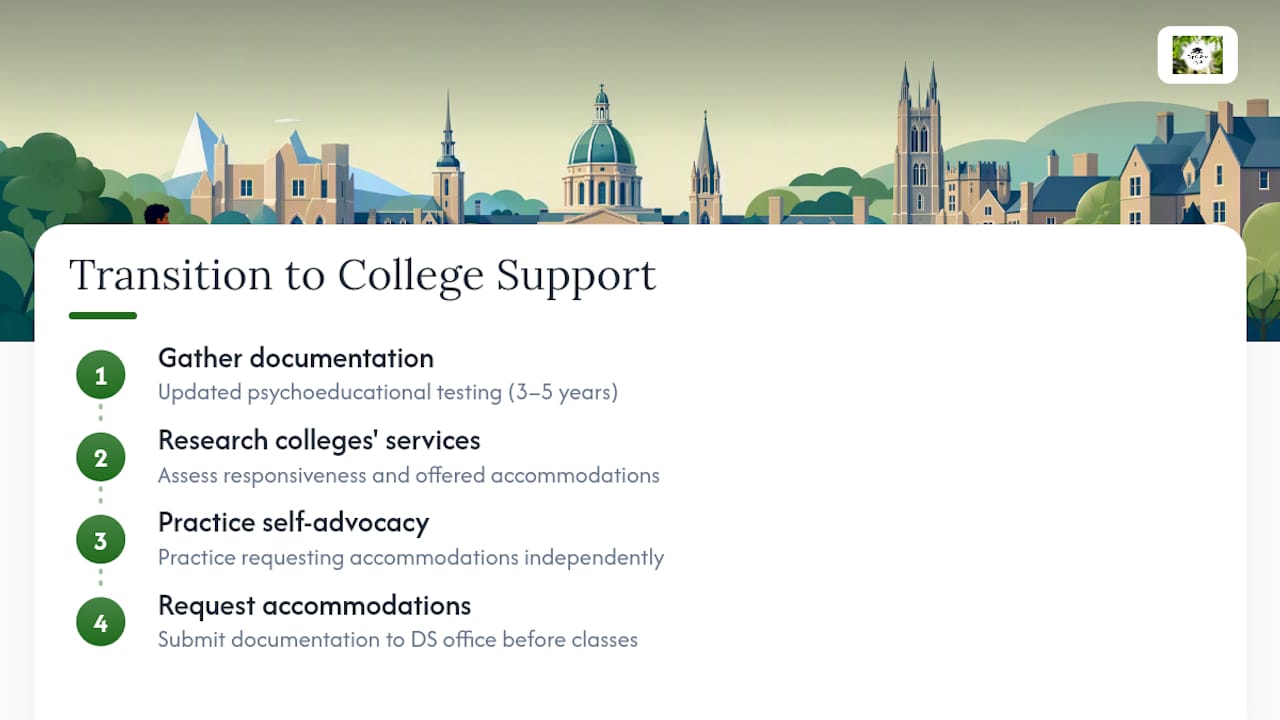
This is also where the admissions and transition timelines genuinely overlap. A student building their college list should factor in how responsive and thorough each school’s disability services office is, alongside the usual academic and social fit questions. A strong summer plan before senior year can include exactly this kind of research alongside essay drafting.
Assistive Technology That Supports Strong Applications
Assistive technology plays a role both in how a student manages daily academic work and in how efficiently they can produce strong application materials. Text-to-speech tools and screen readers help students with dyslexia or visual processing differences get through dense reading assignments faster. Speech-to-text software lets students who struggle with handwriting or typing speed get ideas down without losing momentum mid-thought, which matters enormously during essay drafting season.
Organizational and executive function tools, digital planners, task-breakdown apps, and calendar systems with built-in reminders, help students manage the sprawling timeline of a competitive application: recommendation requests, testing registration deadlines, essay drafts, and supplemental questions that vary by school. Graphic organizers and mind-mapping software can help a student outline an essay’s structure before writing a single sentence, which often produces a tighter final draft than writing straight through.
None of this technology replaces good writing instruction or admissions strategy. It removes friction so a capable student can actually produce work that reflects their real thinking, rather than losing an idea to a slow keyboard or a missed deadline. Parents evaluating a counseling program should ask whether the counselor is comfortable working alongside whatever assistive technology their student already relies on, rather than expecting the student to change their process entirely.
Getting Support Once You’re on Campus
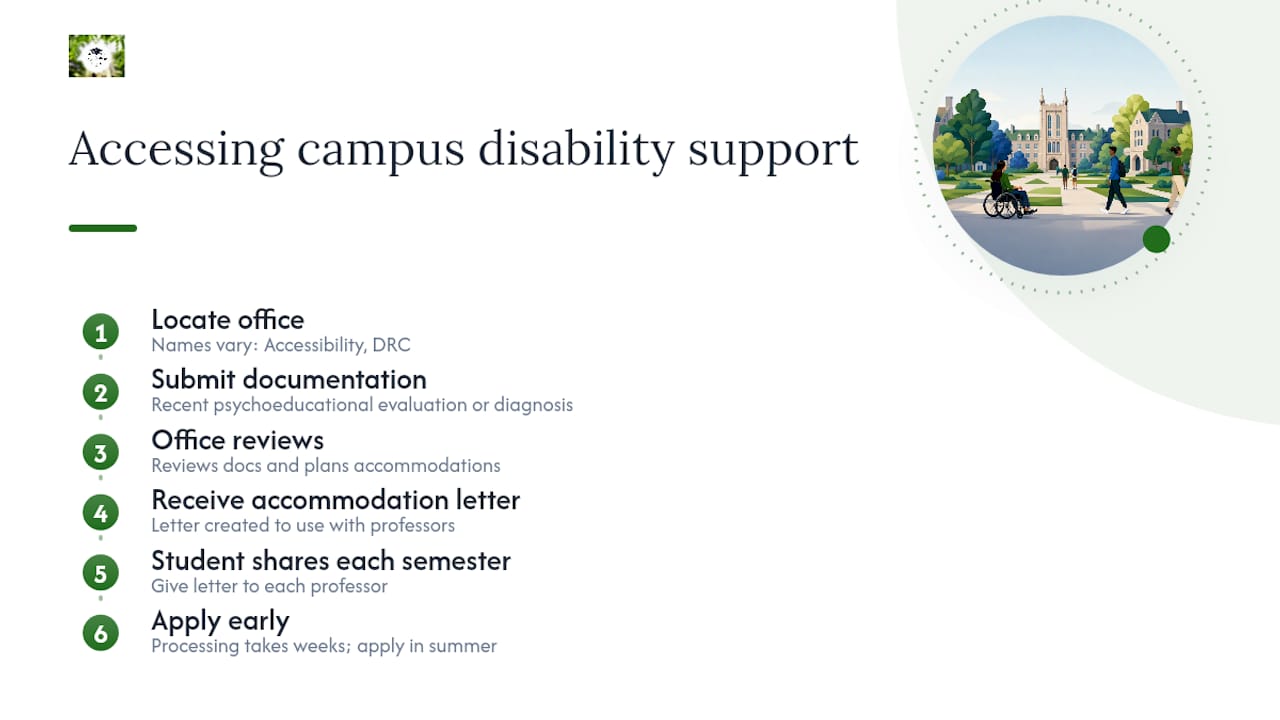
Every college with meaningful enrollment numbers has some version of a disability services office, though the name varies: Office of Accessibility Services, Disability Resource Center, or similar. The process to access it follows a consistent pattern across most schools. A student submits documentation, typically a recent psychoeducational evaluation or medical diagnosis, directly to that office, usually during the summer before freshman year or during new-student orientation.
From there, the office reviews the documentation and works with the student to build an accommodation letter, a document the student then shares with individual professors each semester. This is different from high school, where a case manager often handled that communication. In college, the student manages it themselves, which is exactly why self-advocacy practice during junior and senior year matters so much.
Applying early matters. Testing accommodations for the SAT and ACT, and later for placement exams or specific courses, often take weeks to process, and disability services offices get flooded with requests right before each semester starts. A student who requests accommodations the week before finals is far less likely to get them in time than one who applied in July.
Parents should also know that colleges cannot require students to disclose a disability during the application process, and choosing not to disclose during admissions has no bearing on a student’s right to request accommodations after they enroll. Those are two entirely separate systems, admissions review and disability services, governed by different rules and different timelines.
What Actually Moves the Needle for These Applicants
Most advice on this topic treats disclosure as a binary choice: reveal or don’t. That framing misses the real work, which is craft. The families who get the best outcomes aren’t the ones who found the perfect disclosure formula. They’re the ones who spent real time turning a genuine struggle into a specific, well-told story about capability.
The conventional wisdom oversells the risk of disclosure and undersells the risk of a flat, generic essay. Admissions officers at selective schools read thousands of essays describing hardship in vague terms. Very few describe the exact organizational system a student built, or the specific grade trend that followed a diagnosis. That specificity is what separates a memorable application from a forgettable one, and it’s also the hardest thing for a family to produce alone, because parents are too close to the story to see what’s missing.
If I had to tell a parent one thing to prioritize first, it wouldn’t be the essay. It would be the testing decision, because it happens earliest and it shapes everything downstream, including how much room the essay has to do other work.
— Randy Pryor
Get Personalized Guidance From Top College Coach
Some college admissions counseling services cater to high-achieving students with disabilities aiming at Ivy League or Top 20 schools, providing counseling by experienced lead counselors, mentoring input from current Ivy League students, and application review by former admissions officers before submission.
The checklist from earlier in this article, including track record, small caseload, familiarity with accommodations, and real sample work, is an important standard for admissions counselors to meet. Come to an initial consultation with your child’s transcript, any IEP or 504 documentation you’re comfortable sharing, a sample of their writing, and current test scores if available. From there, services like Junior Year Preparation and The College List map directly onto the timeline this article laid out, starting with testing strategy and building toward final essays and interview prep.
Full details on counseling packages are outlined on the Top College Coach FAQ page. Reach out to schedule a consultation and find out where your student’s application stands right now.
FAQ
Does disclosing a disability hurt college admission chances?
Disclosure itself doesn’t hurt an application. Admissions officers focus on whether a student can succeed in college, and framing a disability around specific compensatory strategies and growth tends to read as a strength, not a liability.
Should my child submit SAT or ACT scores, or go test-optional?
The answer depends on how the student scores on official practice tests taken under their actual accommodations. More than 1,800 colleges now accept test-optional applications, but each school’s specific policy and alternative requirements need to be checked directly.
What documentation do colleges need for accommodations?
High schools use an IEP or 504 plan under IDEA, but colleges require the student to submit fresh documentation, usually a psychoeducational evaluation completed within the last three to five years, directly to the disability services office. Requirements vary by school, so check each one’s specific documentation guidelines.
How much difference does personalized counseling actually make?
A counselor experienced with learning differences helps translate accommodations and challenges into a clear, specific growth narrative rather than a vague explanation, which is exactly the distinction admissions officers respond to. Some admissions counseling firms build their entire practice around delivering that kind of individualized strategy for Ivy League and Top 20 applicants.
How much does admissions counseling with Top College Coach cost?
Pricing depends on the specific service package, such as Junior Year Preparation or The Application & Beyond, so current rates are available directly through Top College Coach’s FAQ page.
Recommended
Comments