Best Liberal Arts Colleges in the U.S.: 2026 Guide
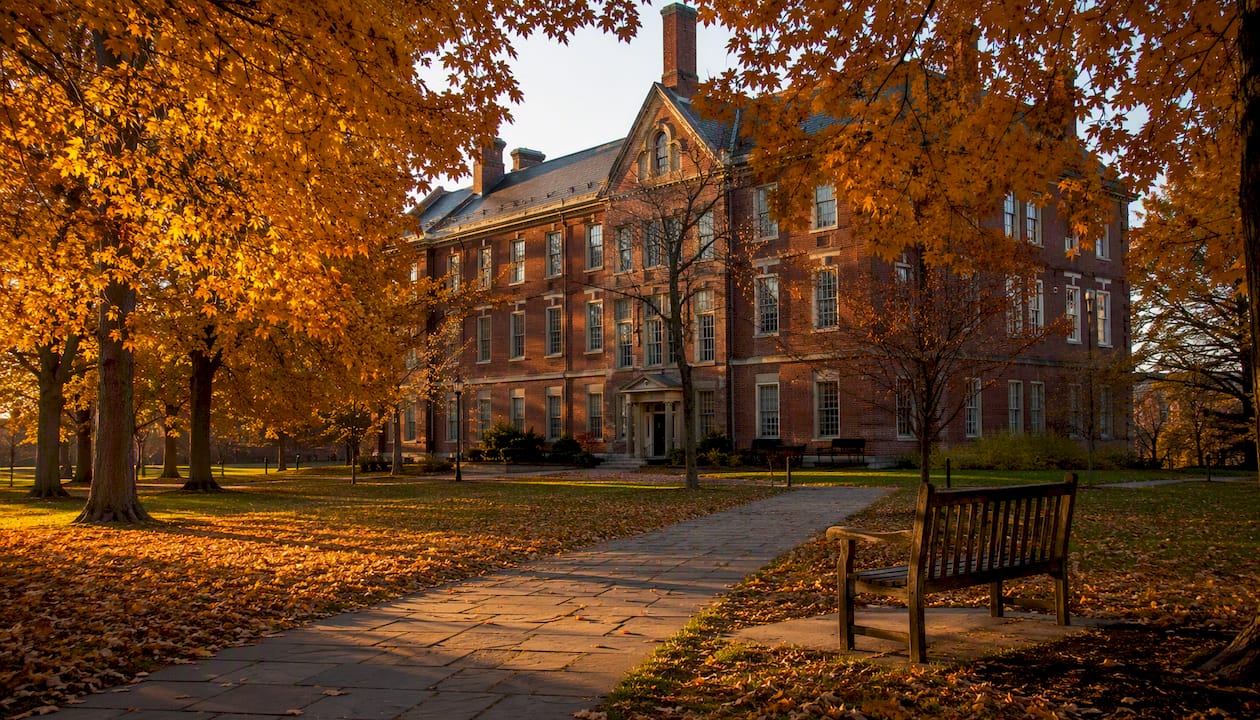
Liberal arts colleges are undergraduate-focused institutions that combine small class sizes, broad exposure across the humanities, social sciences, and natural sciences, and a faculty culture built around teaching rather than research output. If you want the short answer on where to start, the schools most consistently cited at the top are:
Williams College (Williamstown, MA)
Amherst College (Amherst, MA)
Swarthmore College (Swarthmore, PA)
Pomona College (Claremont, CA)
Wellesley College (Wellesley, MA)
Davidson College (Davidson, NC)
Claremont McKenna College (Claremont, CA)
Carleton College (Northfield, MN)
Middlebury College (Middlebury, VT)
Pick two or three from that list and compare them side by side on net price, location, and the majors you are most drawn to. That single step will move your research further than reading another ranking.
Table of Contents
What are the top liberal arts colleges in the U.S.?
The U.S. News 2026 Best National Liberal Arts Colleges rankings place Williams, Amherst, and Swarthmore at the top, a position they have held consistently for years. Washington Monthly’s 2025 ranking takes a different angle, weighing access, affordability, graduation rates, and social mobility alongside prestige. Together, the two frameworks give you a fuller picture than either alone.
The top 10 at a glance
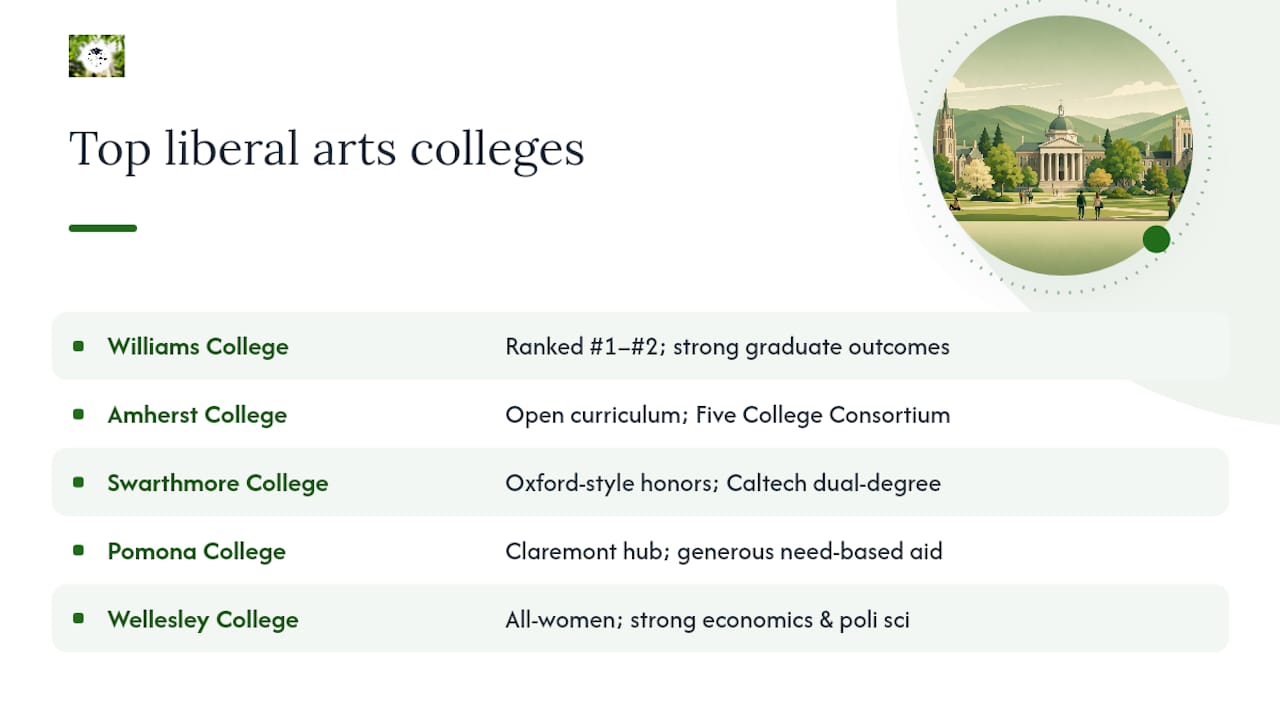
1. Williams College — Consistently ranked #1 or #2 nationally. Exceptional student-faculty ratio, a residential house system that builds tight community, and strong outcomes in graduate school and professional fields.
2. Amherst College — One of the few schools with a fully open curriculum: no required courses, maximum academic freedom. Part of the Five College Consortium, giving students access to four neighboring institutions.
3. Swarthmore College — Known for intellectual intensity and a strong honors program modeled on the Oxford tutorial. Dual-degree engineering program with Caltech is a standout option.
4. Pomona College — Anchor of the Claremont Colleges consortium in Southern California. Generous need-based aid and a reputation for science and pre-med preparation.
5. Wellesley College — All-women’s college with a long record of producing leaders in government, business, and academia. Strong economics and political science programs.
6. Davidson College — Davidson College is known for its rigorous academics, close relationships between students and professors, and strong sense of community. Ranked as the #10 College overall in the Wall Street Journal.
7. Claremont McKenna College — The most career-oriented school in the Claremont Colleges. Economics, government, and finance are signature strengths; the Kravis Leadership Institute is a notable resource.
8. Carleton College — Midwest gem with a reputation for quirky intellectual culture and rigorous academics. Strong STEM programs and one of the highest Ph.D.-attainment rates among liberal arts graduates.
9. Middlebury College — Vermont campus known for language programs and environmental studies. The Middlebury Institute of International Studies extends graduate-level opportunities.
10. Vassar College — Coeducational since 1969, with strong arts, humanities, and interdisciplinary programs. New York location provides access to internships and cultural resources.
Quick comparison grid
School | Best for | Selectivity | Size | Location type | Notable majors | Typical postgrad paths |
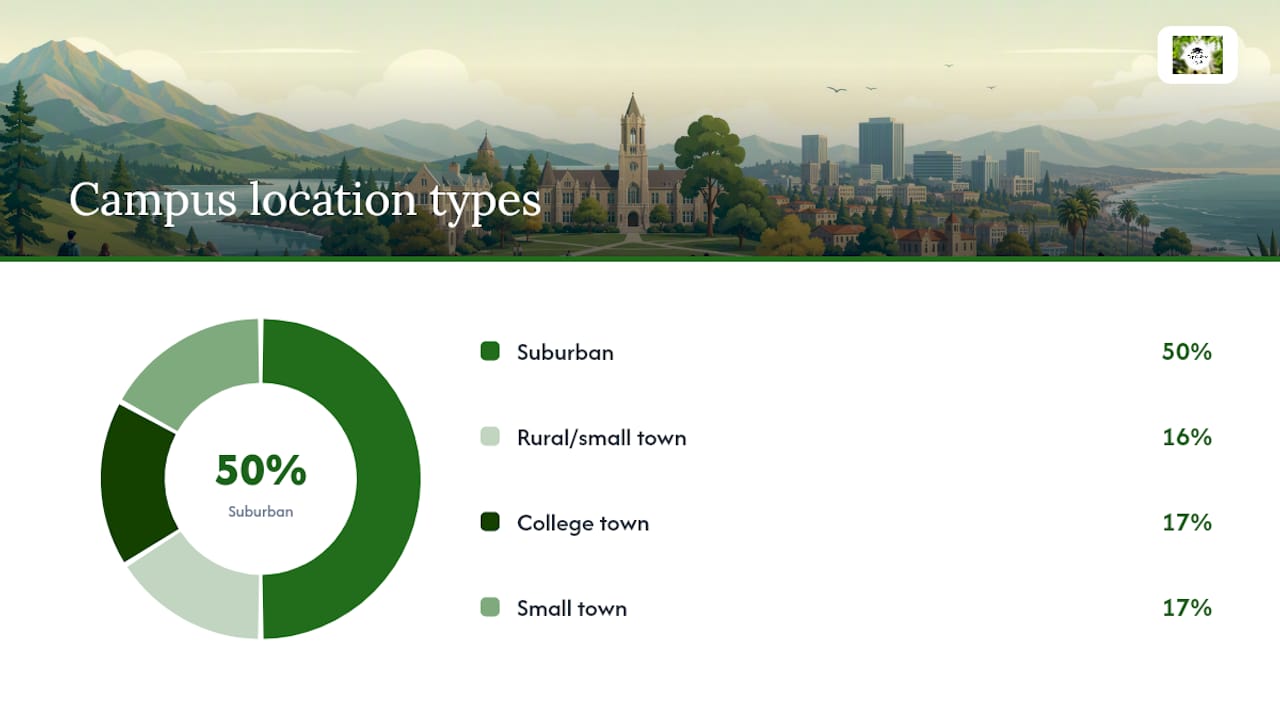
Williams | Broad academic excellence | Highly selective | Small undergraduate enrollment | Rural/small town | Economics, biology, history | Grad school, finance, law |
Amherst | Academic freedom | Highly selective | Small undergraduate enrollment | College town | Open curriculum | Grad school, law, public service |
Swarthmore | Intellectual rigor | Highly selective | Small undergraduate enrollment | Suburban | Engineering, political science | Grad school, research, policy |
Pomona | Science/pre-med | Highly selective | Small undergraduate enrollment | Suburban | Biology, economics, CS | Medicine, grad school, tech |
Wellesley | Women’s leadership | Highly selective | Small undergraduate enrollment | Suburban | Economics, political science | Law, government, business |
Davidson | Community + environment | Highly selective | Small undergraduate enrollment | Suburban | Economics, political science | Grad school, law, government |
Claremont McKenna | Career-focused | Highly selective | Small undergraduate enrollment | Suburban | Economics, government | Finance, consulting, law |
Carleton | STEM + Ph.D. prep | Highly selective | Small undergraduate enrollment | Small town | Math, physics, biology | Ph.D. programs, research |
Middlebury | Languages + environment | Selective | Small undergraduate enrollment | Rural | Environmental studies, languages | International careers, grad school |
Vassar | Arts + humanities | Selective | Small undergraduate enrollment | Suburban | English, psychology, drama | Arts, education, grad school |
What makes a liberal arts college different from other schools?
A liberal arts college prioritizes undergraduate education above all else. The model is built on breadth: students take courses across multiple disciplines before and alongside their major, developing analytical thinking, writing, and communication skills that transfer across careers.
There is no single formal definition recognized by a governing body. Researchers commonly operationalize the term by looking at institutions that award at least half of their degrees in liberal arts fields and concentrate resources on undergraduate instruction. That operational definition excludes most large research universities, even when they offer a liberal arts core curriculum.
What you will notice on a campus visit is the scale. Classes at Williams or Davidson often have 15–20 students, not 200. Professors teach those classes themselves. The residential culture at most of these schools means that intellectual life does not stop at the classroom door; it continues at dinner, in dorm common rooms, and at faculty-hosted events. Williams describes its model as one that minimizes pressure to arrive with a fixed professional plan, emphasizing curiosity and student-faculty engagement instead.
Amherst’s open curriculum takes that philosophy further than most. With no required courses at all, students design their own academic path from day one. That freedom is genuinely exciting, but it also demands self-direction and proactive advising in a way that a structured core curriculum does not.
How do you choose the right liberal arts college for you?
Fit is the single most important criterion, and fit has three components: academic match, financial feasibility, and community alignment. A school that scores perfectly on rankings but costs $30,000 more per year than your family can manage is not the right fit, no matter how prestigious it is.
Washington Monthly recommends evaluating colleges on access, affordability, outcomes, and service rather than prestige alone. That framework is worth keeping in mind as you build your list.
Academics
Look at the specific departments in your areas of interest, not just the school’s overall reputation. Ask admissions offices for the names of two or three faculty members whose work you could see yourself engaging with. A school where you can name a professor you want to study under is a school where you will thrive.
Cost and financial aid
Run the net-price calculator on every school’s website before you fall in love with it. Sticker price at selective private colleges can exceed $80,000 per year, but institutional aid at endowment-rich schools often brings that figure down dramatically for qualifying families. We cover this in detail in the cost section below.
Campus culture and community
Spend a night on campus if you can. Sit in on a class. Eat in the dining hall. The social culture at Middlebury, where residential colleges replace Greek life entirely, feels very different from Claremont McKenna, where career networking is woven into the social fabric. Neither is wrong; they serve different students.
Outcomes and support
Ask each school for its four-year graduation rate, its graduate school placement rate, and the career resources available to students. Strong alumni networks and dedicated career centers matter more than most families realize during the application process.
Red flags to investigate
Three warning signs worth scrutinizing: a four-year graduation rate below 80%, a career center that cannot name specific employers who recruit on campus, and a financial aid office that cannot clearly explain how your aid package would change in years two through four.
Pro Tip: When you visit, ask a current student, not an admissions tour guide, what they wish they had known before enrolling. The answers are almost always more honest and more useful.
What do liberal arts graduates study and where do they go?
The academic breadth of these schools is real. Students typically choose a major while taking courses across at least three or four disciplines, and many pursue double majors or design interdisciplinary concentrations.
Major area | Examples | Typical postgraduate paths |
Humanities | English, history, philosophy | Law school, publishing, education, policy |
Social sciences | Economics, political science, sociology | Finance, consulting, government, grad school |
Natural sciences | Biology, chemistry, neuroscience | Medical school, Ph.D. programs, research |
Mathematics & CS | Math, computer science, statistics | Tech industry, data science, finance, grad school |
Arts | Studio art, theater, music | Creative industries, arts administration, education |
Interdisciplinary | Environmental studies, cognitive science | NGOs, research, public health, graduate study |
Languages | Modern languages, linguistics | International business, diplomacy, translation |
Postgraduate paths vary by institution, student choices, and economic conditions. CDS and IPEDS data from individual schools provide the most accurate placement figures.
Internships and undergraduate research are two of the biggest outcome drivers at these schools. Because faculty know students by name, a recommendation from a Williams or Carleton professor carries real weight with graduate admissions committees and employers. Alumni networks at small liberal arts colleges tend to be unusually tight; graduates often describe a culture of mentoring younger alumni that does not exist at the same intensity in large university networks.
Expert admissions tips for liberal arts college applicants
What moves the needle most in selective liberal arts admissions is a combination of academic rigor, genuine demonstrated interest, and application clarity. Admissions readers at these schools are looking for students who will contribute to a small, intellectually engaged community, not just students who have checked every box.
Junior year priorities
Junior year is when your academic trajectory becomes legible to admissions readers. Take the most rigorous courses your school offers in your areas of strength. If AP or IB options exist, pursue them. Use the summer after junior year productively: a research program, a meaningful internship, or a sustained creative project all signal the kind of intellectual initiative these schools value. Our guide on summer preparation for college admissions walks through specific options worth considering.
Senior year priorities
Your essays are the most controllable part of your application. Write about something specific and true, not something you think admissions officers want to hear. The “Why This College” essay matters more at liberal arts colleges than at large universities, because fit is genuinely central to how these schools build their classes. Name specific courses, professors, programs, or campus traditions that connect to your academic interests. Understanding what top colleges look for in applications can sharpen how you frame every component.
Choose recommenders who know your thinking, not just your grades. A teacher who has read your papers and can describe how you argue is more valuable than a department chair who knows your GPA.
For families navigating testing policy changes, the reconsideration of SAT/ACT requirements at selective institutions is worth tracking, as policies continue to evolve at many schools.
Pro Tip: For selective liberal arts colleges, the “Why This College” essay is not a formality. Admissions readers can tell immediately whether you have spent 20 minutes on a school’s website or whether you genuinely understand what makes it different. Specificity is the difference.
Key Takeaways
The strongest liberal arts college applications combine academic rigor, specific school knowledge, and a clear-eyed view of net cost rather than sticker price.
Point | Details |
Definition matters | Liberal arts colleges prioritize undergraduate teaching, broad curricula, and small classes over research output. |
Top schools to research | Williams, Amherst, and Swarthmore lead major rankings; compare at least two or three before narrowing your list. |
Net price beats sticker price | Run each school’s net-price calculator; endowment-rich schools often cost less than their published tuition suggests. |
Fit drives outcomes | Match academics, community culture, and financial feasibility before prestige; Washington Monthly’s access and outcomes metrics offer a useful second lens. |
Top College Coach | Personalized counseling from Top College Coach helps students frame essays, select schools, and build applications that reflect genuine fit. |
Why liberal arts still delivers in 2026
The conventional critique of a liberal arts education is that it lacks vocational focus. That critique misreads what employers and graduate schools actually reward. The skills these colleges build most deliberately, critical analysis, clear writing, the ability to synthesize across disciplines, are precisely what organizations struggle to find in new hires. A Carleton graduate who majored in philosophy and minored in statistics is not less prepared for a data-driven career than a narrowly trained specialist; in many cases, they are more adaptable when the role changes, which it will.
What gets underweighted in the prestige conversation is the quality of mentoring. At a school where a professor knows your name, reads your drafts, and writes your graduate school recommendation from genuine knowledge of your work, the four-year experience compounds in ways that a large lecture-hall education simply cannot replicate. That is not a soft benefit. It shows up in Ph.D. attainment rates, in the density of alumni networks, and in the career trajectories of graduates who learned to think before they learned to execute.
The families we work with at Top College Coach who choose liberal arts colleges thoughtfully, matching academic interests to specific programs and running the real cost numbers, consistently report that the investment made sense. The ones who struggle are those who chose on prestige alone without visiting, without reading the CDS, and without asking hard questions about outcomes. The school matters less than the match.
Ready to build your liberal arts college list with expert guidance?
Researching selective liberal arts colleges on your own is entirely possible, and this guide gives you a strong foundation. But when the stakes are high and the application window is short, having a counselor who has helped students gain admission to Ivy League and Top 20 schools makes a measurable difference. Top College Coach offers personalized admissions counseling, essay coaching, interview preparation, and application strategy built around your student’s specific strengths and goals.
Our counselors include former admissions officers and current Ivy League mentors who understand exactly what small, selective colleges look for in an applicant. Whether your student is a sophomore building their academic profile or a senior finalizing essays, we can help them put their best application forward. Schedule a free admissions strategy session to talk through your list, your timeline, and your options with no obligation.
Useful sources for deeper research
Recommended
Comments