Ivy League Admission Guide for Students & Parents 2026
- Aug 4
- 20 min read

Your student can get into an Ivy League school. That sentence deserves to stand on its own, because too many families write off the possibility before they have even looked at the numbers clearly. I say this not only as a college admissions counselor, but as the parent of a current Ivy League student.
The Ivy League acceptance rate is very low, which means only a small fraction of applicants earn a spot. Those odds are real, and they are not random. The students who succeed are the ones who start early, apply strategically, and build applications that tell a coherent, compelling story.
Here are the three actions every student should take right now:
Check your academic baseline. Pull your GPA, review your course rigor (AP, IB, or dual enrollment), and compare it honestly against the middle 50% ranges for your target schools.
Build a testing plan. Most Ivies have returned to requiring standardized tests. Know which schools require scores, which are still test-optional, and map out your SAT or ACT prep timeline accordingly.
Pick a realistic application strategy. Decide early whether Early Decision or Early Action makes sense for your situation, because applying early is the single most measurable tactic for improving your odds.
The highest-impact levers, in order, are: early application strategy, demonstrated academic excellence, deep extracurricular commitment, and essays that reveal intellectual curiosity and genuine fit.
Table of Contents
What the Ivy League is and why it matters for your application
Acceptance rates, early application effects, and recent trends
How Ivy League admissions committees actually evaluate your application
How Ivy League financial aid works and what it actually costs your family
High-impact strategies to strengthen your Ivy League application
Which Ivy is the most accessible, and how to build your school list
What the Ivy League is and why it matters for your application
The Ivy League is a group of eight private universities in the northeastern United States: Harvard, Yale, Princeton, Columbia, Brown, Dartmouth, the University of Pennsylvania, and Cornell. The name originated from an athletic conference, but today it signals something much larger: world-class faculty, extraordinary resources, powerful alumni networks, and, for many families, the most generous need-based financial aid in American higher education.
Why does the label matter for your application strategy? A few reasons worth understanding:
Program depth — Each school has genuine academic strengths. Applying to “the Ivies” as a monolith is a strategic mistake. Fit to a specific program or college within a school matters both for your happiness and your odds.
Every Ivy League application runs through the Common Application or, for some schools, the Coalition Application or QuestBridge. Financial aid requires completing the FAFSA and, for most Ivies, the CSS Profile. Understanding these platforms early saves time and prevents last-minute errors.
One realistic expectation to set now: Cornell’s eight undergraduate colleges have meaningfully different acceptance rates. Columbia’s urban context attracts a specific kind of student. Princeton’s financial aid model is among the most generous in the country. The right Ivy for your student is the one where program, culture, and realistic probability align, not simply the one with the most recognizable name.

The eight Ivy League schools: quick profiles for applicants
Each school has a distinct identity. Knowing the differences helps you target the right fit and write essays that actually land.

School | Recent Acceptance Rate | ED/EA Policy | Known For |
Harvard | very low acceptance rate | Restrictive Early Action (non-binding) | Breadth of excellence; most recognized brand globally |
Yale | low acceptance rate | Restrictive Early Action (non-binding) | Liberal arts depth; strong arts and humanities |
Princeton | low acceptance rate | Single-Choice Early Action (non-binding) | Undergraduate focus; exceptional financial aid |
Columbia | low acceptance rate | Early Decision (binding) | NYC location; Core Curriculum; global affairs |
Brown | moderate acceptance rate | Early Decision (binding) | Open Curriculum; student autonomy |
Dartmouth | moderate acceptance rate | Early Decision (binding) | Close-knit community; strong alumni loyalty |
Penn | moderate acceptance rate | Early Decision (binding) | Wharton; interdisciplinary dual-degree programs |
Cornell | comparatively higher acceptance rate | Early Decision (binding) | Specialized colleges; engineering, hotel, agriculture |
A few notes that go beyond the table:
Harvard draws applicants from every corner of the world, and its holistic review is among the most opaque. The Common Application is the required platform, and the school expects SAT or ACT scores.
Yale accepts the Common App, Coalition Application, and QuestBridge, giving applicants flexibility in platform choice. Its Restrictive Early Action program produced a reported REA admit rate of about 10.82% versus roughly 4.59% overall for the cited class.
Princeton runs a Single-Choice Early Action program, which is non-binding but restricts you from applying early elsewhere. Its admissions pages provide detailed testing-policy guidance and preparation steps. Princeton’s no-loan financial aid policy is one of the most student-friendly in the country.
Columbia sits in Manhattan, which shapes everything from its student body to its curriculum. Its Core Curriculum is non-negotiable, and essays that ignore it tend to fall flat. Columbia maintains a test-optional policy among the Ivies.
Brown operates on an Open Curriculum, meaning no distribution requirements. Students who thrive here are self-directed learners. Brown’s binding Early Decision program has a notably higher admit rate compared to the overall rate, illustrating the early-application advantage.
Dartmouth is the smallest Ivy by undergraduate enrollment and has the most intense alumni culture. Its rural New Hampshire campus is a genuine differentiator, and students who don’t address fit in their essays often struggle.
Penn is home to Wharton, one of the most competitive undergraduate business programs in the country. Its dual-degree programs (like the Huntsman Program in International Studies and Business) attract applicants who want to combine disciplines.
Cornell is the most accessible Ivy by acceptance rate, but that number masks significant internal variation. The College of Engineering and the School of Hotel Administration have very different admit rates. Applying to the right college within Cornell, the one that matches your demonstrated coursework and interests, can materially shift your odds.
The average Ivy acceptance rate is low overall, but individual school rates vary, with some schools having more accessible acceptance rates than others. That spread represents real strategic opportunity.
Acceptance rates, early application effects, and recent trends
The numbers tell a clear story, and students who understand them apply smarter.
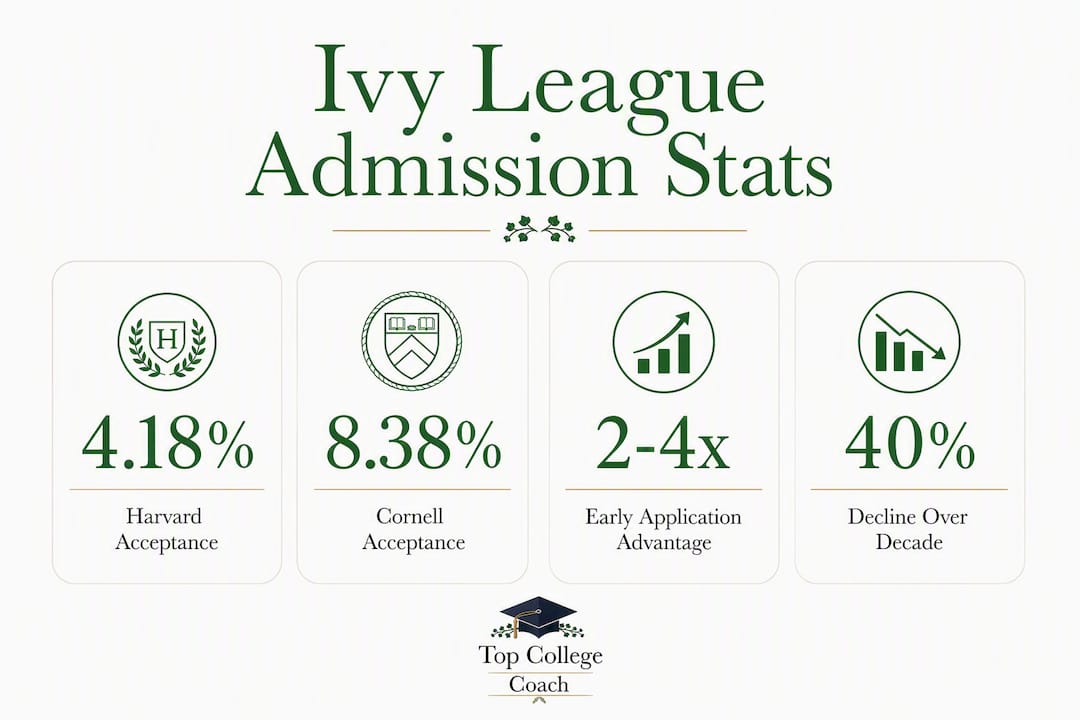
Recent acceptance rates by school
School | Overall Rate (Class of 2029) | ED/EA Rate | ED/EA Policy |
Harvard | 4.18% | ~14% (REA) | Restrictive Early Action |
Yale | 4.59% | 10.82% (REA) | Restrictive Early Action |
Princeton | ~4–5% | ~15% (SCEA) | Single-Choice Early Action |
Columbia | ~3.9–4% | ~10–11% (ED) | Early Decision (binding) |
Brown | 5.65% | 17.95% (ED) | Early Decision (binding) |
Dartmouth | ~6–7% | ~20% (ED) | Early Decision (binding) |
Penn | ~6–7% | ~15–17% (ED) | Early Decision (binding) |
Cornell | 8.38% | ~20% (ED) | Early Decision (binding) |
Note: ED/EA figures are approximate and vary by year. Always verify on each school’s official admissions page.
What the early-application advantage actually means
Early Decision and Early Action applicants are admitted at roughly 2–4 times the overall rate at many Ivies. Brown’s numbers above illustrate this vividly: 17.95% ED versus 5.65% overall. Yale’s Restrictive Early Action admit rate was 10.82% versus 4.59% overall for the cited class. That’s not a small edge; it reflects genuine institutional preference for students who have signaled commitment.
The reason is partly structural. Schools fill a significant portion of their class through early rounds, which means the regular decision pool is competing for fewer spots after early admits are counted. Applying early also signals demonstrated interest, which matters at schools that track it.
Pro Tip: Before committing to binding Early Decision, run a financial-aid sensitivity check. Use each school’s net price calculator to estimate your family’s expected contribution. If the aid package could be a dealbreaker, applying ED to a school with a generous no-loan policy (like Princeton or Harvard) is safer than binding yourself to a school where you haven’t modeled the numbers.
The decade-long trend
Ivy League acceptance rates have fallen by roughly 40% or more over the last decade. As an example, Cornell’s acceptance rate dropped from about 13% in 2015 to 8.38% for the Class of 2029. Application volumes have grown steadily, driven by the Common App’s ease of use, test-optional policies that encouraged more submissions, and growing international interest. The practical implication: a strategy that worked for an older sibling or a parent may be significantly less effective today.
For a deeper look at how these numbers have shifted year over year, the Ivy League acceptance rates analysis at Top College Coach breaks down the trends with context for current applicants.
How Ivy League admissions committees actually evaluate your application
Holistic review is real, and it’s worth understanding what that phrase actually means in practice. Committees don’t run a formula. They read applications looking for evidence of academic excellence, intellectual curiosity, personal character, and a contribution the student would make to the campus community. Every element of your application is a data point in that story.
The factors that carry the most weight:
Essays — The personal statement and supplements are where your voice and intellectual identity come through. Committees read thousands of essays from students with near-perfect grades. The ones that stand out show genuine curiosity, specific experiences, and honest self-reflection.
Legacy status and recruited athlete status do affect admissions odds, and it’s worth being honest about that. Legacy applicants receive a measurable advantage at several Ivies, though the weight of that factor has come under scrutiny and varies by school. Recruited athletes, particularly in non-revenue sports, can receive significant boosts. For the vast majority of applicants, neither factor applies, which means the application itself has to do all the work.
At Top College Coach, we work with students to identify and articulate their authentic story, the specific combination of academic achievement, personal experience, and intellectual curiosity that makes their application coherent and memorable.
Your complete application components checklist
Every Ivy League application requires the same core set of materials, though platform choices and supplemental requirements vary. Here’s what you need to prepare:
1. Application platform
Harvard requires the Common Application. Yale accepts the Common App, Coalition Application, and QuestBridge. Most other Ivies accept the Common App; check each school’s official page for platform options. Create your account early, at least by the summer before senior year.
2. Official transcripts and school report
Your high school sends these directly. Request them early and confirm your counselor has submitted the school profile. Committees use the school report to contextualize your GPA.
3. Counselor recommendation
Your school counselor submits a recommendation and the school report. Brief your counselor on your goals, activities, and any context they should know. A counselor who knows you writes a stronger letter.
4. Teacher recommendations
Most Ivies require two teacher recommendations. Choose teachers from junior year who taught you in a core academic subject and can speak to your intellectual engagement, not just your grade. Ask by the end of junior year, before summer.
5. Standardized testing
Princeton’s admissions pages provide testing-policy guidance and recommended preparation steps. Most Ivies now require or strongly encourage standardized test scores, with some exceptions. Submit your strongest scores, and if your scores are below the middle 50% for a school, weigh carefully whether submitting helps or hurts.
6. Personal statement
The Common App personal statement is 650 words. Use every word. Choose a prompt that lets you show something specific about who you are, not a summary of your resume. The best essays are specific, honest, and reveal how you think.
For detailed guidance on crafting essays that resonate with Ivy readers, the Ivy League personal statement tips at Top College Coach walk through structure, voice, and the most common mistakes to avoid.
7. Supplemental essays
Each school has its own supplements, typically ranging from one to five short essays. These are where you demonstrate fit. Research each school’s specific culture, programs, and opportunities, then write supplements that could only have been written about that school.
8. Additional materials
Some programs accept or require portfolios (arts, architecture). Submit these only if they’re genuinely strong. A weak portfolio can hurt more than no portfolio.
9. Interviews
Several Ivies offer alumni interviews. Treat them seriously. Prepare answers to common questions, research the school, and come with thoughtful questions of your own. Interviews rarely make an application, but they can occasionally break one.
10. Application fee or fee waiver
Most Ivies charge an application fee. Fee waivers are available for qualifying students through the Common App or by request. Never let a fee be the reason you don’t apply.
Pro Tip: Complete a final quality-control pass at least 10 days before each deadline. Open every uploaded PDF and confirm it renders correctly. Check that every recommender has submitted. Verify your test scores were sent directly from College Board or ACT. Deadline-day technical problems are avoidable with a buffer.
For a full step-by-step checklist specific to the 2026 cycle, the Ivy League application guide at Top College Coach covers every component with submission sequencing.
Your semester-by-semester application timeline
The students who submit the strongest applications aren’t the ones who worked hardest in October of senior year. They’re the ones who started planning in ninth or tenth grade and used junior year to execute.
Junior year: build your foundation
September–November (Junior Year): Confirm your course schedule includes the most rigorous options available. If AP or IB courses are accessible, take them in your strongest subjects. Identify two or three teachers who might write strong recommendations.
December–February (Junior Year): Take a diagnostic SAT or ACT to establish your baseline. Use results to decide which test to focus on and build a prep schedule. Begin researching schools, not just rankings, but specific programs, campus culture, and financial aid policies.
March–May (Junior Year): Ask your two teacher recommenders before the school year ends. Give them context: your goals, your strongest work in their class, and the schools you’re targeting. The earlier you ask, the better the letter.
May–June (Junior Year): Take the SAT or ACT for the first time (or a second time if you tested earlier). Review your extracurricular list and identify where you can deepen leadership or impact before applications open.
Summer before senior year: draft and research
August (Summer): — Build your school list. Aim for a balanced mix: two or three schools where your profile is competitive but admission is not guaranteed (reaches), two or three where your profile is solidly within range (matches), and two or three strong safety schools. Confirm your ED/EA choice and run the financial-aid numbers before committing.
Senior year: execute and submit
September (Senior Year): Finalize your personal statement. Complete your Common App activities section, focusing on specific outcomes and leadership rather than generic descriptions. Brief your counselor on your application strategy.
October (Senior Year): Submit ED/EA applications. Most ED deadlines fall on November 1 or November 15. Aim to have everything ready at least 10 days early. Confirm all recommenders have submitted.
November–December (Senior Year): Receive ED/EA decisions (typically mid-December). If admitted ED, withdraw other applications. If deferred or denied, pivot to regular decision with updated materials if permitted.
January (Senior Year): Submit regular decision applications. Most RD deadlines fall January 1–15. Do not reuse ED supplements without revising them for each school.
March–April (Senior Year): Receive regular decision notifications. Compare financial aid packages carefully before committing. The May 1 National Candidates Reply Date is the universal deadline for enrollment deposits.
Backup planning reminders:
Include at least two schools where you’re confident of admission and would genuinely attend.
If a first-semester senior transcript is required, confirm your school sends it automatically or request it manually.
If you’re waitlisted, send a letter of continued interest immediately (more on this below).
How Ivy League financial aid works and what it actually costs your family
The sticker price at an Ivy League school, typically $85,000–$90,000 per year in total cost of attendance, is not what most families pay. Every Ivy League school meets 100% of demonstrated financial need for admitted students, and several have policies that make them genuinely affordable for middle-income families.
The key aid concepts every family needs to understand:
Need-blind vs. need-aware — Harvard, Yale, Princeton, Columbia, Brown, Dartmouth, and Penn are need-blind for domestic applicants, meaning your financial situation does not affect your admission decision. Cornell is need-sensitive for some applicants. Need-blind does not mean free; it means aid is available regardless of your application.
School | Aid Policy Highlights |
Princeton | No-loan policy; grants replace loans entirely for all aid recipients |
Harvard | Families earning under ~$85,000/year typically pay nothing; sliding scale above that |
Yale | Meets 100% of need; strong grant packages |
Columbia | Meets 100% of need; test-optional policy removes one barrier |
Brown | Meets 100% of need; strong grant-to-loan ratio |
Dartmouth | Meets 100% of need; loan-free for families under certain income thresholds |
Penn | Meets 100% of need; strong grant packages |
Cornell | Meets 100% of need for domestic students |
Always verify current income thresholds and aid policies directly with each school’s financial aid office, as figures change annually.
Pro Tip: Use each school’s net price calculator before you finalize your ED choice. Net price calculators are available on every Ivy’s financial aid page and give a rough estimate of what your family would actually pay. If the estimated contribution is unworkable, applying binding ED to that school is a risk. Non-binding early programs (Princeton’s SCEA, Harvard’s REA, Yale’s REA) let you compare aid packages before committing.
For families who qualify for significant aid, an Ivy League education can cost less than many state universities after grants are applied. That’s a fact worth sharing with every family who assumes these schools are out of reach financially.
High-impact strategies to strengthen your Ivy League application
The gap between a strong application and an admitted one is usually not one dramatic achievement. It’s a pattern of intentional choices made over two or three years. Here’s where to focus your energy.
The highest-impact levers, in priority order:
Course rigor above all else. Take the hardest courses your school offers in your strongest subjects. Committees notice when a student avoids challenge.
Academic excellence within that rigor. Strong grades in hard courses signal both ability and work ethic.
Extracurricular depth, not breadth. One or two areas where you’ve built something, led something, or achieved something unusual carry far more weight than a list of fifteen clubs. Committees call this a “spike,” a distinctive area of contribution that makes you memorable.
Essays that show, not summarize. The personal statement should reveal how you think, not list what you’ve done. Use specific scenes, specific moments, specific questions that preoccupy you.
Demonstrated fit in supplements. Every supplement should answer an implicit question: why this school, and why this program? Generic answers that could apply to any Ivy are the most common essay mistake.
Building your extracurricular narrative
Depth means progression. A student who joined a robotics club freshman year, became team captain junior year, and led the team to a state competition has a story. A student who joined twelve clubs has a list. When describing activities, focus on outcomes and leadership, not just participation. For practical guidance on how to frame these experiences on your application, describing extracurriculars effectively is a skill that can be learned and practiced.
Testing strategy for current applicants
Know each school’s current policy before you decide whether to submit scores. Most Ivies have returned to requiring or strongly encouraging standardized tests, with Columbia remaining permanently test-optional. If your scores fall within or above the middle 50% for a school, submit them. If they fall below, research whether that school’s test-optional policy genuinely treats non-submitters neutrally, and make a strategic decision.
The essay framework that works
Show, don’t summarize. Pick one specific experience, idea, or question and explore it with honesty and depth. The best essays make the reader feel they know the student, not just their resume. Avoid the “I overcame adversity and learned a lesson” arc unless your experience is genuinely unusual. Committees read thousands of those essays.
Pro Tip: Run an internal admissions audit 30 days before your first deadline. Review your application as if you were a committee member seeing it for the first time: Does the activities list show depth or just volume? Do the essays reveal something the rest of the application doesn’t? Does every supplement answer the “why this school” question specifically? If any answer is no, you still have time to fix it.
A generalized example of what targeted strategy looks like in practice: a student with a 3.9 GPA, strong AP coursework, and a 1480 SAT who had been involved in many activities with no clear focus shifted strategy in junior year. She narrowed to two areas, environmental advocacy and science research, built a meaningful project in one, and wrote essays that connected both to her target programs. The result was a coherent, memorable application rather than a scattered one. That kind of intentional focus is what separates admitted students from equally qualified ones who don’t get in.
For more counselor-backed tactics on building a competitive application, the expert guide to getting into an Ivy League school at Top College Coach covers the full strategy.
Which Ivy is the most accessible, and how to build your school list
Cornell’s 8.38% acceptance rate makes it the most accessible Ivy League school by the numbers, while Harvard (4.18%) and Columbia (about 3.9–4%) sit at the most selective end. But that headline figure is only part of the story.
Within Cornell, the eight undergraduate colleges have meaningfully different admit rates. The College of Agriculture and Life Sciences and the School of Industrial and Labor Relations tend to be more accessible than the College of Engineering or the College of Arts and Sciences. Applying to the college that genuinely aligns with your academic background and stated interests, rather than the one with the highest admit rate, is both more ethical and more effective. Committees can tell when a student’s application doesn’t match their declared college.
A decision framework for building your Ivy list:
Academic fit. Does your coursework align with the program’s expectations? A student applying to Penn’s Wharton with no economics or business coursework faces an uphill case.
Program fit. Does the school offer the specific program, research opportunity, or academic culture you’re genuinely excited about? Vague interest reads as vague in essays.
Campus and geographic fit. Columbia’s urban intensity is not for everyone. Dartmouth’s rural community is not for everyone. Honest self-assessment here saves you from spending four years in the wrong environment.
Realistic probability. Apply to two or three Ivies where your profile is genuinely competitive, not just aspirational. Include non-Ivy highly selective schools (top-20 universities) as part of a balanced list.
Financial considerations. If cost is a factor, prioritize schools with the most generous aid policies and use net price calculators before finalizing your list.
How many schools should you apply to? A well-built list of 10–14 schools, including two or three Ivy or Ivy-peer reaches, three or four strong matches, and two or three genuine safeties, gives you real options without spreading your essay energy too thin. Quality of application matters more than quantity of submissions.
Common myths about Ivy League admissions, corrected
Myth: You need a perfect GPA to get in. False. Committees evaluate GPA in context. A 3.8 in the most rigorous courses available at your school is more compelling than a 4.0 in standard coursework. No GPA guarantees admission, and no GPA automatically disqualifies you.
Myth: A 1400 SAT is enough. A 1400 SAT falls below the middle 50% range at most Ivies, where the 25th–75th percentile typically runs from roughly 1500 to 1580. That doesn’t mean a 1400 is automatically disqualifying, especially at test-optional schools, but it means the rest of your application needs to be exceptionally strong. Submitting a below-range score at a school that requires testing puts pressure on every other element.
Myth: Legacy status guarantees admission. Legacy applicants receive a measurable advantage at several Ivies, but the admit rate for legacy applicants is still well below 50% at most schools. It’s a factor, not a guarantee, and its weight has been declining as schools face scrutiny over equity in admissions.
Myth: Getting into all eight Ivies is a realistic goal. It happens, rarely, and it makes headlines precisely because it’s extraordinary. Applying to all eight Ivies with a single undifferentiated application strategy is not a plan. Each school requires tailored supplements, and spreading effort across eight schools without customization typically produces eight weaker applications.
Myth: Extracurricular volume impresses committees. Depth impresses committees. A student who spent four years building something meaningful in one area is more memorable than a student who joined every available club. The middle 50% test ranges at Ivies are high, but scores function as thresholds, not guarantees. Above the threshold, other factors determine the outcome.
Quick corrections:
There is no single “easiest Ivy.” Cornell has the highest overall admit rate at 8.38%, but internal college variation means some Cornell programs are as selective as Harvard.
Demonstrated interest matters at some Ivies and not at others. Harvard and Yale state they do not track it; other schools do.
The application process is not random. Students who apply strategically, with strong academics, deep extracurriculars, and tailored essays, outperform their raw statistics.
How a professional admissions counselor can help you get in
A counselor adds the most value at three specific stages: building the initial strategy, developing essays, and preparing for interviews. Used well, professional guidance can be the difference between a scattered application and a coherent, compelling one.
At Top College Coach, the counseling process follows a structured workflow:
Initial admissions audit — We review your academic profile, test scores, activity list, and school list to identify strengths, gaps, and strategic opportunities. This includes recalibrating your reach/match/safety list by major and college within each school.
Top College Coach is based in Orlando, Florida, with a track record of helping students gain admission to Ivy League and Top 20 universities. Our counselors include former admissions officers and current Ivy League student mentors who bring firsthand knowledge of what committees actually look for.
Pro Tip: When evaluating any admissions counselor, ask three questions: What is your process from start to submission? Can you share anonymized examples of students with profiles similar to mine? What happens if I’m deferred or waitlisted? A counselor who can answer all three clearly is worth your time.
For more on how private counseling affects outcomes, the private college counselors and Ivy League admission resource at Top College Coach covers the evidence and the process in detail.
Handling waitlists and deferrals: your next steps
A deferral from Early Action or a waitlist notification in April is not a rejection. It’s an invitation to make a stronger case.
If you’re deferred from EA/REA/SCEA:
Send a letter of continued interest immediately. Keep it to one page. Confirm the school is still your top choice (if it is), and add any meaningful updates since you submitted: a new award, a completed project, a significant grade improvement.
Do not flood the admissions office with additional materials. One strong update letter is more effective than multiple follow-ups.
Submit your regular decision applications to all other schools on your list without delay.
If you’re waitlisted in the spring:
Send a letter of continued interest within a week of receiving the notification. Reiterate your commitment and provide any updates from senior year.
Commit to another school by May 1. Waitlist movement is unpredictable, and you cannot count on it.
Ask your counselor whether a phone call or additional recommendation letter is appropriate for that specific school. Policies vary.
Waitlist admission rates vary widely by school and year. Some years, schools admit hundreds from the waitlist; other years, very few. Plan as if you won’t be admitted, and be grateful if you are.
The most important thing to remember: a deferral or waitlist is not a verdict on your worth as a student or a person. It’s a reflection of institutional needs and class-building decisions that are often beyond any individual applicant’s control.
Key Takeaways
Ivy League admission is achievable for well-prepared students who apply strategically, demonstrate genuine depth, and build applications that tell a coherent, compelling story from academics to essays to fit.
Point | Details |
Early application is the strongest tactic | ED/EA applicants are admitted at roughly 2–4x the overall rate; Brown’s ED rate was 17.95% vs. 5.65% overall. |
Course rigor outweighs GPA alone | Committees evaluate grades in context; the hardest available courses signal both ability and commitment. |
Testing policy varies by school | Most Ivies now require or strongly encourage test scores; Columbia remains permanently test-optional. |
Financial aid makes Ivies affordable | Every Ivy meets 100% of demonstrated need; Princeton’s no-loan policy means grants replace loans entirely. |
Top College Coach provides structured support | From initial audit to essay coaching and interview prep, professional counseling helps students present their strongest application. |
What I’ve seen after years of working with Ivy League applicants
The most persistent mistake I see families make is treating Ivy League admission as a credentials race. They stack AP courses, pile on activities, and chase test scores, all without asking the more important question: what story does this application tell, and is it a story worth reading?
The students who get in are rarely the ones with the most impressive lists. They’re the ones who’ve done something with genuine commitment, written about it with honesty, and applied to schools where their specific profile fits. Fit is not a consolation prize. It’s the actual goal.
My caution to every family: don’t let prestige override fit. A student who thrives at a school that matches their academic interests and campus culture will outperform, in every meaningful sense, a student who attends a more famous school where they feel lost. The Ivy League includes eight extraordinary institutions with genuinely different cultures. The right one for your student is the one where they’ll do their best work and become who they’re meant to be.
That’s the frame we bring to every student at Top College Coach, and it’s the frame that produces the best outcomes.
Ready to build your Ivy League application strategy?
The difference between a strong application and an admitted one often comes down to strategy, timing, and the quality of your essays. At Top College Coach, we work with students and families who are serious about Ivy League and Top 20 admission and want a structured, expert-guided process from initial audit to final submission.
A first consultation with Top College Coach covers your current academic profile, a preliminary school list review, and a clear picture of where your application stands and what it needs. We bring former admissions officers, current Ivy League student mentors, and a proven track record of results to every engagement. Our clients in Orlando and across the country have earned spots at Harvard, Yale, Princeton, and every Ivy in between.
Book your consultation at Top College Coach and come prepared with your transcript, test scores, and activity list. We’ll take it from there.
Sources and how the numbers were compiled
The statistics and school-specific figures in this guide come from official institutional sources and publicly available admissions data. Acceptance rates are drawn from each school’s Common Data Set disclosures and official admissions pages. Early Decision and Early Action figures reflect published institutional reports for the Class of 2029 where available.
How to verify these numbers yourself: Every Ivy League school publishes a Common Data Set annually, accessible through each school’s institutional research or admissions office page. These documents contain the most authoritative acceptance-rate, test-score, and enrollment figures available.
Primary sources used in this guide:
ED/EA rate estimates for schools not directly sourced above are drawn from publicly reported institutional data and may vary by year. Always confirm current figures directly on each school’s official admissions page before making application decisions.
Recommended
Comments