45 Point IB Program: How U.S. Families Turn Scores Into College Credit

The International Baccalaureate is a four-programme continuum, spanning ages 3 through 19, built to develop critical thinkers who can move between disciplines and cultures with ease. Families choose it for one core reason: it prepares students for the intellectual demands of selective colleges while building research, writing, and time-management skills that outlast any single test score. The rest of this guide walks through each programme, the Diploma Programme in detail, what colleges actually do with IB results, and how to judge whether a specific school delivers on the promise.
TL;DR:
Schools must be officially authorized IB World Schools with consistent participation data, as not all schools claiming IB status meet international standards.
The IB Diploma requires six subject scores, with three to four at Higher Level, and the core components of TOK, EE, and CAS are mandatory for diploma completion.
The average IB diploma score is around 30 out of 45, with fewer than 1% reaching the maximum, and diploma requirements include passing specific categories and maintaining balanced grades.
The IB program benefits college applications by providing rich material like the Extended Essay and CAS activities, which can support major choices and personal narratives.
Parents should verify actual HL offerings, diploma award rates, and support systems to ensure the school delivers the intended IB rigor before enrollment.
Table of Contents
Understanding the IB Program: Four Stages From Preschool to College
Inside the Diploma Programme: Six Subjects, a Demanding Core, and a 45-Point Scale
MYP, PYP, and CP: What Younger Students and Career-Focused Learners Actually Experience
Let Top College Coach Turn Your IB Results Into a Standout Application
Understanding the IB Program: Four Stages From Preschool to College
Most people who ask about the “IB program” are really asking about one piece of a much larger system. The IB is actually four distinct programmes, each targeting a different age band, and a school can offer just one of them or all four.
Primary Years Programme (PYP): ages 3 to 12, built around inquiry-based learning in an elementary classroom setting.
Middle Years Programme (MYP): ages 11 to 16, organized into subject groups with interdisciplinary units and a capstone personal project.
Diploma Programme (DP): ages 16 to 19, the rigorous two-year high school curriculum most American families mean when they say “IB.”
Career-related Programme (CP): ages 16 to 19, blending career-focused study with select DP coursework for students headed toward technical or professional paths.
Together, these four programmes form a continuum designed to build skills progressively rather than in isolated bursts. A student who starts in PYP and moves through MYP arrives at the DP already comfortable with the kind of self-directed research and reflective thinking the diploma demands.
Not every school offers the full sequence, and that is normal. Plenty of strong schools introduce IB only at the high school level with a standalone DP, while others run PYP and MYP but send students elsewhere for grades 11 and 12.
One detail parents often miss: a school cannot simply decide to “do IB.” It has to become an IB World School, a formal authorization requiring specific training, curriculum alignment, and ongoing evaluation. If a school’s website mentions IB but doesn’t confirm World School status, that’s worth a direct question to the admissions office before you assume the programme meets IB standards.
Inside the Diploma Programme: Six Subjects, a Demanding Core, and a 45-Point Scale
The Diploma Programme is where the academic weight of “IB” really shows up, and it’s built around a structure that surprises a lot of newcomers: six subject groups, plus three additional requirements that exist entirely outside normal coursework.
Students pick one course from each of six groups, covering language and literature, language acquisition, individuals and societies, sciences, mathematics, and the arts (often swapped for a second science or humanities course). Within that lineup, students take three to four subjects at Higher Level (HL) and the remainder at Standard Level (SL), with HL courses demanding roughly 240 teaching hours compared to 150 for SL.
Then comes the part that trips up even strong students: the DP core.
Theory of Knowledge (TOK): a course examining how we know what we claim to know, assessed through an essay and an oral presentation.
Extended Essay (EE): an independent research paper of up to 4,000 words on a topic the student chooses within one of their subjects.
Creativity, Activity, Service (CAS): a program of experiential learning outside the classroom, spread across the two-year program.
None of these three are optional add-ons. A student can post excellent exam scores and still walk away without a diploma if the core isn’t completed to standard.
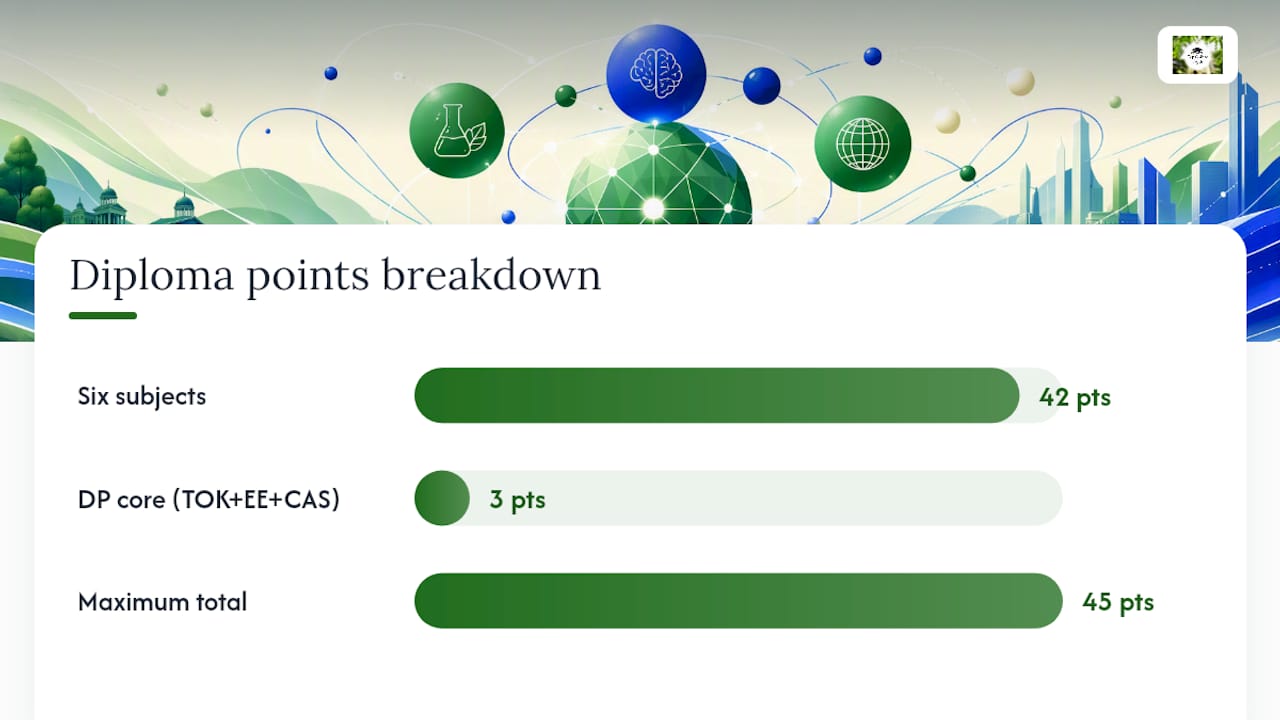
Assessment mixes internal and external components. Some coursework, like oral presentations and lab work, is graded by the student’s own teachers and moderated by IB. Final exams, sat at the end of grade 12, make up the bulk of most subject grades. Each subject is scored on a 1 to 7 scale, so six subjects can contribute up to 42 points, and the TOK/EE combination adds up to 3 more, for a maximum of 45.
By the numbers: Students need a minimum of 24 points to earn the diploma, the average candidate scores around 30, roughly 80% of full diploma candidates succeed, and fewer than 1% ever reach the full 45.
Passing isn’t just about hitting 24 points, either. IB applies categorical rules alongside the point threshold, including a cap on how many grade 2s a student can carry, so a lopsided transcript can sink a diploma even if the total looks fine on paper.
On workload: the EE and CAS hours run continuously across both DP years, not in a single semester crunch. Students who treat them as afterthoughts tend to collide with exam prep in the spring of senior year. Building a simple month-by-month tracker for CAS hours and EE drafts in year one saves real stress in year two.
MYP, PYP, and CP: What Younger Students and Career-Focused Learners Actually Experience
Each of the other three programmes has its own rhythm, and understanding it helps families see how a student ends up ready (or not) for the DP’s intensity.
The PYP runs on inquiry rather than lecture. Kids ages 3 to 12 work through units of inquiry that blend subjects around a central idea, so a unit on “how the world works” might touch science, math, and language arts at once. The goal is curiosity and self-management skills, not content coverage.
The MYP raises the structure level considerably. Students work across eight subject groups with mandated minimum teaching hours, complete interdisciplinary units that force connections between subjects, and finish with a required personal project in the final year, a self-directed piece of work students present to a panel.
The CP exists for students who want rigor without the full DP course load. It pairs at least two DP courses with career-related studies (think health science, business, or engineering pathways) and a Career-related Programme core focused on service learning, personal and professional skills, and a reflective project. It suits students aiming at technical colleges, applied degree programs, or workforce entry as much as traditional four-year universities.
PYP builds curiosity and independence early.
MYP adds structure, subject depth, and a first taste of independent research.
CP offers DP-level rigor in select subjects without the full core burden.
A student who thrives in MYP’s interdisciplinary units often transitions smoothly into the DP’s TOK course, since both ask the same underlying question: how do different fields of knowledge actually connect?
Does the IB Program Actually Help With College Admissions?
Yes, and the data backs it up more concretely than most families expect. Analysis in the DP guide for universities shows Diploma Programme graduates complete a bachelor’s degree within four years at notably higher rates than the national average, a pattern that shows up across multiple studies IB cites in its own research on postsecondary outcomes.
Colleges generally recognize the DP as a marker of sustained academic rigor, and many extend credit or advanced standing for strong HL scores, though policies vary widely by institution. A 6 or 7 on an HL exam might convert to a full semester of college credit at one university and nothing at another, so checking a target school’s IB recognition policy early in junior year avoids surprises later.
From an admissions standpoint, the DP’s real advantage isn’t the diploma itself. It’s the material it hands students for their applications. The Extended Essay topic often becomes the seed of a strong “why this major” narrative. TOK’s habit of questioning assumptions shows up in supplemental essays that actually sound like a specific person wrote them, not a template. CAS hours, if chosen with intention rather than convenience, can demonstrate sustained community involvement that colleges value far more than a scattershot activities list.
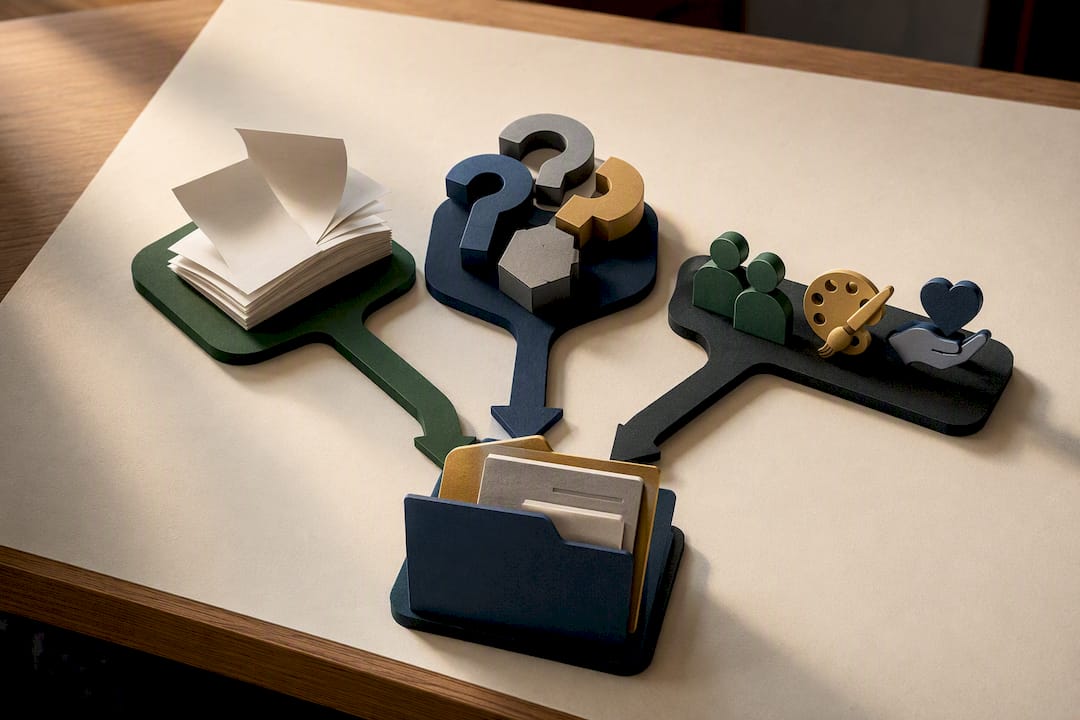
Pro Tip: Don’t wait until senior year to think about how your EE topic or CAS work will read in an application. Choosing an Extended Essay subject that connects to an intended college major, or CAS activities that build toward a real skill, turns two years of required work into two years of application material.
One caveat worth stating plainly: the IB carries weight, but it doesn’t replace the rest of the application. A 38-point diploma paired with a thin essay and no extracurricular depth will lose out to a 32-point diploma backed by a specific, well-told story. Predicted scores matter for early decisions, but final scores confirmed in July still get verified, so consistency between the two protects a student’s standing with the schools that admitted them.
Educators who work closely with CAS also point out that the personal growth side of the program, not just the transcript line, can reduce burnout when students balance service and creativity deliberately rather than treating CAS hours as one more box to check.
How to Evaluate an IB School Before You Commit
Not every school labeled “IB” runs the program the same way, so a short, direct checklist saves families from discovering gaps after enrollment.
Confirm authorized IB World School status directly with the school, not just through marketing materials.
Ask how long the DP coordinator has held the role and how many cohorts they’ve guided through diploma completion.
Check which HL subjects are actually offered, since some schools list six subject groups but only staff HL sections in two or three.
Ask how CAS hours and EE deadlines are tracked, and whether there’s a structured check-in system across both years.
Request recent diploma award rates and average scores for the school’s own cohorts, compared to the roughly 80% global average.
Ask how the school supports university credit conversations, since guidance counselors familiar with IB recognition policies save families real confusion senior year.
Red flags include vague answers about coordinator turnover, a school that “plans to add” HL sections next year, or an inability to share past diploma award rates. Strong programs share this data readily because they’re proud of it.
Pro Tip: Start these conversations in eighth or ninth grade, not eleventh. Course selection for the DP typically locks in during sophomore year, and switching into a stronger HL lineup later gets harder the closer a student gets to exams.
When the IB Program Fits, and When It Doesn’t
The DP rewards students who genuinely enjoy connecting ideas across subjects and can manage two years of sustained, self-directed work. It suits fewer students well when the fit is forced for prestige alone. A student with a narrow, deep interest might get more mileage from a handful of AP courses or dual enrollment in that specific subject, paired with real depth elsewhere, than from six subjects spread across the full DP core. Rigor matters, but only when a student can sustain it without losing the parts of high school that also matter.
— Randy Pryor
Let Top College Coach Turn Your IB Results Into a Standout Application
Understanding the IB program is the first step. Translating six subject grades, an Extended Essay, and two years of CAS hours into an application that actually gets noticed is a different skill entirely, and it’s one Top College Coach works on with families every day.
Where families often get stuck is deciding which HL subjects to lean into for a specific college goal, how to frame an Extended Essay topic so it supports a major or career narrative, and how to talk about predicted scores honestly in early applications without underselling a student’s trajectory. Top College Coach’s counselors, several of whom studied at Ivy League and Top 20 institutions themselves, work directly with IB students on exactly these decisions, from sophomore-year course planning through final essay review. If you want a clear strategy for turning your child’s DP or MYP work into a competitive application, start a conversation with Top College Coach about what that plan could look like for your family.
FAQ
What is the IB program for?
The IB program exists to build internationally minded critical thinkers through inquiry-based learning, culminating in the Diploma Programme’s rigorous, college-preparatory curriculum for students ages 16 to 19.
Is IB harder than AP?
The IB Diploma Programme generally demands more sustained, interconnected work than AP, since it requires a full slate of six subjects plus TOK, the Extended Essay, and CAS, rather than individual standalone courses students can pick one at a time.
Does Harvard prefer IB or AP?
Selective universities don’t publicly favor one over the other; both are recognized as markers of academic rigor, and admissions offices evaluate the strength and consistency of a student’s chosen courses rather than the label on the program.
Is IB harder than college?
The DP’s workload and research demands, especially the Extended Essay and CAS hours layered onto six subjects, closely mirror the independent study skills college expects, which is part of why DP graduates tend to complete degrees on time at higher rates than the national average.
Recommended
Comments