UC's 13 Factors and Grutter: Holistic Admissions Review in Practice
- 5 hours ago
- 11 min read

Holistic admissions review is an individualized, mission-aligned evaluation of your whole application, weighing academics, activities, essays, and context together rather than ranking students by a single cut score. No formula decides the outcome. Practices vary from campus to campus, but the goal stays the same: understand who you are, not just what you scored.
TL;DR:
Holistic review emphasizes understanding a student’s environment, choices, and potential contributions rather than relying solely on test scores and GPA.
Schools like the University of California consider up to 13 factors, including academic performance relative to opportunity and personal circumstances, with no fixed weighting.
Proper training and calibration of admissions officers are crucial for maintaining consistency and fairness in evaluating diverse applicants.
Test-optional policies generally allow students to choose whether to submit scores, which primarily provide additional context rather than serve as strict cutoffs.
Success in holistic admissions often depends on how well schools incorporate contextual data, train readers, and evaluate applicants’ sustained commitments.
Table of Contents
Understanding Holistic Reviews: Origins and Definition
The legal foundation for holistic review in American higher education traces to Grutter v. Bollinger, where the U.S. Supreme Court described “highly individualized review” as a legitimate way to consider how an applicant might contribute to a diverse educational environment. That 2003 ruling gave colleges a framework for weighing the whole person, not a checklist.
From that legal seed grew several overlapping models: whole-file review, whole-person review, and whole-context review. Each asks admissions officers to look past a transcript and test scores toward the environment a student came from and the choices they made inside it. The organizing principle behind all of them is mission alignment. A college’s admissions office is trying to build a class that fits its educational purpose, not simply reward the highest-scoring applicants.
Holistic review, done well, is mission-driven: institutions weigh likely academic success alongside potential contributions to campus life, according to College Board guidance.
That framing matters for families. A student who researches what a specific school values, and shapes their materials around that mission, has a real advantage over one who submits identical essays everywhere.
Factors in Holistic Admissions: What Reviewers Actually Weigh
Admissions officers sort what they see into three broad buckets, and understanding them helps you know where to put your energy.
Academic basics: GPA, course rigor relative to what your school offers, and the trajectory of your grades over time.
Nonacademic evidence: essays, extracurricular activities, leadership roles, and letters of recommendation.
Contextual factors: your school profile, family responsibilities, neighborhood, and access to resources like AP courses or counseling.
The University of California’s comprehensive review is the most widely cited model for how many factors can realistically be in play. UC considers up to 13 distinct factors, from academic performance measured against available opportunity to personal qualities and life circumstances, and it explicitly assigns no fixed weight to any single one.
Pro Tip: If your school doesn’t offer AP or IB courses, don’t leave that unaddressed. Reviewers evaluate rigor relative to what was available to you, and stating that plainly (in the Additional Information section or through a counselor letter) often does more for your file than a vague reference to “limited resources.”
How Institutions Implement Holistic Review
Files rarely get decided by one person reading in isolation. Here’s the typical workflow at selective colleges:
First reads. One or two admissions officers review the file independently and assign notes or ratings.
Rubric scoring. Many offices use internal rubrics with numeric ratings for academic strength, personal qualities, and extracurricular impact. Practitioner research on reader behavior confirms these scores function as discussion starters rather than rigid formulas that automatically produce a decision.
Committee deliberation. Borderline or competitive files move to committee, where readers debate and reconcile differing impressions.
Calibration and norming. Before and during reading season, offices run training sessions so readers interpret rubrics consistently.
Large public universities processing tens of thousands of applications often lean more heavily on rubrics simply to manage volume, while smaller liberal arts colleges can afford more discussion-heavy committee review. Either way, training quality determines whether “holistic” stays consistent from one reader to the next.
Do You Need to Submit Test Scores? Test-Optional Explained
Test-optional means you choose whether to submit SAT or ACT scores, and the college will not penalize you for withholding them. Test-blind means the school won’t consider scores even if you send them. The two are not interchangeable, and mixing them up can lead you to send scores a school won’t even look at.
Most schools that went test-optional after COVID-19 have kept the policy, though a handful of highly selective institutions reinstated testing requirements.
Scores that are submitted typically function as one more data point for academic context, not a gatekeeping cutoff.
Research from the Marsal admissions initiative documents this policy shift and notes considerable variation that continues from campus to campus.
Strong scores can still help you, particularly if your school profile makes grades hard to compare against national norms, or if you’re applying to a competitive major within a larger university.
If you’re unsure whether your scores help or hurt, a test feedback resource like PrepAdmit’s guide can clarify how admissions offices actually use submitted results.
Is Holistic Review Fair? Equity, Criticism, and What the Evidence Shows
Critics of holistic review raise a consistent set of concerns. Essays and recommendation letters can favor students whose families can afford private counselors or English-fluent parents who edit drafts. Reader-to-reader inconsistency is another real risk when training is thin. And because so much of the process happens behind closed doors, it’s genuinely hard for outside researchers to audit.
Policy and research reviews find that while many institutions claim to use holistic review, actual implementation varies widely, and measuring its effects remains difficult, according to an ERIC-published review of holistic admissions.
That same review notes a meaningful counterpoint: certain UC campus analyses found increases in underrepresented student enrollment after holistic review took hold, even though isolating cause from correlation across a system as large as UC is genuinely hard. The practical remedies researchers point to are unglamorous but effective: better contextual data about applicants’ schools and neighborhoods, routine calibration sessions among readers, and ongoing evaluation of outcomes rather than a “set it and forget it” policy.
Presenting Yourself Under Holistic Review: A Practical Checklist
You can’t control every factor a reader weighs, but you control how clearly your file explains itself. Work through these steps before you submit anything.
Explain your course choices. If you took the hardest schedule your school offered, say so directly, and note any grade dip tied to a specific challenge.
Write essays that reveal motivation, not résumé repeats. Readers already have your activity list. Use essays to show why you did what you did and how it changed you.
Brief your recommenders. Give teachers and counselors specific examples they can cite, since depth of evidence in a letter matters more than generic praise.
Use Additional Information for real constraints. Name specific circumstances, like lacking AP access or working a part-time job for family income, instead of vague complaints.
Show sustained commitment. One or two activities pursued for years often reads stronger than eight short-lived clubs.
Proofread for consistency. Make sure your essays, activity descriptions, and recommendation themes tell one coherent story rather than three unrelated ones.
Pro Tip: Before you hit submit, read your entire application as a stranger would, start to finish, in one sitting. If the “why” behind your choices isn’t obvious by the end, a reader skimming your file in fifteen minutes won’t find it either.
How Top College Coach Helps You Navigate Holistic Review
Top College Coach built its practice around exactly this challenge: helping families translate a student’s real story into a file that reads clearly under holistic review. The team includes former admissions officers who have sat on the other side of the committee table, alongside current Ivy League students who remember what worked in their own applications.
Services include application narrative strategy, essay coaching, recommender preparation, and full file review before submission.
A file reviewed by someone who has actually sat in committee deliberations catches problems a student or parent alone will miss, from a course choice that reads as unexplained to an essay that repeats the activities list instead of adding to it.
For students who want a deeper look at how selective colleges weigh these factors, Top College Coach’s guide on what top colleges look for breaks down priorities by institution type.
From Grutter to Today: How Holistic Review Evolved
Grutter v. Bollinger gave colleges legal cover for individualized review in 2003, but the practice itself kept evolving well past that ruling. Through the 2000s and 2010s, more selective schools formalized contextual review, building explicit protocols for weighing a student’s environment alongside their transcript. The Common Application’s growth made essay-based storytelling a near-universal part of the process, pushing personal narrative further into the evaluation than it had been decades earlier.
The 2010s also brought scrutiny. Lawsuits and public debate over race-conscious admissions kept holistic review under a legal microscope, and several institutions responded by publishing more detail about their evaluation criteria, partly to demonstrate consistency and partly to defend the process against claims of arbitrariness.
COVID-19 accelerated the next shift. Test-optional policies, adopted almost overnight in 2020, forced admissions offices to lean harder on the nonacademic and contextual pieces of a file since fewer applicants submitted comparable test data. That shift didn’t fade uniformly. Some schools made test-optional permanent; others reinstated requirements once testing centers reopened and data on optional cohorts accumulated.
The throughline across two decades of change is a steady expansion of what counts as relevant evidence, and a parallel push toward more structured, better-documented ways of reading it. Holistic review today looks less improvisational than it did in the early 2000s, even as its core premise, individualized judgment, remains the same.
Training Admissions Officers to Read Holistically
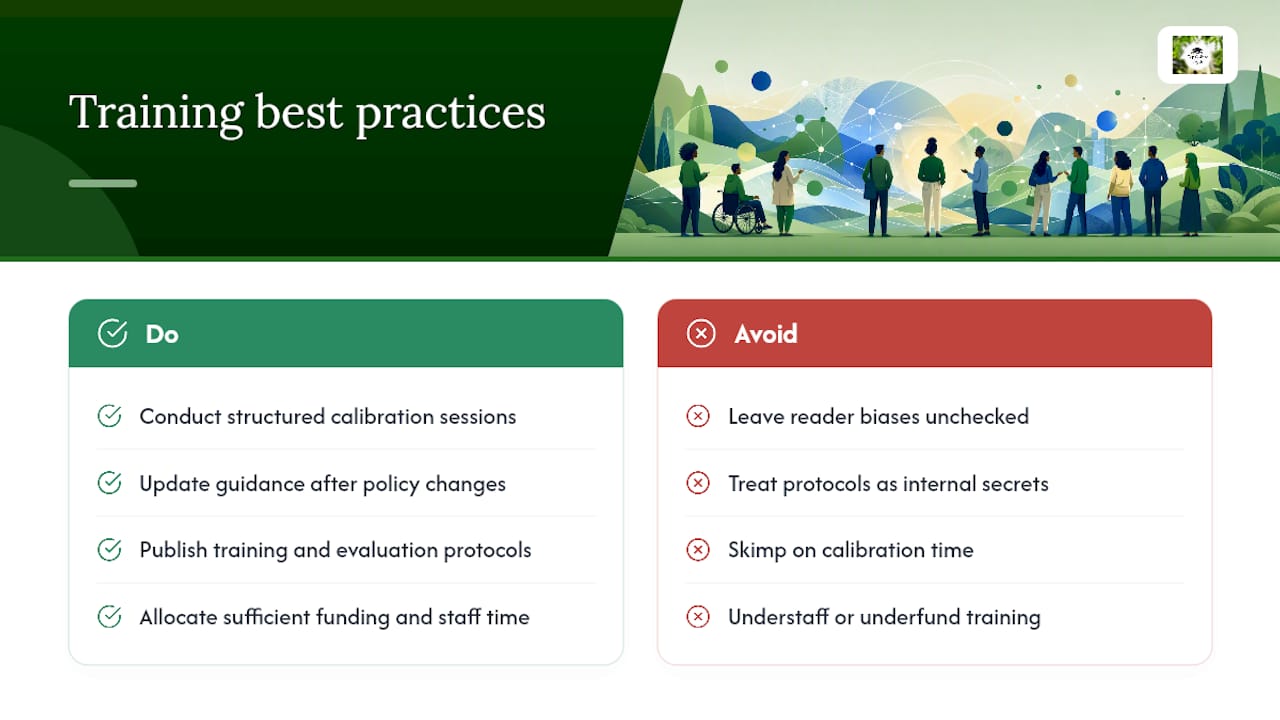
Consistency is the hardest part of holistic review to get right, and it starts with how admissions offices train their readers. A new admissions officer walks into the job with their own biases and assumptions about what “strong” looks like. Left unchecked, that produces wildly different outcomes for similar files depending on who reads them first.
The best offices counter this with structured calibration, sometimes called norming: readers score a batch of sample files independently, then compare notes and discuss discrepancies before the real reading season begins. Research on reader behavior shows this kind of routine calibration measurably reduces variability between readers, which is exactly the inconsistency critics of holistic review point to most often.
Training also has to keep pace with policy change. When a school adjusts its stated mission, adds a new scholarship program tied to specific values, or shifts test policy, readers need updated guidance on how those changes affect scoring. Offices that publish their training and evaluation protocols, rather than treating them as internal secrets, tend to show stronger fidelity to holistic principles over time, according to College Board’s guidance on the process.
The practical challenge for most institutions isn’t designing good training. It’s funding and staffing enough of it. Reading season is compressed, reader turnover is common, and thorough calibration takes time that admissions offices often don’t have to spare.
Does Holistic Review Actually Increase Diversity on Campus?
The honest answer is: it depends heavily on how a school implements it, and clean before-and-after data is hard to come by. Some UC campus analyses found increases in underrepresented student enrollment after adopting comprehensive review, a signal researchers point to as evidence the approach can work as intended when paired with contextual data and consistent training.
But that same research is careful not to overclaim. Isolating holistic review’s specific effect from other simultaneous changes, like outreach programs, financial aid shifts, or broader applicant pool changes, is genuinely difficult across a system as large as a state university network. The honest picture is a coherent but limited signal, not proof that holistic review alone drives diversity outcomes.
Campus climate is an even harder variable to measure, but admissions officers who work in holistic systems often describe a downstream effect: when a class is built through individualized review rather than a single metric, students arrive with a wider range of backgrounds, academic interests, and reasons for being there. That variety shapes classroom discussion and extracurricular life in ways a purely numbers-driven admit pool tends not to produce.
What’s clear is that holistic review without real investment in contextual data and reader training doesn’t automatically produce more diverse outcomes. The policy creates the possibility. Execution determines whether that possibility becomes reality.
Holistic Review vs. Formulaic Admissions: What’s the Difference?
A formulaic or metric-based admissions model ranks applicants by a fixed combination of GPA and test scores, sometimes with a minimum threshold that automatically screens out anyone below it. Some large public universities and many community colleges still use versions of this approach for at least part of their process, particularly for high-volume programs where reading every file individually isn’t practical.
The appeal of a formula is consistency. Two students with identical numbers get identical treatment, and the process is easy to explain and defend. The tradeoff is that formulas can’t account for context. A 3.7 GPA earned at an under-resourced school with no AP courses and a 3.7 GPA earned at a well-funded magnet school with a dozen AP options are not equivalent achievements, but a pure formula treats them as identical.
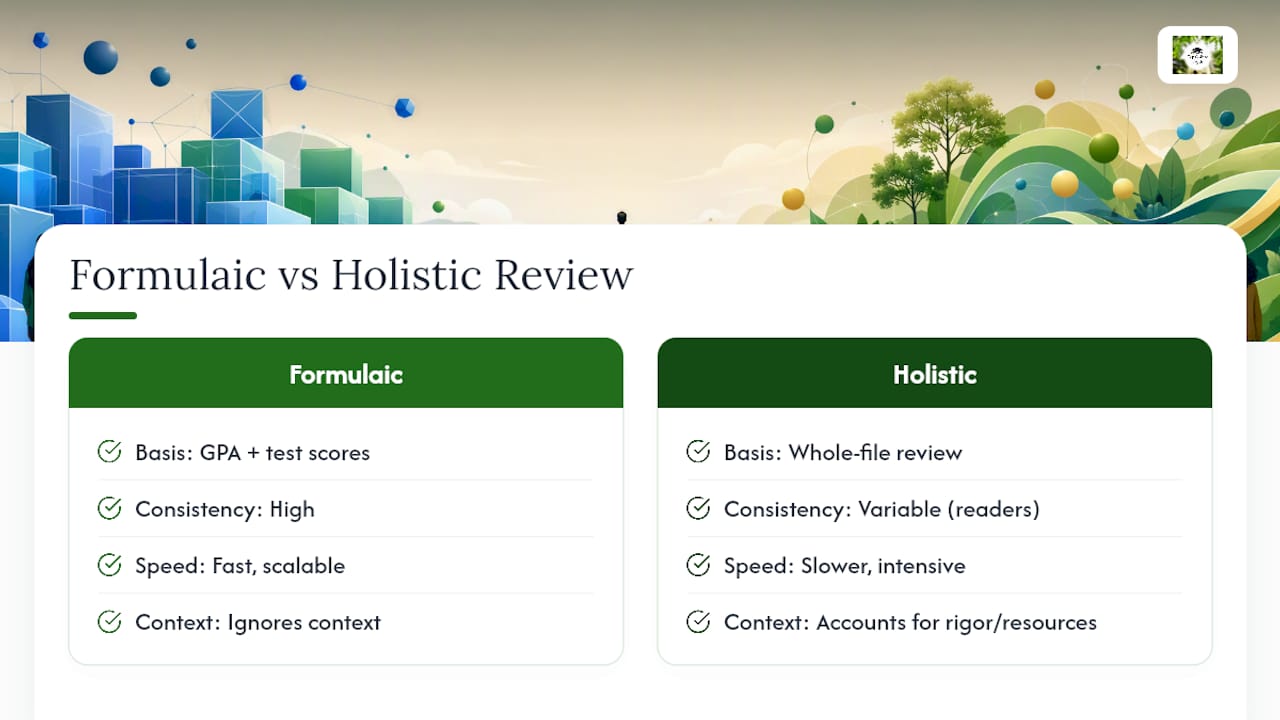
Holistic review exists precisely to capture that difference, at the cost of speed and easy comparability. It requires more staff time per applicant, more training investment, and it introduces the reader variability critics rightly point to as a weakness.
Most selective private universities and liberal arts colleges use holistic review for the bulk of their applicant pool specifically because they have the staffing to support individualized reads and a mission that prioritizes building a varied class over pure metric ranking. Large public systems often use a hybrid: an initial academic index screens the pool, then holistic factors decide among students who clear that bar. Neither method is universally “better.” They serve different institutional priorities, and knowing which model a target school uses should shape how you build your application.
What’s Next for Holistic Review
Expect more schools to build contextual dashboards that pair a student’s grades with their high school’s resource profile automatically, and expect test-optional policies to keep splitting rather than converging toward one national standard. If you’re applying in the next cycle, do three things now: confirm each target school’s current test policy directly on its admissions page, ask your counselor what context your school profile already sends automatically, and draft your Additional Information section before your essays, not after. Get specific about your context early, and the rest of your file gets easier to write.
Ready to build an application that reads clearly under holistic review? Book a free admissions strategy session with Top College Coach and get feedback from advisors who have read files from the other side of the table.
— Randy Pryor
Sources
FAQ
Do Ivy League Schools Use Holistic Review?
Yes. Every Ivy League school evaluates applicants through individualized, mission-aligned review that weighs academics, essays, activities, and context together rather than ranking by test scores or GPA alone.
Is Harvard’s Admissions Process Holistic?
Harvard uses a holistic process that considers academic performance, personal qualities, extracurricular impact, and context from a student’s school and community, consistent with the broader legal and policy framework established by Grutter v. Bollinger.
Are Holistic Admissions Fair?
Holistic review has real strengths and real weaknesses: it can account for context that pure metrics miss, but critics point to inconsistency between readers and advantages for students with more essay-coaching resources. Research shows implementation varies widely across institutions, and fairness depends heavily on how rigorously a school trains its readers.
What Is a Holistic Review in College Admissions?
A holistic review evaluates an applicant’s whole file, including academics, essays, activities, recommendations, and personal context, rather than relying on a single cut score or formula to decide admission.
How Many Factors Does the University of California Consider?
UC’s comprehensive review can weigh up to 13 distinct factors, from academic achievement measured against available opportunity to personal qualities, with no single factor assigned a fixed weight.
Recommended
Comments