Georgetown Admission: A Parent's Complete Guide

Georgetown admission is a holistic review where strong academics, demonstrated personal fit with the university’s Jesuit mission, and a distinctive alumni interview together determine your student’s chances. Submit the Georgetown Application as early as possible — doing so opens your student’s file and initiates alumni interview scheduling between September and February.
Start within 48 hours:
Request official transcripts from your student’s high school counselor.
Contact recommenders and confirm their availability.
Choose between the Georgetown Application (available immediately) or the Common Application (available August 1).
Confirm your student’s intended school so you can map school-specific course prerequisites now.
Table of Contents
What Georgetown’s admissions committee actually evaluates
Georgetown weighs academic achievement alongside personal qualities that reflect its Jesuit tradition: motivation, resiliency, and genuine community commitment. The committee is not simply looking for the highest GPA or test scores. They want to see a student who has thought seriously about why Georgetown fits their goals and values.
The alumni interview adds qualitative context that can tip close decisions. It is not a formality. A student who speaks clearly about their intellectual interests, community impact, and specific reasons for choosing Georgetown will stand out. Interviews are commonly scheduled September through February, and early submission of the Georgetown Application increases the chance of securing a local alumni interviewer before the window closes.
School-specific expectations also shape how the committee reads a file. McDonough School of Business applicants are expected to have completed calculus. The Walsh School of Foreign Service and the Faculty of Languages and Linguistics strongly recommend advanced modern language preparation. Applying to the wrong school for your student’s actual course history is a real risk.
Pro Tip: In short application elements like the activities list and supplemental essays, name a specific Georgetown program, professor, or Jesuit value that connects to something your student has already done. Generic “I want to make a difference” language reads as filler; specific, earned connections read as fit.
Every component a complete Georgetown application requires
A complete Georgetown application requires: the Georgetown Application or Common Application plus the Application Supplement, a secondary school report with official transcript, at least one teacher recommendation, an alumni interview (scheduled after submission), the application fee, and official SAT or ACT scores sent directly from the testing agency.
Required Item | Who Provides It | Typical Lead Time |
Georgetown Application or Common App | Student | Start several weeks before deadline |
Application Supplement | Student | Complete alongside main application |
Secondary school report + transcript | School counselor | Several weeks; request early |
Teacher recommendation | Teacher | Several weeks; ask by September |
Alumni interview | Scheduled by admissions office | Opens after submission; Sep–Feb window |
application fee | Student/parent | Due at submission |
Official SAT scores (College Board) | College Board | about one week processing |
Official ACT scores (all administrations) | ACT | about one week processing |
Georgetown requires official SAT or ACT scores sent directly from the testing agencies. For the ACT, all individual administrations must be reported — Georgetown does not use ACT superscoring. For the SAT, Georgetown will consider the highest Evidence-Based Reading and Writing and Math scores across multiple sittings.
A complete application will not be reviewed until every credential is received. The admissions office sends missing-credential notices, but proactive tracking is your responsibility.
Deadline checklist for parents:
November 1: Early Action deadline (decisions released December 15)
January 1: Regular Decision deadline (decisions released April 1)
February 1: CSS Profile and FAFSA typically due for financial aid
May 1: Enrollment reply deadline
Always confirm current-year deadlines directly on Georgetown’s official admissions site before relying on any third-party source.
How to build your student’s profile before they apply
The single highest-leverage preparation priorities are rigorous coursework aligned to your student’s intended school, sustained activities that show real leadership, and essays that tell a genuine story rather than a polished performance.
Academic roadmap by school: Families often underestimate how much school-specific course planning matters. A student targeting McDonough should complete calculus before applying. SFS and Languages applicants should reach an advanced level in at least one modern language. AP and IB exam results can yield course exemptions or credit at Georgetown, though awards vary individually by student and program. Families with AP or IB students should review Georgetown’s departmental credit policies when planning junior and senior year schedules.
Activities strategy: Depth beats breadth at Georgetown. One sustained leadership role in a community organization, a research project, or a service initiative tied to Georgetown’s values carries more weight than a long list of clubs. Extracurricular depth signals the kind of commitment Georgetown’s Jesuit mission prizes. Help your student identify two or three activities where they have genuinely grown, then build the narrative around those.

Essay strategy: Georgetown’s supplement prompts ask students to reflect on their intellectual passions and their reasons for choosing a specific school. The strongest essays are specific and honest. Encourage your student to draft early, share drafts with a trusted reviewer, and revise with the question “Does this sound like me?” rather than “Does this sound impressive?” A Common App essay that reveals character and genuine curiosity will serve the Georgetown supplement well too.
Pro Tip: The single most effective interview preparation is a 20-minute recorded mock interview followed by self-review. Students who watch themselves on video identify filler words, vague answers, and missed opportunities to connect their experiences to Georgetown’s mission far faster than any amount of coaching notes alone.
Common mistakes that hurt otherwise strong Georgetown applicants
The most damaging mistakes are late submissions that delay interview scheduling, incomplete testing records, misaligned course choices for the intended school, and essays that describe ambition without showing mission fit.
Submitting late: Waiting until the deadline to submit means the alumni interview window may be nearly closed. Submit the Georgetown Application as early as your student is ready.
Selective ACT reporting: Georgetown is not a score-choice school for the ACT. Sending all ACT administrations is required. Omitting a sitting risks an incomplete file.
Missing the secondary school report: Your student cannot submit this — the school counselor must. Confirm the counselor has the submission instructions and a firm internal deadline at least three weeks before the application deadline.
Course mismatch: Applying to McDonough without calculus, or to SFS without strong language preparation, signals a gap in academic readiness the committee will notice; families can find guidance on strengthening math preparation in this external background on college math readiness.
Generic essays: An essay that could apply to any university will not demonstrate Georgetown fit. Every supplement response should reference something specific to Georgetown’s programs, values, or community.
Financial aid deadline errors: Missing the CSS Profile or FAFSA deadline (typically February 1) does not affect admission, but it can affect your aid package significantly. Set a calendar reminder the moment your student submits their application.
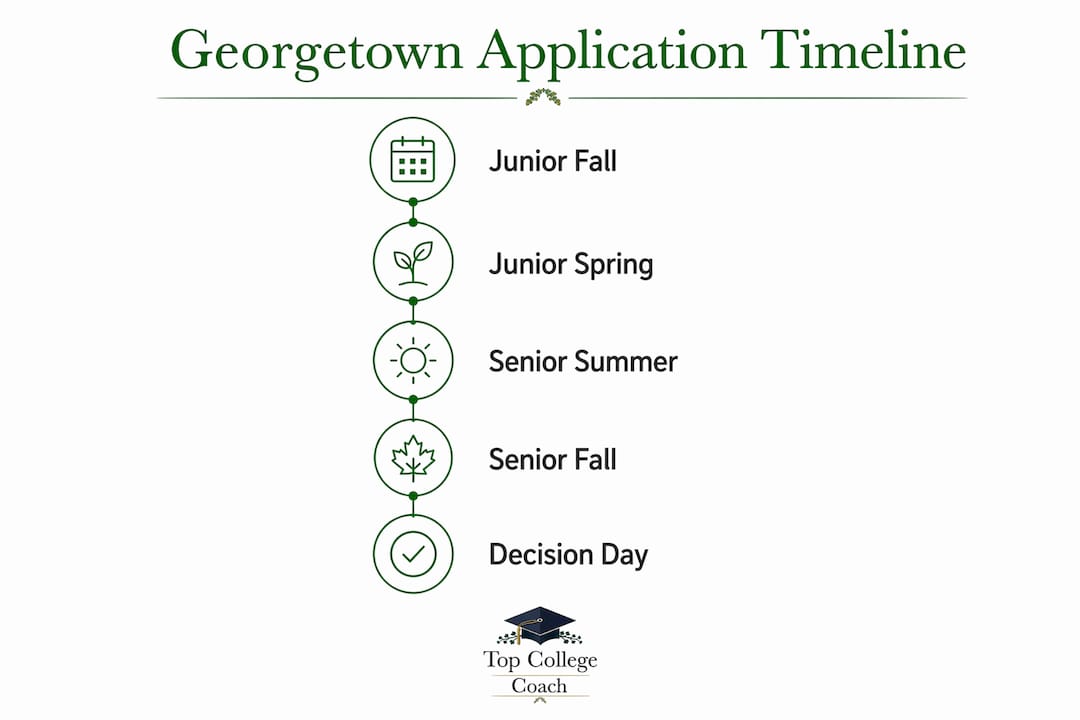
A practical timeline from junior year through decision day
Early Action is strategically useful beyond the earlier decision date: submitting by November 1 gives your student the best chance of securing an alumni interview before the September–February window fills. Regular Decision applicants can still receive interviews, but the pool is larger and the window shorter.
Phase | Key Actions | Target Timing |
Junior year (fall/spring) | Finalize intended school; plan calculus/language courses; begin test prep | September–May |
Junior summer | Draft activity list; outline essay themes; request summer recommendations | June–August |
Senior year (September) | Submit Georgetown Application; contact recommenders formally | As early as possible |
September–February | Alumni interview window; prepare and complete interview | Ongoing after submission |
October | Finalize essays; confirm transcript and counselor report submitted | 2 weeks before EA deadline |
November 1 | Early Action deadline | Hard deadline |
December 15 | Early Action decisions released | Review and plan next steps |
January 1 | Regular Decision deadline | Hard deadline |
February 1 | CSS Profile and FAFSA due | Financial aid priority |
April 1 | Regular Decision results | Review offers |
May 1 | Enrollment reply deadline | Commit |
Waitlist and deferral: If deferred from Early Action or waitlisted after Regular Decision, send one concise letter of continued interest within two weeks. Update the admissions office on any significant new achievement. Do not send multiple follow-ups — one well-crafted note is the right move.
When expert admissions counseling makes a real difference
The highest-impact counseling services for a Georgetown applicant are application strategy, essay coaching, interview preparation, and school-specific course planning. Families who hire a counselor in junior year get the most value because there is still time to shape the academic record, not just package it.
Signs your family should consider external counsel: your student’s target list includes multiple highly selective schools, you want essay drafts reviewed by someone with former admissions-officer experience, or your student needs structured mock-interview practice before the alumni interview window opens.
Top College Coach, led by Randy Pryor and based in Orlando, Florida, offers exactly this kind of support. Services include scoping sessions to map your student’s profile against Georgetown’s expectations, essay drafting and revision with reviewer checkpoints, mock alumni interviews, and transcript and course mapping to confirm school-specific prerequisites are met. Randy Pryor’s admissions interview guidance reflects the kind of practitioner experience that turns a nervous student into a confident, prepared candidate.
Key takeaways
Georgetown admission rewards students who combine academic rigor, school-specific preparation, and a clear, authentic connection to the university’s Jesuit mission.
Submit the Georgetown Application early to open your file and initiate alumni interview scheduling (September–February window).
Confirm transcripts, the secondary school report, and teacher recommendations are on track at least three weeks before your deadline.
Meet school-specific course expectations: calculus for McDonough, advanced modern language for SFS and Languages.
Prepare seriously for the alumni interview — it carries real weight in close decisions.
Consider expert counseling if your student’s target list is highly selective and you want former-admissions-officer review of essays and strategy.
Verify current-year deadlines and testing policies directly on Georgetown’s official admissions site before acting on any third-party dates.
Point | Details |
Submit early | Early Georgetown Application submission opens the alumni interview scheduling window (Sep–Feb). |
School-specific courses | Calculus for McDonough; advanced modern language for SFS and Languages applicants. |
Complete credentials | No application is reviewed until all items are received; proactive tracking prevents delays. |
Alumni interview | A qualitative input that can tip close decisions; preparation and scheduling timing both matter. |
Top College Coach | Offers essay coaching, mock interviews, and course mapping tailored to Georgetown’s expectations. |
What most Georgetown applicants get wrong
The gap we see most consistently at Top College Coach is not weak grades or low test scores. It is a profile that looks strong on paper but fails to answer the question Georgetown is actually asking: Why here, and why you?
Georgetown’s Jesuit mission is not a marketing phrase. The committee reads every essay and interview response looking for evidence that a student has genuinely wrestled with questions of purpose, community, and service. Students who treat the supplement as a checklist — naming a program, citing a statistic, moving on — miss the point entirely. The ones who get in have usually spent time on campus, spoken with current students, or engaged deeply enough with Georgetown’s curriculum that their specific interest is unmistakable.
The alumni interview compounds this. A student who cannot articulate why Georgetown over another highly selective school will struggle in that conversation, no matter how polished their delivery. Preparation means having a real answer, not a rehearsed one.
Randy Pryor’s practical advice: before your student writes a single word of the supplement, have them answer this question out loud — “What would I lose if I went somewhere else?” That answer, made specific and honest, is the essay.
How Top College Coach can help your family
Families preparing a Georgetown application often have the grades and the activities. What they need is a clear strategy, honest essay feedback, and structured interview practice from someone who understands what Georgetown’s committee is actually looking for.
Top College Coach provides exactly that. Our services map directly to Georgetown’s process:
Application strategy: School-specific course review, platform selection, and submission timeline planning.
Essay coaching: Prompt analysis, draft review, and revision cycles that bring out your student’s authentic voice.
Mock alumni interviews: Structured practice sessions with feedback on content, delivery, and Georgetown-specific fit messaging.
Checklist management: Transcript, recommendation, and credential tracking so nothing falls through the cracks.
We work with families from the Orlando area and across the country. To get started, schedule a consultation with Top College Coach and bring your student’s current transcript, intended school, and a list of activities. We will tell you exactly where the profile stands and what to do next.
Official sources and further reading
Georgetown University Admissions is the definitive source for current deadlines, application forms, and school-specific requirements. Confirm all dates directly on their official pages before acting.
Georgetown Admissions and Financial Aid — overview of undergraduate and graduate admission, financial aid commitment
First Year Application — platform options, required credentials, and supplement information
First Year Applicant — testing policies, score submission requirements, and missing-credential process
Preparation Process — school-specific course expectations and AP/IB credit policies
Georgetown University Undergraduate Bulletin — detailed school-specific admission standards and academic requirements
Top College Coach — counseling resources, guides, and consultation scheduling for Georgetown and other highly selective universities
Always verify current-year Early Action, Regular Decision, and financial-aid deadlines directly on Georgetown’s official site. Dates can shift year to year, and no third-party source, including this guide, substitutes for the primary source.
Recommended
Comments