How U.S. Universities Evaluate International Student Applications
- 10 hours ago
- 9 min read

U.S. admissions teams evaluate international student applications by weighing academic rigor within your local context, verified English-language records, and a personal statement that supplies the human detail transcripts cannot. Start today: order official transcripts, confirm whether your target school requires a NACES-member credential evaluation, obtain certified English translations if any documents are in another language, and begin drafting your personal statement.
Your immediate checklist:
Request official transcripts from every secondary school you attended
Check each university’s international-applicant page for credential-evaluation requirements
Arrange certified English translations for any non-English documents
Confirm English proficiency test scores are valid and on file (TOEFL, IELTS, or Duolingo English Test)
Begin a personal statement draft that contextualizes your curriculum and achievements
Pro Tip: Before paying for a third-party credential evaluation, read the target school’s published international-applicant policy. Penn, for example, explicitly states it does not require third-party evaluations and will not ask you to recalculate your GPA. Paying for a report the school ignores wastes both money and time.
Top College Coach works with international students and families at every stage of this process, from document strategy to essay coaching.
Table of Contents
How do U.S. admissions teams evaluate international applications?
Admissions officers review international applications holistically, meaning no single grade or score determines your outcome. They assess academic rigor within your local context, English proficiency, evidence of sustained extracurricular impact, and how well your personal statement fills in what a transcript cannot say.
Holistic review means every component is weighed together rather than scored on a single scale. For international applicants, this matters because a 90% in a rigorous national exam system may carry more weight than a 4.0 GPA in a less demanding curriculum. Admissions officers are trained to interpret local transcript formats without requiring families to convert grades.
Princeton’s published guidance captures this directly:
“We review each applicant within their own context — the opportunities available at their school, in their community, and in their country. We have no preference for a particular curriculum.” — Princeton Admissions, International Students
What this means practically: submitting a school profile alongside your transcript helps officers understand what courses were available to you and whether you chose the most demanding options. External exam results (IB, A-Levels, national board exams) are expected where they are standard in your country. Teacher recommendations and essays round out the picture by showing intellectual curiosity and character that grades alone cannot capture.
What documents do you need to submit as an international applicant?

Always send official transcripts and any required external exam results. Order a credential evaluation only when the university explicitly requires a third-party report. Schools like UNLV and the University of Pittsburgh at Bradford require evaluations from approved agencies; Penn and Columbia perform their own in-house review and ask you not to submit recalculations.
Document checklist by priority:
Official secondary school transcripts (grades 9–12, or equivalent)
School profile (explains grading scale and course offerings)
Certified English translations of any non-English documents
External exam results (IB, A-Levels, national board exams) where applicable
English proficiency scores (TOEFL, IELTS, or Duolingo English Test)
Letters of recommendation
Midyear and final grade reports when required
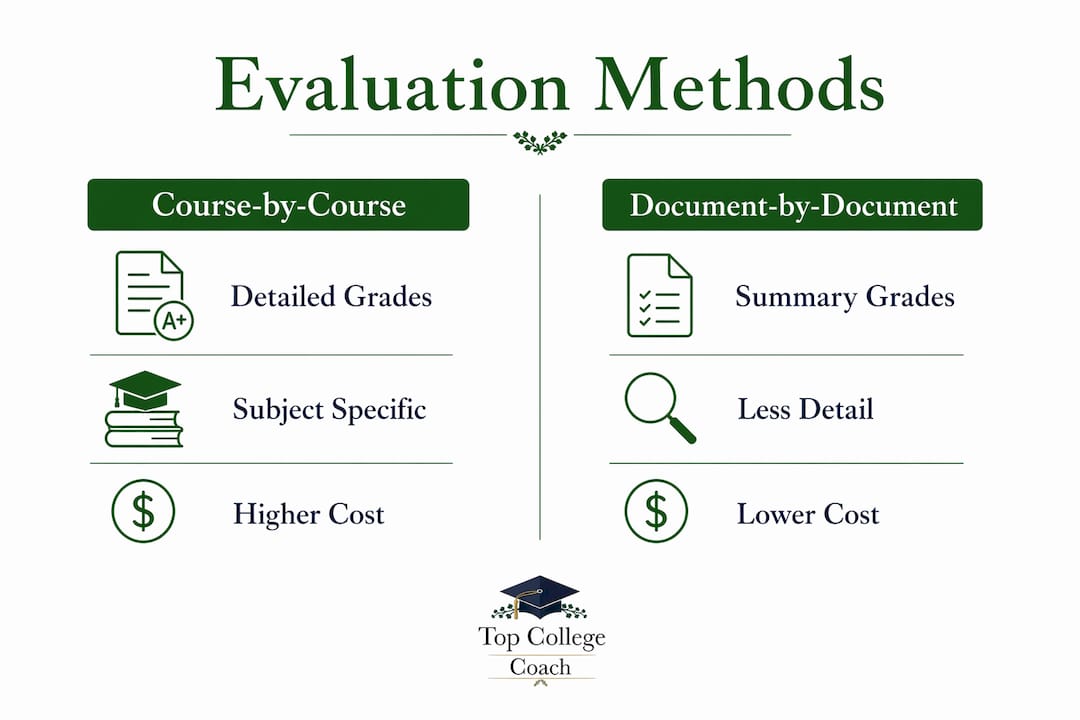
Course-by-course vs. document-by-document evaluations
A course-by-course evaluation converts each subject and grade into a U.S. equivalent and is the more detailed (and more expensive) option. Schools that require it, such as Pitt-Bradford, use it to assess transfer credit and academic preparation. A document-by-document evaluation confirms that your credential is genuine and equivalent to a U.S. diploma without breaking down individual courses. Many undergraduate programs accept the simpler version for admission purposes.
World Education Services (WES) and Educational Credential Evaluators (ECE) are two widely recognized NACES-member agencies. Submitting a report from a non-NACES agency to a school that requires NACES membership typically results in the school ignoring the report entirely and conducting its own review anyway.
How to confirm a school’s policy before paying:
Go to the university’s official international-applicant admissions page
Search the page for “credential evaluation” or “transcript evaluation”
Note whether the school names specific approved agencies
Email the admissions office if the policy is unclear
Document | Required vs. Optional | Who Evaluates | Evaluation Type | Typical Timeline | Applicant Cost | Admissions Weight |
Official transcripts | Required | University (in-house) | Contextual review | Immediate on receipt | None beyond postage | Very high |
Certified translation | Required if non-English | School official or approved translator | Word-for-word | 1–3 weeks | Low to moderate | High (enables review) |
Credential evaluation | Required at some schools | NACES agency (WES, ECE) | Course-by-course or document-by-document | 3–6 weeks standard | Moderate | High where required |
English proficiency score | Required for most | Testing agency (ETS, British Council) | Standardized | Score valid 2 years | Paid at testing | High |
School profile | Strongly recommended | School counselor | Contextual | Days | None | Moderate to high |
Letters of recommendation | Required | Teachers/counselors | Qualitative | 2–4 weeks to request | None | Moderate |
How should your personal statement explain your international background?
The personal statement is your strongest tool for giving admissions officers the context they cannot read from a transcript. Use it to explain unusual grading systems, limited course availability, or achievements that only make sense within your national education structure.
Effective essays for international applicants do three things: they state a structural fact briefly, show its impact on your learning, and pivot to what you did with the opportunity you had. Avoid apologetic framing. “My school did not offer AP courses” is a fact; pair it with what you pursued instead.
Writing prompts that surface contextual detail:
What is one aspect of your country’s education system that shaped how you think, and how did you push beyond it?
Describe a moment when you had to explain your academic background to someone unfamiliar with it. What did you want them to understand?
Which course or exam in your national curriculum challenged you most, and what did that challenge reveal about you?
How has studying in [your country] prepared you for a U.S. university environment in a way that might surprise an admissions officer?
What opportunity was unavailable at your school that you created or sought out on your own?
Editing checklist:
Every sentence earns its place (cut anything that does not add new information)
Specific over general: name the exam, the subject, the teacher
Show, don’t tell: replace “I am hardworking” with a scene that proves it
No apologetic language (“unfortunately,” “despite the limitations of”)
Final read aloud: if a sentence sounds stiff, rewrite it
Pro Tip: Frame structural facts as context, not excuses. “My school ranks students on a 20-point scale rather than GPA, and I placed in the top 3% nationally” gives officers exactly what they need without a word of apology. Our personal statement guide walks through this framing in detail.
For deeper essay strategy, the Common Application Essay Guide covers prompts and international-applicant considerations.
Why does clean file formatting matter for your application?
Many admissions offices now use AI-enabled first-read systems to triage applications before a human officer reviews them. Element451’s Bolt agents, for example, perform rubric-based checks, flag missing documents, and route files for staff review. A PDF that cannot be parsed, a filename that does not match the document inside, or an untranslated recommendation letter can trigger a flag that delays your file.
File formatting checklist:
Save every document as a searchable PDF, not a photo or image scan
Name files clearly: LastName_FirstName_Transcript_SchoolName.pdf
Include a cover note with translated documents confirming the translator’s credentials
Use the “Additional Information” section to flag anything unusual (late exam results, a gap in records, a grading scale explanation)
Verify every required document appears in your application portal checklist before submitting
Pro Tip: Admissions AI and first-read officers look at completeness first. A missing document stops the review entirely. Check your portal checklist the day before you submit and again the morning of the deadline. For more on how AI affects your application, see the dangers of using AI in the admissions process.
When should you start ordering transcripts and evaluations?
Start ordering official documents and translations 3–6 months before application deadlines. If a school requires a credential evaluation, allow 6–8 weeks for standard processing, longer if you need rush service or if your documents must be mailed internationally.
Task | Suggested Lead Time | Common Delay Cause |
Request official transcripts | 3–6 months before deadline | School administrative delays, postal transit |
Arrange certified translation | 8–12 weeks before deadline | Translator availability, document complexity |
Order credential evaluation (if required) | 6–8 weeks before deadline | Incomplete document submission to agency |
English proficiency test | 4–6 months before deadline | Limited test dates, score reporting time |
Midyear/final grade reports | Per school instructions | Exam board release schedules |
When final external exam results arrive after application deadlines, predicted grades and midyear reports are accepted workflows at most selective schools. Plan for staggered submissions rather than delaying your entire application. Credential-evaluation costs vary by agency, turnaround speed, and number of document copies required; confirm exact fees directly with WES, ECE, or your chosen NACES-member agency before ordering.
What mistakes do international applicants most commonly make?
The most damaging errors are inconsistent records, missing certified translations, evaluations from non-approved agencies, and application materials that are hard to parse. Each is fixable before you submit.
Common mistakes and quick fixes:
Missing official transcripts: Contact your school registrar immediately; allow extra time for international postal delivery
Using a non-NACES evaluator: Verify agency membership at NACES.org before ordering; switch to WES or ECE if needed
Untranslated recommendation letters: Ask your teacher to write in English or arrange a certified translation before the letter is submitted
Low-quality scans: Rescan at 300 DPI minimum; submit searchable PDFs only
Late document arrival: Email the admissions office proactively, explain the delay, and confirm the deadline for supplemental materials
Recommendation letters from home-country teachers carry real weight when they speak to intellectual curiosity, classroom contributions, and growth over time. Ask your teacher to include specific examples rather than general praise, and give them a brief summary of what you hope the letter will convey.
One final note: once you are admitted, your I-20 document (required for an F-1 student visa) is issued by the university. UNLV’s process, for example, requires admitted students to upload financial certification and bank documentation through its compliance portal before the I-20 is released. Keep visa timelines in mind when accepting offers.
Key Takeaways
U.S. universities assess international student applications through holistic review, weighing academic rigor in local context, verified documents, English proficiency, and a personal statement that supplies the context transcripts cannot.
Point | Details |
Confirm school policy first | Check each university’s international page before paying for a credential evaluation. |
Use NACES-member agencies | WES and ECE are widely accepted; non-NACES reports are often ignored by schools that require third-party review. |
Start documents 3–6 months early | Transcripts, translations, and evaluations all have lead times that compound under deadline pressure. |
Personal statement adds critical context | Use it to explain grading systems, curriculum constraints, and achievements admissions cannot read from grades alone. |
Top College Coach guidance | Top College Coach provides document strategy, essay coaching, and application review for international applicants targeting Ivy League and Top 20 universities. |
A counselor’s perspective on what actually moves the needle
Most families assume the credential evaluation is the hardest part of an international application. In practice, the document logistics are manageable once you know the rules. What consistently separates strong international files from weak ones is the personal statement and the way the application is assembled.
Admissions officers are skilled at reading transcripts from dozens of national systems. What they cannot do is infer your story from a grade sheet. When a student from a country with a highly competitive national exam system submits a 78% without any context, that score looks mediocre. When the same student’s essay explains that a 78% places them in the top 5% nationally and describes how they pursued independent research beyond the curriculum, the file reads completely differently.
The intervention that changes outcomes most often is not finding the right agency for a credential report. It is helping a student reframe their academic narrative so that rigor is visible, not assumed. That is where personalized counseling earns its value, and it is what Top College Coach focuses on with every international student we work with.
How Top College Coach supports international applicants
International applicants who work with Top College Coach arrive at their deadlines with organized documents, a polished personal statement, and a clear sense of what each target school actually requires.
Our services for international students include transcript review and document sequencing, credential-evaluation advising (so you pay only for reports schools will actually use), personal statement coaching grounded in U.S. admissions expectations, application formatting checks, and full timeline planning from first document request to final submission. When you come to a consultation, bring your current transcript, a list of target schools, and any questions about translation or evaluation requirements.
Professional guidance is not required to apply successfully, but it prevents the costly mistakes — wrong evaluation agency, missed translation, misread policy — that derail otherwise strong applications. Schedule a consultation with Top College Coach and get a clear, school-by-school plan built around your specific background.
Authoritative sources and further reading
Princeton University International Students Admissions — Published policy on holistic review, curriculum context, and translation requirements
Penn Admissions International Applicants — Confirms Penn’s in-house evaluation policy and accepted English proficiency tests
Columbia Undergraduate Admissions International — Guidance on internal transcript review and context-based assessment
University of Pittsburgh at Bradford International Admissions — Step-by-step process including Pitt-approved evaluation services
UNLV International Undergraduate Admissions — Details on in-house evaluation, NACES acceptance, and I-20 document requirements
NACES Member List — Official directory of approved credential-evaluation agencies
Element451 Application First Reads — Explains how AI-enabled first-read agents triage applications
Top College Coach Personal Statement Guide — Planning, drafting, and polishing your personal statement
Top College Coach Application Review Process — How admissions offices process applications from first read to committee
This article provides general informational guidance on U.S. college admissions for international applicants. Policies change; always confirm current requirements directly with each university’s admissions office or a qualified admissions professional before making decisions.
Recommended