Binding vs Nonbinding: Early Decision vs Early Action for Family Costs
- 1 day ago
- 7 min read

Early Decision is a binding promise to enroll if admitted; Early Action lets you apply early and hear back sooner with zero enrollment obligation until May 1. That single distinction shapes almost every other decision families face this fall, especially around comparing financial-aid offers before committing to one school.
TL;DR:
Applying early decision limits families to one school and requires a commitment before seeing all financial aid options, which can cause affordability issues.
Most early deadlines are in November, with notifications arriving by mid-December or January, making timely score submission and campaign planning crucial.
Early decision offers a slight advantage for high-fit applicants but can backfire if aid packages fall short or if the application is rushed or uncertain.
Early action permits multiple applications and is nonbinding, but deferred applicants often remain in the regular decision pool and should update their files accordingly.
Families should confirm each school’s specific ED and EA rules and run precise affordability calculations before applying early to avoid costly surprises.
Table of Contents
Early Decision vs Early Action: The Core Differences
Early Decision (ED) means you’re telling a college “you’re my first choice, and if you say yes, I’m in.” Early Action (EA) means “let me know early, but I’m still shopping around.” Roughly 450 colleges nationwide offer some form of early admission, and most fall into one of these categories:
Early Decision (ED I): Binding. One school only, typically due in November, with a signed agreement from the student, a parent, and often the school counselor.
Early Decision II: The same binding commitment as ED I, but on a later timeline, useful for students who need more time to settle on a first choice.
Early Action (EA): Nonbinding, and often lets you apply to multiple EA schools simultaneously.
Restrictive/Single-Choice Early Action: Nonbinding on enrollment, but it typically bars you from applying early to other private colleges (public schools are sometimes exempt, so check each policy).
We always tell families: read the fine print on restrictive EA before you submit anything else early. Violating those rules can jeopardize offers at every school involved.
When Are Early Decision and Early Action Deadlines?
Most early deadlines cluster in November, whether you’re applying ED or EA. From there, the timelines diverge a bit.
ED and EA notifications: Often arrive by mid-December, though some EA windows stretch into February.
ED II: Deadlines typically land in late December or January, with decisions following in late January or February.
Regular Decision (RD): Deadlines usually fall in January, with results trickling out through spring.
If you’re taking the SAT or ACT in October, confirm your target schools can receive scores before their early deadline. And don’t assume your file is frozen once you hit submit. Many admissions offices welcome updated senior-year grades, especially if you’re deferred. Our college admissions timeline guide breaks down exactly when to schedule tests around these dates.
What Are the Pros and Cons of ED and EA?
Neither path is universally “better.” The right choice depends on how certain you are, and how much financial flexibility your family needs.
ED advantages: Demonstrates clear fit, can carry an admit-rate edge for well-matched applicants, and closes out the process early so you’re not juggling six applications in February.
ED disadvantages: Binding, limits your ability to compare aid packages, and pressures you to decide before you’ve seen every option. It can also disadvantage families who need to weigh cost carefully across schools.
EA advantages: Nonbinding, lets you apply to several EA schools, and gives you an early read without locking you in.
EA disadvantages: Outside of restrictive EA, it sends a weaker “you’re my top choice” signal, and if you’re deferred, you’re back in the RD pool with everyone else.
Pro Tip: If you’re torn between two schools, that’s usually a sign you’re not ready for ED. Binding commitments work best when the answer is already obvious.
How Does Applying Early Affect Financial Aid?
This is where ED gets tricky. Your acceptance and your financial-aid award arrive together, which means you’re deciding on a school before you’ve had a chance to see what anyone else would offer.
The one legitimate exit ramp is a demonstrably insufficient aid package. Colleges generally accept that a family simply can’t afford the cost, but you need documentation, not just a feeling that the number seems high. Backing out of ED without that paperwork can prompt a college to contact your high school, which can complicate things for future applicants from your school.
Before you apply ED anywhere, run the numbers:
Use the federal net-price calculator to estimate real out-of-pocket cost, not sticker price.
Submit the FAFSA as early as your state allows, since aid formulas depend on it.
Ask the financial-aid office directly about appeal timelines if the award falls short.
Avoid common FAFSA mistakes that can quietly shrink your award before you even see an offer.
Do Colleges Really Favor Early Applicants?
Early pools sometimes post higher admit rates, and families read that as proof that applying early is a shortcut. It usually isn’t. Early applicants tend to be strongly self-selected, meaning they’ve researched the school thoroughly and applied because they’re a genuine fit, not because timing alone worked in their favor. Admissions offices also value early applicants for yield, the percentage of admitted students who actually enroll, which is a separate factor from your qualifications.
If you’re deferred rather than accepted or denied, you’re moved into the regular pool for reconsideration. That’s not a rejection.
Update your file with new grades, test scores, or awards as soon as they’re available.
Contact your counselor to see if a call or letter to the admissions office would help.
Ask the school directly whether deferred applicants are held to the same standard as RD applicants, since policies vary.
Is Early Decision Right for Your Family? A Readiness Checklist
Before you sign anything binding, walk through these questions honestly, not hopefully.
Is this genuinely your first choice, or just your favorite of the schools you’ve toured?
Does the net-price estimate fit your family’s budget without financial-aid surprises?
Is your application, essays included, actually ready, or are you rushing to meet a November deadline?
Has your counselor reviewed your list and confirmed this school is a realistic fit academically and financially?
When you call admissions or financial aid offices, ask specific questions: What’s the exact deadline for ED II if I need more time? Does your restrictive EA policy allow public-school applications elsewhere? What’s the process if my aid package falls short of what we need?
Pro Tip: If you can’t answer all four checklist questions with confidence, apply EA or RD instead. ED should feel like a relief, not a leap of faith.

A Counselor’s Take on Early Decision and Early Action
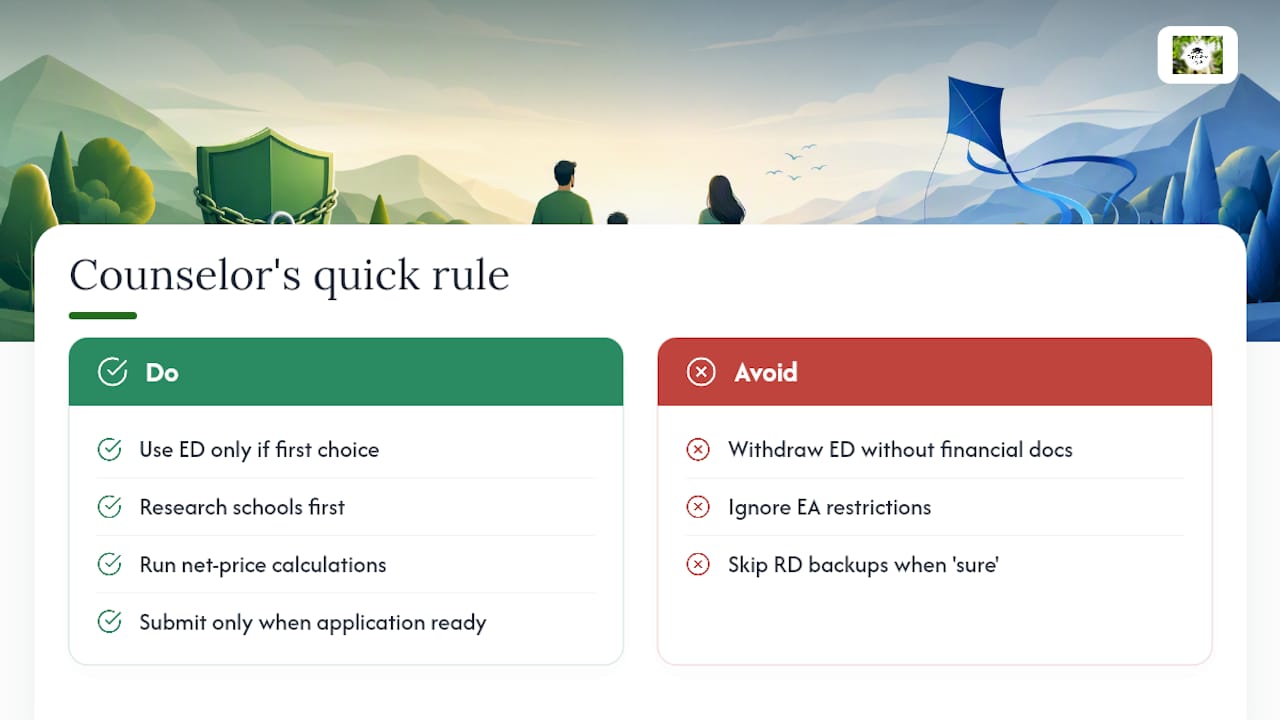
We tell families a simple rule: use ED only when you have a clear first choice, you’ve run the net-price numbers, and your application is genuinely ready, not rushed. Admissions guidance from College Board backs this up. ED works best for students who’ve done the research, not those hoping certainty will follow the deadline.
The mistakes we see most often: backing out of ED without financial documentation, misreading restrictive EA rules and applying early elsewhere anyway, and skipping RD backup plans because a student was “sure” about their ED school.
— Randy Pryor
How Top College Coach Helps You Choose Between ED and EA
Deciding between binding and nonbinding early applications isn’t a guess you should make alone. Top College Coach works with students and parents on exactly this decision, building an early-application strategy around your real financial picture and your actual readiness, not just excitement about a school’s name.

Our counselors, many of them former admissions officers, review applications for readiness, coach essays until they sound authentically like you, and prep families for the financial-aid conversations that ED timing forces early. If you’re weighing ED against EA and want a clear-eyed strategy session before any deadline hits, schedule a consultation with Top College Coach and get a plan built around your specific list of schools.
Where to Confirm Deadlines and Aid Rules Before You Apply
Check College Board’s early admission overview for official ED/EA definitions and policy basics.
Run the federal net-price calculator for a realistic affordability estimate.
Confirm your target school’s own admissions page, since ED/EA rules vary by institution, as seen in policies like MIT’s early admission program.
Sources
FAQ
Does Early Action Give You a Better Chance of Admission?
Not inherently. Early pools sometimes show higher admit rates, but that usually reflects self-selected, well-matched applicants rather than a timing advantage tied to EA itself.
Does Harvard Use Early Decision or Early Action?
Harvard offers a restrictive (single-choice) Early Action program, which is nonbinding but limits you from applying early to other private colleges. Check the school’s own admissions page for the exact current rules before applying.
Does Early Action Have a Higher Acceptance Rate Than Regular Decision?
At many schools, yes, EA pools can show higher admit rates than RD, but the gap often reflects applicant strength and fit rather than timing alone.
Is There a Downside to Applying Early Action?
The main downside is that, outside restrictive EA, it carries less demonstrated-interest weight than ED, and a deferral sends you back into a larger, more competitive RD pool.
What’s the Difference Between ED I and ED II?
ED I deadlines typically fall in November with December decisions, while ED II runs on a later timeline, with deadlines in December or January and decisions following in late January or February. Both are equally binding.
Recommended
Comments