U.S. Colleges Tracking Demonstrated Interest in 2026: Where to Focus

Some colleges track demonstrated interest closely, and it can tip a decision at yield-sensitive schools. It matters far less at the most selective institutions, where nearly every applicant already looks committed. Either way, it never substitutes for strong grades, rigorous coursework, and a compelling application. Your best move is to focus your engagement energy on the schools where the data shows it actually counts.
TL;DR:
Demonstrated interest significantly influences admissions decisions mainly at yield-sensitive, ranked schools outside the top 15 to 20, especially those that consider it “very important” or “important.”
Colleges track engagement through campus visits, event attendance, interviews, and specific email interactions, often using CRM systems to log these activities.
Most Ivy League and highly selective schools do not weigh demonstrated interest heavily, assuming all applicants are genuinely interested, with exceptions like Dartmouth.
Authentic, trackable engagement efforts—such as official campus visits, targeted emails, or scheduled interviews—are more effective than superficial actions like social media likes.
Families should focus engagement efforts on schools where their academic profile is strong, and where college data shows interest can meaningfully influence admissions decisions.
Table of Contents
What Is Demonstrated Interest, and Does It Matter in College Admissions?
Demonstrated interest is the evidence you leave behind that shows a college you’re serious about attending. It includes campus visits, attendance at info sessions or virtual events, interviews, email exchanges with admissions officers, and sometimes even how you engage with a college’s social media accounts.
Colleges track it for one main reason: enrollment management. Admissions offices need to predict yield, the percentage of accepted students who actually enroll, and a strong yield rate protects a school’s rankings and financial planning. A college that admits students unlikely to attend wastes seats and looks less desirable to future applicants. Tracking interest helps admissions offices admit students who are more likely to say yes.
Not every school cares equally. Highly selective institutions generally assume every applicant is serious. Yield-sensitive schools, often ranked outside the top 15 to 20 nationally, lean on demonstrated interest much more heavily to shape their incoming class.
Heading into the 2026 admissions cycle, more colleges have quietly adjusted how they weigh this factor as Common Data Set reporting evolves and admissions offices lean further into digital engagement tracking. Some schools that once listed demonstrated interest as “considered” have upgraded it to “important,” largely because email and web analytics make tracking easier and cheaper than it was a decade ago.
Common ways colleges document interest include:
In-person or virtual campus visits with official sign-in
Attendance at admissions events, fairs, or fly-in programs
Alumni or on-campus interviews
Opening or clicking through recruitment emails
Specific, substantive email questions sent to an admissions counselor
How Do Colleges Track Demonstrated Interest?
Admissions offices rely on a mix of software and human reporting to build a picture of who’s genuinely engaged. Most large universities use a customer relationship management (CRM) system, similar in concept to sales software, that logs every touchpoint a prospective student has with the school.
Here’s what typically gets recorded:
Email engagement. CRM platforms track opens, link clicks, and whether you filled out an interest form after clicking through.
Event attendance. Tour sign-ins, virtual info session registrations, and college fair scans all create a timestamped record tied to your name.
Interview reports. Alumni interviewers and admissions staff file notes that often get weighed alongside your application.
Application timing and choice. Applying Early Decision or Early Action, and writing a supplemental essay that names specific professors or programs, signals commitment even without a formal visit.
What schools generally can’t reliably measure is passive social media activity, like following an Instagram account or liking a post. A handful of admissions offices have said publicly they don’t factor this in at all, since it’s easy to fake and hard to verify.
Pro Tip: Always open recruitment emails from a school’s real admissions address and click through at least one link. It’s a thirty-second action that creates a genuine engagement record, and it costs you nothing.
News. The weight given to these signals varies enormously by institution, which is exactly why blanket strategies backfire. What counts at one school might be invisible at another.
Which Colleges Report Considering Demonstrated Interest?
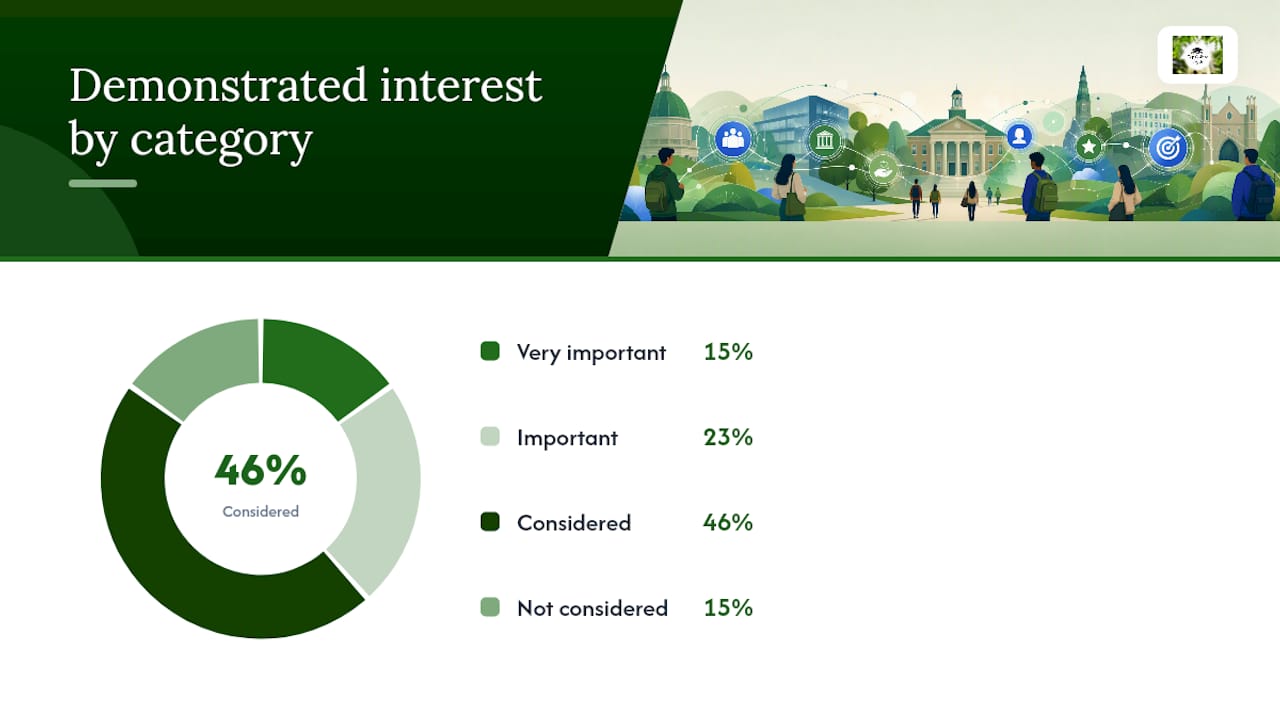
Colleges self-report how much weight they give demonstrated interest through the Common Data Set, an annual survey most four-year institutions complete and publish. Several outlets, including The College Curators, have aggregated these CDS entries into tiered lists. Here’s how the schools named in this article’s research generally fall, based on CDS reporting and admissions office statements.
Very important
Syracuse University lists demonstrated interest as “very important,” among the small number of factors it weighs at the top tier alongside academic record.
Thomas Aquinas College treats interest and fit heavily given its small, mission-driven applicant pool, where genuine engagement with its core curriculum model matters to admissions readers.
Important
Northeastern University, known for cooperative education placements, has historically rated interest as “important,” reflecting its yield-management focus as application volume has surged.
Tulane University also places interest in the “important” tier, consistent with its emphasis on students who can articulate a real connection to New Orleans and its programs.
Duke University lists demonstrated interest as a factor it considers meaningfully, even though its selectivity puts it in a different applicant tier than most yield-sensitive schools.
Considered
Dartmouth College, New York University, Rice University, Tufts University, and University of Michigan each report considering demonstrated interest as one of several factors, without ranking it among their top-tier criteria.
Barnard College similarly lists it as a considered factor, consistent with many highly selective women’s colleges that weigh fit alongside interest.
Not considered
United States Air Force Academy and United States Naval Academy do not track or factor in demonstrated interest the way civilian schools do. Their admissions processes run through congressional nomination and physical fitness requirements, making campus visits and email clicks irrelevant to the decision.
Policies shift year to year as admissions offices adjust enrollment strategy, so verify each school’s current stance directly through its Common Data Set or admissions office FAQ before you build your engagement plan around it.
How to Show Interest in Colleges the Right Way
The goal is authentic, trackable engagement, not volume for its own sake. Some actions carry real weight; others are just noise that admissions readers have learned to ignore.
Register for and attend an official campus visit. Sign in every time. This is one of the clearest, most trackable signals a school can log.
Attend a targeted info session, ideally one focused on your intended major or a specific program, rather than a generic open house.
Schedule an interview whenever one is offered, even if it’s optional. Interview reports carry weight at schools that conduct them.
Send specific, substantive emails that ask about a named professor’s research, a particular scholarship, or a program detail you couldn’t find on the website.
Apply Early Decision or Early Action if a school is a genuine top choice, since binding or near-binding applications are one of the strongest interest signals colleges track.
Avoid mass-sent, barely personalized emails that swap in a school’s name but say nothing specific. Admissions officers read hundreds of these and can spot the template instantly. Skip repeated shallow social media likes, and never overstate your intent to a school you’re not seriously considering. That kind of exaggeration can backfire if it surfaces later in an interview or essay.
Pro Tip: Space your engagement across junior and senior year rather than cramming it into the fall application deadline. A visit in the spring of junior year followed by a fall interview reads as sustained interest, not last-minute scrambling.
Timing matters, too. Junior year spring and summer are ideal for campus visits essential for first-year students, while senior year fall is when interviews and follow-up emails should happen.
Where Does Demonstrated Interest Fit in Your College List Strategy?
Map your list into safety, target, and reach categories before deciding where to spend your engagement time. Demonstrated interest can move a decision at target and safety schools where you’re already competitive academically. It rarely changes anything at a reach school with a single-digit acceptance rate, where admissions decisions hinge almost entirely on academic strength and essay quality.
Ask three questions before committing time or travel to a school:
Does this college report considering demonstrated interest in its Common Data Set or admissions FAQ?
Is my academic profile genuinely competitive here, or would engagement just be a distraction from a reach?
Is an in-person visit realistic given cost and distance, or would a virtual session accomplish the same goal?
If travel isn’t feasible, a well-timed virtual event and a specific follow-up email can create nearly the same signal as an in-person visit at most schools that track this factor. Spend the expensive, time-consuming visits on the schools where the payoff is clearest, and read more on refining your college list if you’re still narrowing your options.
How Top College Coach Advises Families on Demonstrated Interest
At Top College Coach, we treat demonstrated interest as one piece of a larger strategy, never the centerpiece. Randy Pryor and our counselors typically flag two or three target schools per student where a visit, interview, or specific email exchange is likely to matter, based on that school’s CDS reporting. We’ve guided students toward sending professor-specific questions instead of generic “why I love your school” emails, because specificity reads as real interest. Every recommendation stays honest. We never advise a student to fake enthusiasm for a school they don’t actually want to attend.
Priorities for Students and Parents Right Now
Academics come first, always. A 3.9 GPA with rigorous coursework will outweigh a dozen campus visits every time. Once your academic profile is solid, spend engagement time on the handful of target and safety schools where interest genuinely moves the needle, not on chasing every reach school’s newsletter. Skip the shallow stuff: social media likes and copy-paste emails fool no one. Verify each school’s current policy yourself, and lean on what colleges actually look for as your anchor before you build a visit calendar.
— Randy Pryor
Get Personalized Guidance on Where Your Effort Pays Off
Figuring out which of your target schools actually rewards a campus visit, an interview, or a well-timed email, and which ones won’t notice at all, is exactly the kind of judgment call that eats up family time without a plan. Our counseling approach includes work with experienced admissions staff, mentoring from current Ivy League students, and application review from former admissions officers, so your engagement time goes toward the schools where it can genuinely move a decision.
Our College List service maps your safety, target, and reach schools against exactly this kind of demonstrated interest data, so you’re not guessing which visits and emails matter. If you’re ready to build a strategy instead of reacting school by school, check our FAQ for details on how a consulting engagement works and what to expect from your first session.
Sources
Policies change annually, so confirm directly with the school before building your visit calendar around any single list.
FAQ
Does Any Ivy League School Track Demonstrated Interest?
Most Ivy League schools do not weigh demonstrated interest heavily, since acceptance rates are low enough that admissions offices assume every applicant is genuinely interested. Dartmouth College is an exception among Ivies, reporting that it considers demonstrated interest as one factor among several, though not at its top tier.
What Colleges Meet 100% of Demonstrated Financial Need?
A number of well-resourced private colleges, including several Ivy League schools and other highly endowed institutions, commit to meeting 100% of demonstrated financial need for admitted students. This is a separate concept from demonstrated interest. It refers to a college’s financial aid policy, not its admissions tracking of applicant engagement, so check each school’s financial aid office directly for its current commitment.
What Are the “Little Ivies”?
The Little Ivies are a group of highly selective, small liberal arts colleges in the Northeast, often cited as offering an Ivy League caliber education with a smaller campus feel. The exact list varies by source, but it commonly includes schools like Amherst, Williams, Wesleyan, and several other New England liberal arts colleges. Demonstrated interest policies vary among them, so verify each one’s Common Data Set individually.
Can Top College Coach Help Me Figure Out Which Schools Value Demonstrated Interest?
Yes. Top College Coach’s College List service factors demonstrated interest data into how we help families build a balanced list of safety, target, and reach schools. Pricing for personalized counseling packages is available directly through our FAQ.
Is a Campus Visit Worth the Cost If a School Doesn’t Report Tracking Interest?
If a school explicitly reports demonstrated interest as “not considered,” a costly visit won’t move your admissions decision, though it can still help you judge fit. Save the expensive travel for schools where you’re academically competitive and where the Common Data Set confirms interest actually factors into decisions.
Recommended
Comments