Five Caltech Essays: A Coach's Playbook to Show Scientific Drive

Caltech asks for five required responses plus one optional short answer, consistent with their official supplement details, and the single best approach is to lean into STEM, get specific, and let your process show. Faculty read these essays looking for scholarly character, not polish, and every applicant now has to acknowledge Caltech’s AI ethics guidelines before submitting. Start by reading every prompt closely, then decide which multi-choice questions actually fit your story.
Table of Contents
Caltech Essay Requirements: Prompts, Word Counts, and Logistics
For the 2026 to 2027 cycle, Caltech’s supplement includes five required responses and one optional short answer, with word counts generally ranging from 100 to 200 words per prompt. That is short by college essay standards. You do not have room for a slow windup or a big thematic reveal. You need your best sentence in the first line.
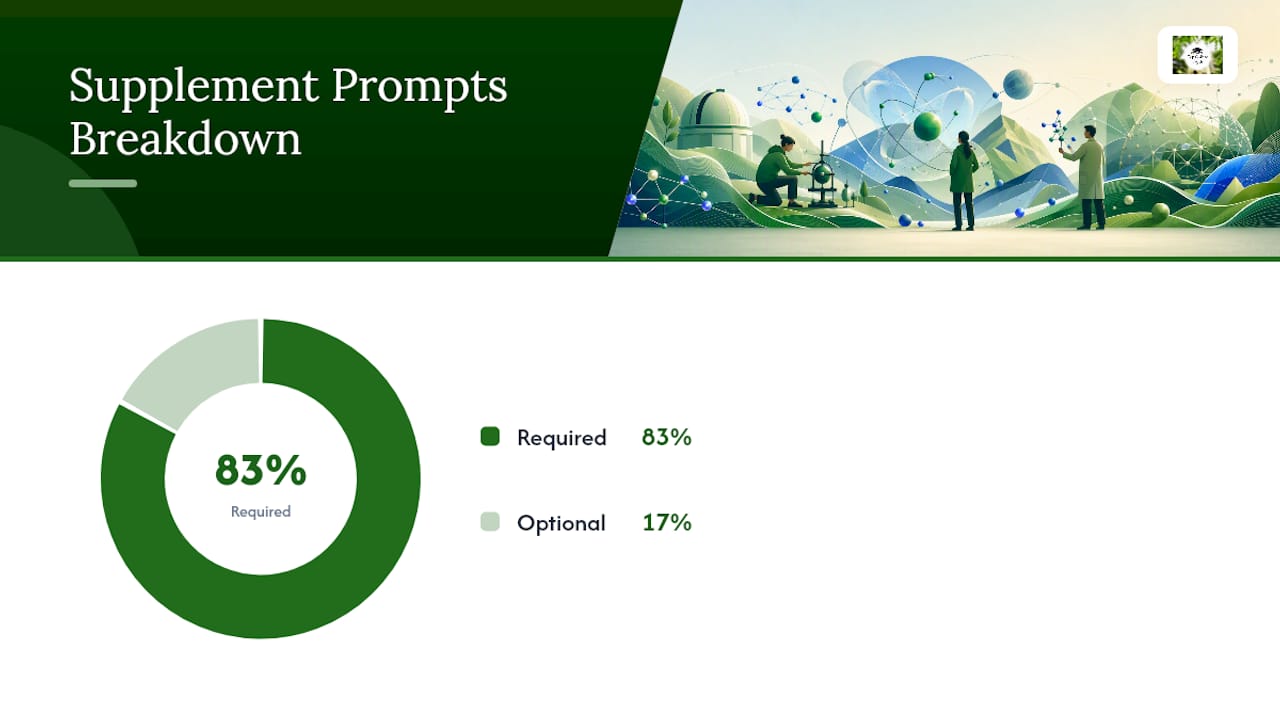
The current supplement structure breaks down like this:
Two questions about your academic and scientific interests (why Caltech, why your intended field)
One question about a project, invention, or creative pursuit you have made or built
One “fun” question about how you would contribute to campus life outside the classroom
One question on collaboration or working through a technical challenge with others
One optional academic short answer, typically used to expand on a research experience or independent project
Some prompts offer a choice between two or three sub-questions, and Caltech budgets these as a shared word pool rather than a flat per-question limit. That means if you are answering one of two options, you are not automatically entitled to the full range on both. Read the character or word count attached to each specific choice before you draft anything.
Submission runs through the Common App or QuestBridge, alongside the standard application requirements: counselor reports, teacher letters, and optional supplemental materials like research papers or portfolios for applicants with relevant work. Before you can submit, Caltech requires every applicant to review its guidelines on the ethical use of AI. Treat that step as mandatory, not optional fine print, and read our breakdown of AI risks in college applications before you draft a single word with AI assistance in the mix.
How Should You Approach Each Caltech Essay Prompt?
Every Caltech prompt is testing the same underlying question in a different costume: how do you think, and what happens when the answer is not obvious? Here is how to approach each one.
1. The academic interest prompts (future, present, past)
Caltech wants to see your scientific trajectory, not a resume rewritten in prose. The strongest answers name a specific moment, question, or failure that pulled you toward a field, then trace what you did next.
A workable micro-structure: open with a concrete moment (a result that surprised you, a problem you could not solve), name the specific concept or tool involved, show one step of your process, and close with where that curiosity is headed. Budget roughly 150 to 200 words, and spend at least a third of them on process, not outcome.
Be technical. Caltech explicitly tells applicants to lean into the “STEMmiest” version of their topic, because faculty members often review these essays. That is unusual. Most schools want jargon translated for a general reader. Caltech wants the opposite: enough real vocabulary that a physics professor recognizes you know what you are talking about. If you built a model to predict protein folding behavior, name the algorithm. If you are stuck on a proof, name the theorem you are wrestling with.
2. The “make” or project prompt
This prompt asks about something you built, invented, or created, and it rewards evidence over description. Weak answers say “I built a robot that could navigate a maze.” Strong answers say what sensor you used, what failed on the third iteration, and what you changed because of it.
Structure this one around a single decision point: the moment your original plan did not work and you had to adjust. That pivot is more revealing than the finished product. Admissions readers already know you finished something. They want to know how you think when the first attempt fails.
3. The “fun” question
Do not treat this as filler. Caltech uses the fun question to gauge how you will add texture to campus life outside the lab, so a genuinely specific, low-stakes answer beats a generic one every time. This is not the place for false modesty or a forced joke. If you have spent three years perfecting a terrible pun collection, or you can solve a Rubik’s Cube blindfolded, say that, and let a little personality through. Keep it under 150 words and resist the urge to make it profound.
4. The collaboration or challenge prompt
This one tests how you behave when a technical problem gets hard and you are not solving it alone. The best answers name a real disagreement or stuck point with a lab partner, teammate, or mentor, and show what you did to move past it, not just that you did.
Avoid the trap of writing about a group project where everything went smoothly. Caltech’s essay advice notes that these questions are designed to reveal how you handle uncertainty and persistence, which means friction is more useful material than harmony.
5. The optional academic short answer
Use this one only if you have a specific research experience, independent project, or technical accomplishment that the other five prompts did not give you room to cover. It is not a place to repeat your activities list in paragraph form. If you have nothing distinct to add, skip it. A thin optional answer weakens your file more than an absent one.
Pro Tip: Recent evidence carries more weight than childhood stories. Caltech’s own admissions guidance favors examples from your recent high school work over anecdotes from when you were seven, so anchor every essay in the last two or three years.
Choosing your two prompts and budgeting shared word pools
When a section offers you two or three sub-question choices, pick based on evidence, not comfort. Ask yourself which prompt lets you show a specific process, with a concrete detail you can verify: a data point, a design decision, a measurable result. If two options feel equally strong on the surface, choose the one where you have the most specific memory of what happened, because specificity is what separates a real essay from a summary.
For shared word-budget sections, treat the total pool as one document, not two. If you have 250 words across two responses, do not split them evenly by default. Give more room to whichever answer needs a process explanation and less to whichever answer is mostly a single vivid image. A fit-driven strategy for allocating supplemental word counts generally rewards depth on one strong point over shallow coverage of two.
A few cross-cutting rules apply to every prompt:
Lead with a concrete detail, not a thesis statement or a rhetorical question.
Use technical vocabulary correctly, but only where it is load-bearing to the point you are making.
Show one moment of genuine uncertainty or failure in at least one essay.
Cut any sentence that describes an achievement without describing how you got there.
What Do Strong Caltech Essays Look Like Compared to Weak Ones?
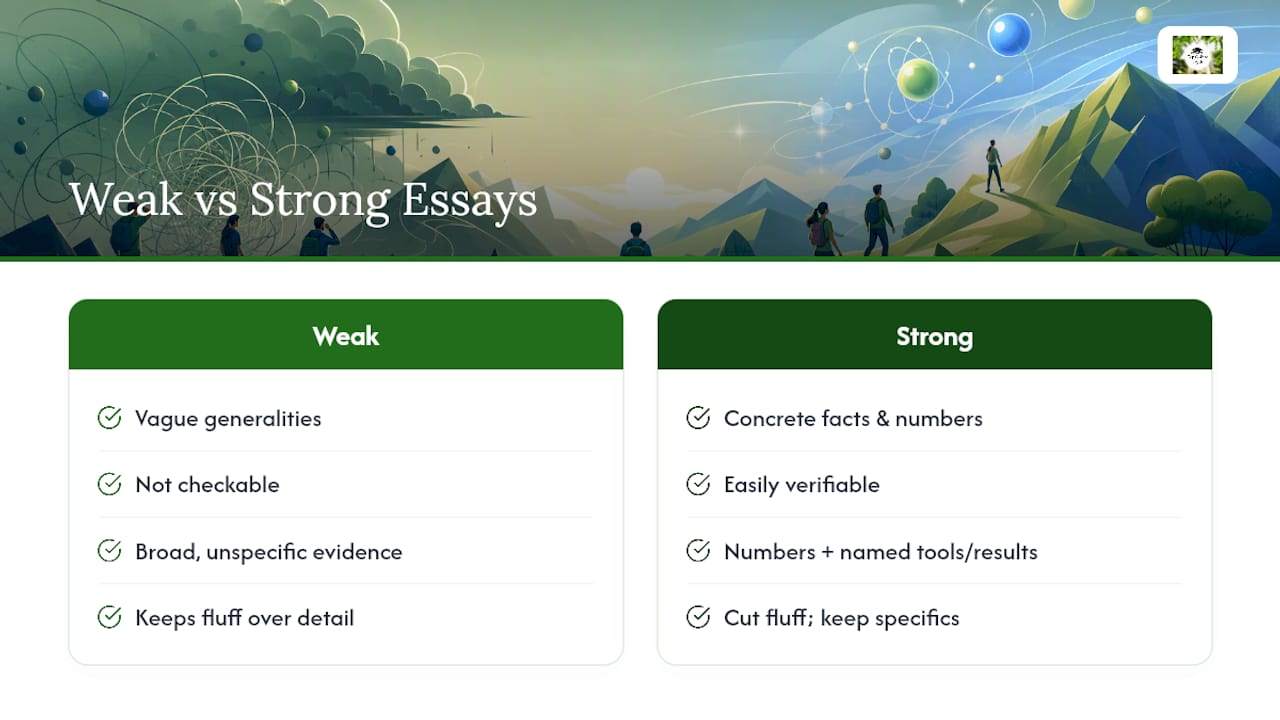
The gap between a forgettable Caltech essay and a memorable one usually comes down to verifiable detail. Here is the same idea, written two ways.
Weak version (academic interest prompt): “I have always loved chemistry. I did a project on chemical reactions in my AP Chem class, and it made me want to study chemistry in college. I learned a lot about how compounds interact and I want to keep learning more at Caltech.”
Strong version: “My titration curve kept flattening 0.3 pH units below the textbook prediction, and I spent two weeks assuming my burette was miscalibrated before I found the real problem: a carbonate contamination in my distilled water. That two-week detour taught me more about analytical chemistry than the lab itself did.”
The difference is not vocabulary. It is that the strong version contains a number, a specific mistake, and a corrected outcome a reader could actually check.
The same logic applies to the fun prompt, where vague charm tends to underperform against a genuinely odd, specific detail.
Weak version: “I love music and I think I would bring a fun, creative energy to campus. I play guitar and I’m always down to jam with people.”
Strong version: “I have transcribed 40 Thelonious Monk piano solos into guitar tablature, a process that involves inventing fingerings Monk never had to consider because he had ten fingers on a keyboard and I have four usable ones on a fretboard.”
Cutting for word limits should target adjectives and throat-clearing phrases first, not your specific evidence. If you are 20 words over, remove qualifiers like “really” or “very,” collapse two short sentences into one, and check for any sentence that restates a point you already made. Never cut the number, the name of the tool, or the specific result to save space. Those details are the entire reason a faculty reader remembers your file.
What Mistakes Sink Otherwise Strong Caltech Essays?
The most common failure is vagueness dressed up as confidence: a claim like “I improved the efficiency of the system” with no number, no method, and no acknowledgment of what did not work along the way. Other frequent problems include skipping the AI ethics acknowledgment, over-claiming results a reader could not verify, and writing an academic interest essay that reads like a resume bullet instead of a process story.
Run every draft through this sequence before you consider it done:
Read it aloud. If a sentence sounds like a list of accomplishments, rewrite it around a single moment.
Circle every number, name, and specific detail. If you find fewer than two per essay, add more.
Check technical terms against their actual definitions. A misused term is worse than a simplified one.
Confirm the essay answers the prompt as written, not the prompt you wish had been asked.
Verify the AI ethics acknowledgment step is complete before submission, and that any AI-assisted drafting followed Caltech’s guidelines.
Get one outside read from a teacher, mentor, or coach who understands supplemental essay strategy, focused specifically on whether your technical claims hold up.
Before you upload, double check that supplemental materials (research papers, portfolios) are attached in the right field, that your counselor’s report and transcript align with what your essays claim about your coursework, and that every required response field on the Common App or QuestBridge portal shows as complete.
Why Caltech Essays Function Like an Interview
Caltech does not interview applicants, which makes these essays the closest thing to a conversation an admissions committee has with you. That single fact should change how you write them. You are not performing for an anonymous reader trained to spot clichés. You are writing for a scientist who will notice if your technical explanation is hollow, and who will also notice if it is genuinely sharp.
We prioritize three things when we work through Caltech drafts with students: evidence-first revisions that replace vague claims with checkable detail, clarity around why a specific technical choice mattered rather than just what was done, and a voice that holds humility and confidence in the same paragraph without either one drowning out the other. That last point trips up more strong students than any word limit does. Caltech applicants tend to either undersell real technical work out of modesty, or oversell it into a claim that does not survive a careful reader’s scrutiny.
The students who get this right are not always the ones with the most impressive project. They are the ones who can explain, precisely, what they still do not understand about it.
— Randy Pryor
How Top College Coach Can Sharpen Your Caltech Essays
We provide support for students who want a technical reader on their Caltech drafts before they submit, not just a general editor checking for typos. Our approach centers on prompt strategy tailored to STEM-heavy applicants, line-by-line technical read-throughs that check whether your scientific claims actually hold up, and word-budget coaching for the multi-response sections where a poorly split 250-word pool can quietly weaken two good essays at once.
We work from the same checklist covered above, then go further: annotating your draft the way a faculty reviewer might, flagging any claim that sounds impressive but is not verifiable, and helping you decide which two prompts actually deserve your strongest material. If you have already drafted your responses using this guide and want a second, more technical set of eyes before you hit submit, book a consultation with Top College Coach to get feedback tuned specifically to what Caltech’s faculty readers are looking for.
Where to Read Caltech’s Official Essay Guidance
Before you finalize anything, read the primary sources directly. They carry the exact prompt wording, word limits, and rules that can shift from cycle to cycle.
Supplemental Application Essays: current prompts, word counts, and the AI ethics acknowledgment step.
Essay writing advice: official tips on prompt intent and drafting.
First-Year Application Requirements: the full checklist of materials beyond the essays.
Apply - Undergraduate Admissions: the application portal and overall submission process.
These pages are the authoritative record. Everything else, including this guide, should be read as strategy built on top of what Caltech itself publishes.
Sources
FAQ
How many essays does Caltech require?
Caltech requires five responses plus one optional short answer, as specified by their official application guidance for the current cycle, with word counts generally between 100 and 200 words depending on the prompt.
Is Caltech harder to get into than MIT?
Both schools are highly selective with acceptance rates in the low single digits, and the two are broadly comparable in difficulty; Caltech’s smaller class size and heavy STEM focus make it a distinct, not simply “harder,” admissions profile.
What are the 8 PIQ questions?
The “PIQs” refer to the University of California’s Personal Insight Questions, a separate essay set used by UC campuses, not Caltech’s supplement. Caltech’s own prompts follow a different structure focused on STEM interest, projects, and collaboration.
Is it easier to get into Caltech as a girl?
Caltech does not publish admissions rates broken out by gender for public comparison, and essay strategy should focus on scientific character and process, which the admissions team explicitly says it evaluates regardless of applicant background.
Recommended
Comments