How to Boost Your GPA Junior Year: Proven Strategies

Junior year is the most consequential academic year on your transcript, and the good news is that it’s not too late to move the needle. The three highest-leverage moves you can make this week are: run a GPA projection to see exactly where you stand, stabilize your current courses so this semester doesn’t slip further, and identify one class where grade replacement or a strong finish will produce the biggest cumulative gain.
Run your GPA projection first. Until you see the math, you’re guessing. Knowing your current cumulative GPA and how many credits remain tells you exactly how much a semester of strong grades can shift your number.
Stabilize before you improve. Protecting a B in a class you’re already passing does more for your cumulative GPA than chasing an A in a class you’re neglecting.
Target one high-impact course. Grade replacement, when your school allows it, can move your cumulative GPA more than a full semester of new A’s. One strategic retake often outperforms a dozen small improvements elsewhere.
Pro Tip: Run your numbers on a free tool like the GPA calculator at Coursera before you do anything else. Ten minutes of projection math will tell you which classes deserve your energy this semester.
Key Takeaways
Junior year GPA improvement is achievable with three moves executed in sequence: run the projection math, protect current courses, and target one high-leverage grade replacement or strong finish.
Point | Details |
Run the GPA math first | Use a GPA calculator to model how this semester’s grades will shift your cumulative number before choosing where to focus. |
Grade replacement is the highest-leverage tool | Replacing one low grade under your school’s policy often moves cumulative GPA more than a full semester of new A’s. |
Active recall beats passive review | Spaced retrieval practice produces better retention than re-reading; use practice tests and Anki as your primary study tools. |
Upward trends matter to admissions | A documented recovery arc from junior to senior year can offset earlier weaknesses at selective universities. |
Top College Coach | Provides personalized transcript strategy, grade-replacement planning, and application narrative coaching for juniors targeting Ivy League and Top 20 schools. |
Table of Contents
How do you calculate your baseline and set a realistic GPA target?
How do you use tutoring and teacher meetings to actually move grades?
How do you maximize grades during exam and assignment weeks?
How much can your GPA realistically improve in one semester or one year?
What students we coached actually did: short case examples and replicable actions
How Top College Coach helps juniors raise GPA and shape applications
How do you calculate your baseline and set a realistic GPA target?
Start with your cumulative GPA and the total credits you’ve completed. Then model what a strong semester can realistically produce.
A simple worked example: You have a 3.1 cumulative GPA across 14 credits. This semester you’re taking 6 credits. If you earn a 3.8 semester GPA, your new cumulative GPA becomes: (3.1 × 14 + 3.8 × 6) ÷ 20 = 3.29. That’s a meaningful gain, and it shows why protecting every course matters.
Weighted vs. unweighted GPA is a distinction worth understanding before you set targets. Unweighted GPA treats every course on a 4.0 scale regardless of difficulty. Weighted GPA, used by many high schools, awards extra points for AP, IB, or Honors courses (typically 0.5 or 1.0 extra per grade level). Indeed’s guide to weighted GPA calculations explains the mechanics clearly. The key strategic point: a B in an AP course may carry more weight than an A in a standard elective, but only if your school reports weighted GPA to colleges. Check with your counselor.
Set a SMART GPA target: specific (3.5 by May), time-bound (this semester), and grounded in the math above. Vague goals like “do better” produce vague results.
Pro Tip: Check your school’s grade-replacement and withdrawal deadlines now. Missing a withdrawal window by one week can lock in a grade that drags your average for the rest of high school.
Which classes deserve your time and energy this year?
Not every course moves your GPA equally. Before you spread effort evenly across six classes, run this quick decision check:
Credit weight: A 1-credit elective and a 5-credit core class are not equal. Prioritize courses with higher credit values.
Graduation requirement: A required course you’re struggling in needs attention before an elective you’re coasting through.
Major relevance: If you’re aiming for engineering programs, a weak grade in pre-calculus sends a louder signal than a weak grade in art history.
Current grade trajectory: A C+ trending upward is a better investment than a B- trending down. Protect what’s moving in the right direction.
On retakes: grade replacement is often the single highest-leverage move available to a junior. Replacing a D or F with a B or better can shift your cumulative GPA more than an entire semester of new A’s, depending on your school’s policy. The math is straightforward: the old grade is removed from your calculation and the new grade takes its place.
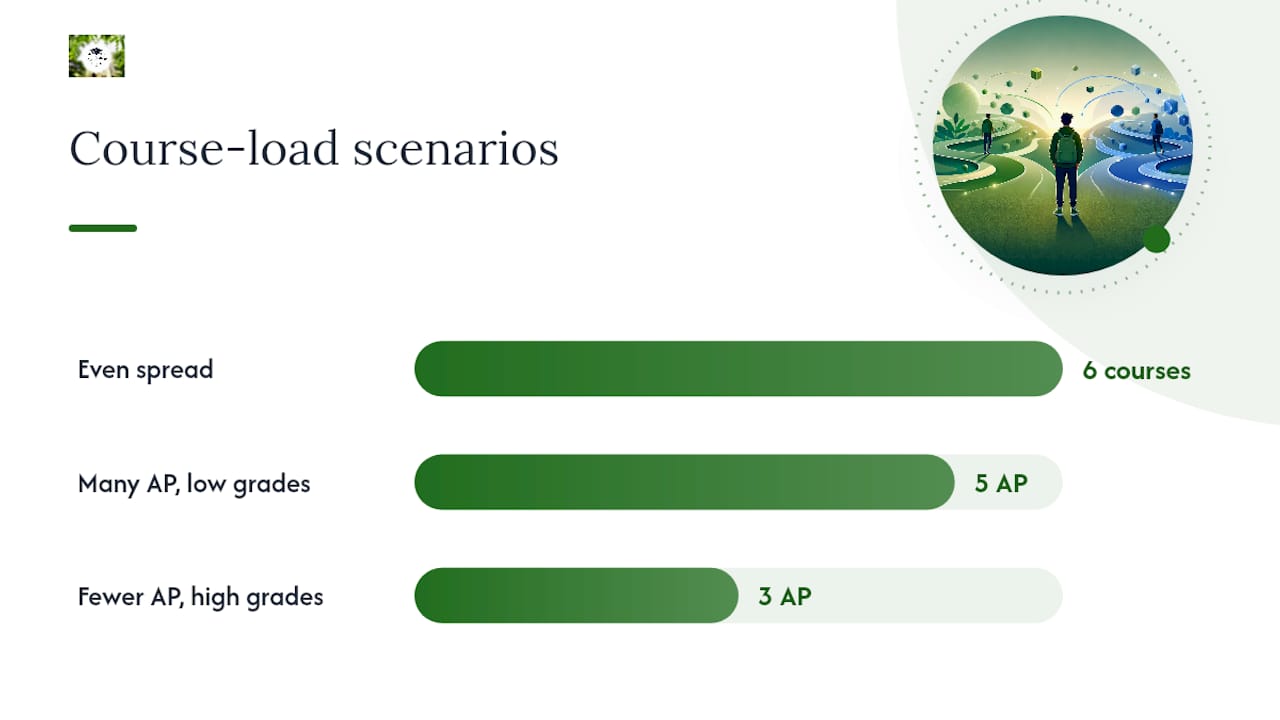
When it comes to course load, resist the temptation to pile on AP courses just to signal rigor. Colleges value course selection that balances challenge with performance. Five AP courses with three B-minuses tells a weaker story than three AP courses with three A’s.
Pro Tip: Talk to your school counselor before the semester ends. Ask specifically about grade forgiveness policies, withdrawal deadlines, and whether retaken courses replace or average the original grade on your transcript.
What study methods actually improve your grades?
Spending more hours studying rarely produces better results on its own. The method matters far more than the time. Research consistently shows that spaced retrieval practice and active recall produce better long-term retention than passive re-reading or highlighting.
The four techniques worth your time:
Active recall: Close your notes and write down everything you remember. Then check. This forces your brain to retrieve information rather than recognize it, which is where real learning happens.
Spaced repetition: Review material at increasing intervals (day 1, day 3, day 7, day 14) rather than cramming the night before. Apps like Anki automate this scheduling for you.
Interleaving: Mix different problem types or topics within a single study session rather than blocking one subject at a time. Controlled research supports interleaving as a way to improve problem-solving and transfer skills, particularly in math and science.
Retrieval practice: Use practice tests, not re-reading, as your primary review tool. If your teacher doesn’t provide them, create your own from past quizzes and homework problems.
A model 45-minute study session:
Five minutes: write a brain dump of what you remember from the last class (active recall).
Twenty-five minutes: work through practice problems or self-quiz on new material, mixing topics where possible (interleaving + retrieval).
Ten minutes: review errors and flag concepts for your next spaced session.
Five minutes: update your spaced-repetition schedule or Anki deck.
AI tools like Anki’s AI card generators or LectureScribe can speed up flashcard creation from your notes, freeing more time for actual practice. Pair any AI-generated material with active recall rather than passive review, or the efficiency gain disappears.
Statistic callout: Spaced retrieval practice consistently outperforms passive review in controlled learning-science studies, with gains appearing across subject types from vocabulary to complex problem-solving.
What daily and weekly routines protect your grades?
Consistency beats intensity. A student who reviews notes for 20 minutes every day outperforms one who studies for three hours the night before an exam, and the research on spaced practice explains exactly why.
A daily routine that works:
Attend every class. Attendance is the single most underrated GPA variable. Missing one lecture in a course with weekly quizzes can cost you points you can never recover.
Review your notes within 24 hours of each class. This is when forgetting is fastest; a quick review cuts that curve dramatically.
Sit near the front. It reduces distraction, increases participation, and signals engagement to teachers who have discretion over borderline grades.
Weekly planning, done in 30 minutes on Sunday:
Open every syllabus and map all deadlines for the coming two weeks.
Identify the highest-weight assignments due this week and block time for them first.
Schedule three active-recall sessions per class for the week, not one long cram.
Check whether any office hours, tutoring slots, or study group sessions need to be booked.
Executive-function tactics that prevent last-minute crashes:
Set a fixed start time for studying each day. The decision fatigue of choosing when to start is a real obstacle; removing it makes consistency automatic.
Break large tasks into 25-minute Pomodoro blocks with five-minute breaks. A 10-page paper becomes manageable when it’s chunked into research, outline, draft, and revision blocks spread across days.
Put your phone in another room during study blocks. Proximity to a phone reduces cognitive performance even when the phone is face-down and silent.
Pro Tip: Participation points are often worth 5–10% of a course grade. Ask your teacher how participation is tracked, then make at least one substantive comment per class. It’s one of the easiest grade points available.
How do you use tutoring and teacher meetings to actually move grades?
Support resources only work when you use them strategically. Showing up to a tutoring session without a specific question is the academic equivalent of going to the gym without a workout plan.
Before meeting a teacher or tutor, prepare these questions:
What are the highest-weight topics on the next exam?
Where are students most commonly losing points on assignments?
Can you look at my last test and tell me what type of error I’m making most?
What does a strong answer on the next essay look like?
Structuring a productive tutoring session means arriving with a specific problem set, not a vague subject. Work through problems with the tutor present, not just watch them solve problems. After the session, write down the two or three concepts you clarified, and test yourself on them within 24 hours. Structured tutoring with clear session goals produces measurably better outcomes than open-ended help sessions.
Your school’s free resources (writing center, peer tutors, library databases) are often underused and genuinely effective for papers and lab reports. Reserve paid tutoring for subjects where you need sustained, expert-level support over multiple weeks.

Pro Tip: Keep a short log after each tutoring session: the concept covered, the error pattern you identified, and whether you tested yourself on it afterward. Three sessions of logged, targeted practice will show you more progress than ten unfocused hours.
How do you maximize grades during exam and assignment weeks?
Test week is where preparation meets execution. The students who perform best aren’t studying more in the final 48 hours; they’re executing a plan they built over the previous two weeks.
Test-week checklist:
Complete at least one full practice exam under timed conditions, three to five days before the test.
Attend office hours with specific questions, not general anxiety. Teachers respect students who come prepared.
Review your most common error types from previous tests, not the entire textbook.
Confirm exam logistics: room, time, allowed materials, and whether a formula sheet is provided.
For major assignments and papers:
Start on the day the assignment is given. Even 20 minutes of outlining on day one prevents the panic of a blank page the night before it’s due.
Map the rubric before you write a single sentence. Every criterion the teacher listed is a point you can earn or lose deliberately.
Ask for clarification on ambiguous prompts before you’re halfway through a draft.
Build in a draft-review-revise cycle with at least one day between drafting and revising. Distance from your own writing reveals errors you can’t see in the moment.
On extra credit and regrades: ask respectfully and specifically. “I believe question three was graded incorrectly because my answer matches the definition on page 47 of the textbook” is a request a teacher can act on. “Can I do anything for extra credit?” is a request that rarely produces results.
Pro Tip: To create a practice exam that mirrors your teacher’s style, pull language directly from their past tests, homework problems, and in-class examples. Teachers reuse their own phrasing more than they realize.
How much can your GPA realistically improve in one semester or one year?
Honest expectations prevent two common traps: giving up because gains feel too slow, and burning out chasing an impossible number. For most juniors applying consistent effort, a realistic improvement range is roughly 0.1–0.3 GPA points per semester. Grade replacement, when available, can produce larger single-semester jumps.
Your action timeline:
This week: Run your GPA projection, identify your lowest-grade high-credit course, and check grade-replacement eligibility with your counselor.
30 days: Establish your daily review routine, schedule tutoring for your weakest subject, and complete your first round of spaced-repetition sessions.
90 days: Assess your semester trajectory, adjust effort allocation based on midterm grades, and begin planning senior-year course selection to support your application narrative.
National education data confirms that academic trajectories shift meaningfully during high school; junior year is the most common inflection point because it’s the last full year colleges see before applications are submitted.
Pro Tip: Don’t sacrifice senior-year planning to chase a 0.1 GPA point this semester. A strong senior-year course load with high grades tells a more compelling story than a marginally higher junior-year number.
What mistakes quietly undermine your GPA recovery?
The most common errors aren’t dramatic failures. They’re quiet, slow-moving decisions that compound over weeks.
Taking only easy electives to pad your GPA. Colleges notice a course load that suddenly drops in rigor. Balance classes you can excel in with courses that demonstrate continued academic ambition.
Ignoring syllabus weights. A student who aces homework but bombs exams in a course where exams are 70% of the grade will finish with a C despite feeling productive all semester. Read the weight breakdown on day one.
Starting retakes too late. Grade replacement only helps if you complete the retake before your transcript is finalized for applications. Check deadlines now.
Treating every assignment as equal. A five-point quiz and a 100-point midterm are not the same. Protect the high-weight assessments first.
Skipping class when grades slip. Attendance is the one variable that affects every other metric: participation points, note quality, teacher goodwill, and test preparation.
If you notice a grade slipping mid-semester, act within one week:
Calculate exactly how much the remaining assignments can move your grade.
Email your teacher and ask what a strong finish looks like.
Schedule tutoring or a study group session for the specific topic where you lost points.
On mental health and burnout: Chronic stress and sleep deprivation impair the memory consolidation that makes studying effective. A student sleeping six hours and studying four hours a night will retain less than one sleeping eight hours and studying two. Protect sleep, build in recovery days, and treat rest as part of your academic strategy, not a reward for finishing.
How do admissions officers read an upward GPA trend?
An upward trajectory on your transcript tells a story that a flat 3.8 cannot: you identified a problem, you changed your behavior, and you produced results. Admissions officers at selective universities are trained to read transcripts longitudinally, not just as a final number.
The concept of “prove recovery” means demonstrating that your improvement is sustained, not a one-semester spike. A junior who goes from a 2.9 sophomore year to a 3.5 junior year, then maintains or improves that in senior year, presents a compelling arc. Admissions guidance consistently emphasizes that this kind of documented recovery, paired with strong senior-year performance, can offset earlier weaknesses at many selective schools.
How to curate your transcript narrative:
Retake courses in subjects relevant to your intended major to show mastery, not just GPA repair.
Add outside academic signals (research projects, dual enrollment, subject competitions) that reinforce the recovery story.
In your application, address a significant grade dip briefly and factually in the additional information section. Focus on what changed: the behavior, the support you sought, and the outcome.
Application language that works:
Before: “My grades sophomore year were lower than I wanted.”
After: “After a difficult sophomore year, I restructured my study approach, sought tutoring in chemistry, and raised my GPA by 0.4 points junior year while taking three AP courses.”
The second version names the problem, the action, and the measurable result. That’s the structure that resonates. For deeper guidance on shaping your admissions story around an upward trend, Top College Coach has resources built specifically for this.
What students we coached actually did: short case examples and replicable actions
One student we worked with entered junior year with a 2.8 cumulative GPA, carrying a D from sophomore chemistry that was eligible for grade replacement. By the end of junior year, after retaking chemistry (earning a B+), establishing a daily active-recall routine, and shifting from re-reading to practice-test prep, the cumulative GPA had risen to 3.2. The chemistry retake alone accounted for roughly half of that gain.
Three actions from that coaching process that you can replicate today:
Audit your transcript for grade-replacement candidates. Pull your transcript, identify every grade below a C, and check whether your school’s policy allows replacement. One strategic retake can outperform months of incremental effort.
Replace passive review with a practice-test habit. Before every exam, create or find a practice test and complete it under timed conditions. Grade it yourself, then study only the topics where you lost points.
Schedule a counselor meeting this week. Not next month. This week. Ask specifically about grade forgiveness, course options, and how your transcript will look to colleges. Counselors have information that isn’t in any handbook.
Setbacks will happen. A bad midterm, a week where everything falls apart, a course that’s harder than expected. The students who recover fastest are the ones who treat a setback as data, not a verdict. One poor grade does not define your trajectory. What you do in the following two weeks does. For more on improving your college application after a rough junior year, Top College Coach has a dedicated guide worth reading.
How Top College Coach helps juniors raise GPA and shape applications
Junior year GPA recovery isn’t just about studying harder. It’s about knowing which levers to pull, in which order, and how the decisions you make now will read on a college application 18 months from now. That’s where personalized guidance makes a real difference.

Top College Coach works directly with juniors on transcript strategy, grade-replacement planning, and the application narrative that turns an upward trend into a compelling story for Ivy League and Top 20 admissions officers. Our team includes former admissions officers and current Ivy League student mentors who know exactly how selective schools read a recovery arc. We don’t offer generic advice. We build a specific plan for your transcript, your target schools, and your timeline.
If you’re ready to move from a GPA projection to a real plan, book a free admissions strategy session with Top College Coach. It’s the fastest way to know exactly where you stand and what to do next.
Sources
Recommended
Comments