Test Optional, Submit or Skip SAT/ACT: 4 Steps for College Applicants

Submit your SAT or ACT score only when it clearly strengthens your file, which typically means it sits at or above your target school’s mid-50th percentile. If it doesn’t, apply test-optional and put that energy into your transcript, essays, and recommendations instead. The one exception worth flagging now: scholarships and certain majors sometimes still require scores, so check those pages before you finalize your decision. Run through the checklist below for every school on your list.
Table of Contents
What Do Test-Optional, Test-Blind, and Test-Flexible Actually Mean?
The terms sound interchangeable. They aren’t, and mixing them up leads students to make the wrong call at the wrong school.
Test-optional: You choose whether to submit SAT or ACT scores. If you send them, admissions officers will look at them.
Test-blind (also called test-free): The school will not consider scores at all, even if you send them. A handful of schools, including the University of California system for freshman admission, fall into this category.
Test-flexible: The school accepts scores in place of other requirements, such as swapping SAT/ACT results for AP exam scores or a graded writing sample.
Most four-year colleges have landed in the test-optional camp, and FairTest’s tracking confirms that this remains the dominant policy category nationally. But “most” isn’t “all,” and policies shift year to year, sometimes school by school within the same university system. A handful of highly selective schools reinstated testing requirements for the 2025 to 2026 cycle, while roughly 86% of colleges still don’t require scores at all. Never assume based on last year’s rules. Check each school’s admissions FAQ or policy page directly, and cross-reference FairTest’s database if you want a second confirmation.
How Do Colleges Actually Use the Scores You Submit?
Applying test optional doesn’t mean scores disappear from the equation once you decide to send them. It means the choice sits with you, and that choice has real downstream effects depending on how a given school’s process works.
If your GPA and course rigor already tell a compelling story, a great score adds confirmation. If your transcript is uneven, a weak score adds doubt where none needs to exist.
Merit scholarships are where this gets tricky. ACT’s own guidance states plainly that test-optional does not mean test-irrelevant, and many institutional scholarship formulas still weigh scores heavily, sometimes automatically. A student who withholds a strong score from the admissions file but never checks the scholarship criteria can walk away from real money without realizing it.
colleges do not require test scores for admission, but a meaningful share of those same schools still use scores elsewhere in the process, particularly for course placement and merit aid, according to Inside Higher Ed’s 2026 reporting. That’s the gap most students miss: admission and scholarship are two different reviews with two different rulebooks, often at the same school.
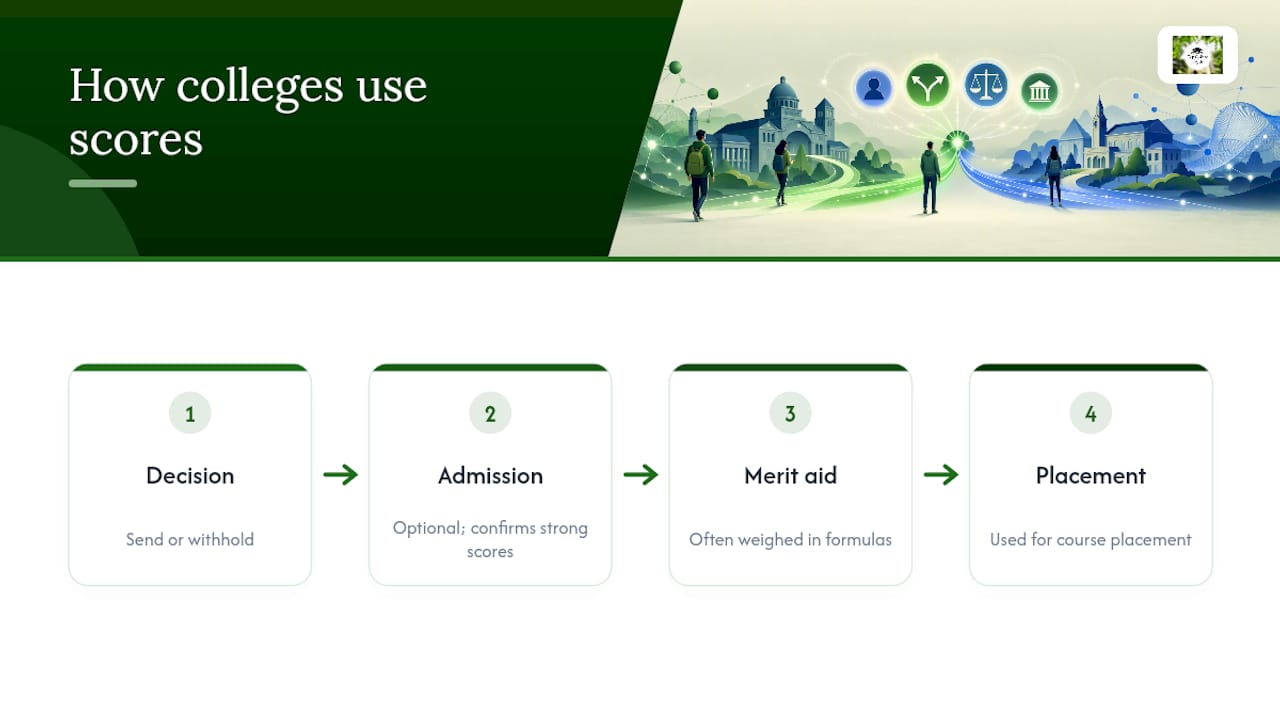
Placement testing is the third piece. Some universities use SAT math or ACT subscores to place incoming freshmen into the right level of calculus or writing seminar. Skip the score at the admissions stage, and you may simply take a placement exam later. It’s a logistics issue, not a rejection risk, but it’s worth knowing before orientation week catches you off guard.
Should You Submit Your SAT or ACT Score? A Step-by-Step Framework
Run this checklist separately for every school on your list. Policies, mid-50th ranges, and scholarship rules vary enough between schools that a blanket “yes” or “no” decision rarely serves you well.
Pull the school’s mid-50th percentile range. Every admissions data page publishes this for the most recently admitted class. Compare it against your best superscore, not your single best sitting.
Weigh your transcript strength independently. Course rigor, grade trajectory, and senior-year schedule matter more at test-optional schools precisely because scores carry less default weight. A junior-year dip followed by a strong senior schedule tells a better story than a flat B+ average with no upward movement.
Check scholarship and major-specific rules before deciding. Engineering programs, honors colleges, and merit scholarship applications sometimes require scores even when general admission doesn’t. This step alone changes the calculus for a lot of students.
Make the call, then commit. If your score sits at or above the mid-50th mark, submit it. If you’re right on the border, one more retest attempt can be worth the time. If your score sits meaningfully below the range, withhold it and redirect that effort into your essays and recommendations.
Here’s the shorthand version worth writing on a sticky note for each school: score at or above the range, submit; score below the range, apply test-optional and strengthen everything else; scholarship or major requires it regardless, submit no matter where you land.
Pro Tip: Build a simple spreadsheet with one row per school, columns for the mid-50th range, your superscore, and any scholarship exceptions. Ten minutes of setup saves you from making the wrong call under deadline pressure in January.
How Do You Apply Test-Optional Through the Common App?
Mechanically, applying without scores is simpler than most students expect, but the details differ by platform.
On the Common App, most member schools include a self-reported testing section where you indicate whether you’re submitting scores for consideration or applying test-optional. Some schools ask you to answer directly within their supplemental questions instead. Either way, the choice is explicit. You’re not leaving a blank field and hoping for the best.
Individual university portals work similarly, though the exact wording varies. University of Missouri’s admissions page walks applicants through marking their file as test-optional directly in the application, and confirms that students can typically switch from score-considered to test-optional review, or the reverse, while the application is still pending. Procedures for making that switch differ by school, so check the specific instructions rather than assuming one university’s process matches another’s.
If you already sent scores and change your mind, contact the admissions office directly and ask them to exclude the score from your file. Some schools, including the University of Minnesota Duluth, note that submitted scores can remain in the system for placement purposes even after being excluded from admissions review, so ask specifically what “removed” means at that school.
Materials you’ll typically need regardless of your testing decision:
Official or self-reported transcript
Activities list with hours and leadership roles
Short-answer or supplemental essays
Letters of recommendation
Senior-year course schedule, sometimes called a mid-year report
What Should You Strengthen If You’re Not Submitting Scores?
Withholding a score isn’t a passive move. It shifts the weight onto every other part of your file, and reviewers know it.
Course rigor becomes your strongest substitute for a test score. AP, IB, and dual-enrollment classes signal that you can handle college-level material without a standardized number proving it. An upward grade trend across four years often reads as more predictive than a single test day anyway.
Your essays carry more weight too. Use supplemental prompts to add context a transcript can’t, especially if you have quantitative strengths like research experience or advanced coursework that a reader might otherwise only see reflected in test scores. A strong essay that demonstrates analytical thinking does real work here.
Recommendations should come from teachers who can speak to specific evidence, not general enthusiasm. Ask your recommender to mention a moment where you solved a hard problem, revised your thinking, or led a group through a setback.
Choose recommenders who taught you in rigorous courses, not just ones who like you most.
Ask for one specific anecdote rather than a general character reference.
Present activities with measurable impact (grew club membership from 12 to 40) rather than vague titles.
Prioritize depth in two or three commitments over a long list of loosely connected clubs.
Pro Tip: A holistic review rewards coherence. If your activities, essays, and recommendations all point toward the same strength, whether that’s leadership, research, or creative work, the file reads as a complete picture rather than a stack of disconnected achievements.
Scholarships and Selective Majors: Where Test-Optional Gets Complicated
The biggest mistake students make with test-optional policy isn’t misunderstanding admissions. It’s assuming the same rule applies everywhere in the application once they’ve decided it applies to general admission.
Merit scholarship applications frequently use test scores in their formulas even when the general admission process doesn’t require them, so omitting a score can shrink your scholarship pool without you realizing it.
Honors colleges, competitive engineering programs, and some professional tracks (nursing, pre-med direct-entry) may require or strongly prefer scores even at otherwise test-optional universities.
Homeschooled students, students from non-accredited schools, and international applicants sometimes face different rules, including a requirement to submit scores that other applicants can skip; resources like Christian Homeschool Curriculums can provide useful context for homeschool families navigating these exceptions.
Before you finalize a test-optional decision, search the specific program or scholarship page rather than relying on the general admissions FAQ. If the page is ambiguous, call the admissions office and ask directly. Reference the University of Cincinnati’s test-optional FAQ as a model of how clearly a school can spell out exceptions when it wants to.
Counselor Perspective: Trade-Offs and Borderline Cases
The borderline cases are where students second-guess themselves the most, and honestly, the heuristic is simpler than the anxiety suggests: if your superscore sits within or above a school’s mid-50th range, send it. If it sits below, withhold it and don’t look back. Where it gets harder is the truly close call, a score five or ten points under the range at a school where the rest of the file is strong. In those situations, a single strong retest or a second opinion from someone who reviews applications for a living tends to resolve more uncertainty than another week of worrying over the decision alone.
— Randy Pryor
How a college admissions counselor can build your test-optional strategy
A specialized college admissions counselor can review your transcript, essays, and score data side by side and help you understand where you stand against a school’s applicant pool.

Working through the framework above on your own is a solid start, but the mid-50th comparison only tells part of the story. Experienced admissions consultants can review your full file to determine whether a borderline score helps or hurts at each specific school, then build your essay and recommendation strategy around whatever gap that decision leaves behind. If you’re applying test optional to several schools with different scholarship and major requirements, that’s exactly the kind of detail work we handle for our clients every cycle. Visit Top College Coach to schedule a consultation and get a strategy built around your actual application, not a generic checklist.
Where to Verify Your School’s Exact Policy
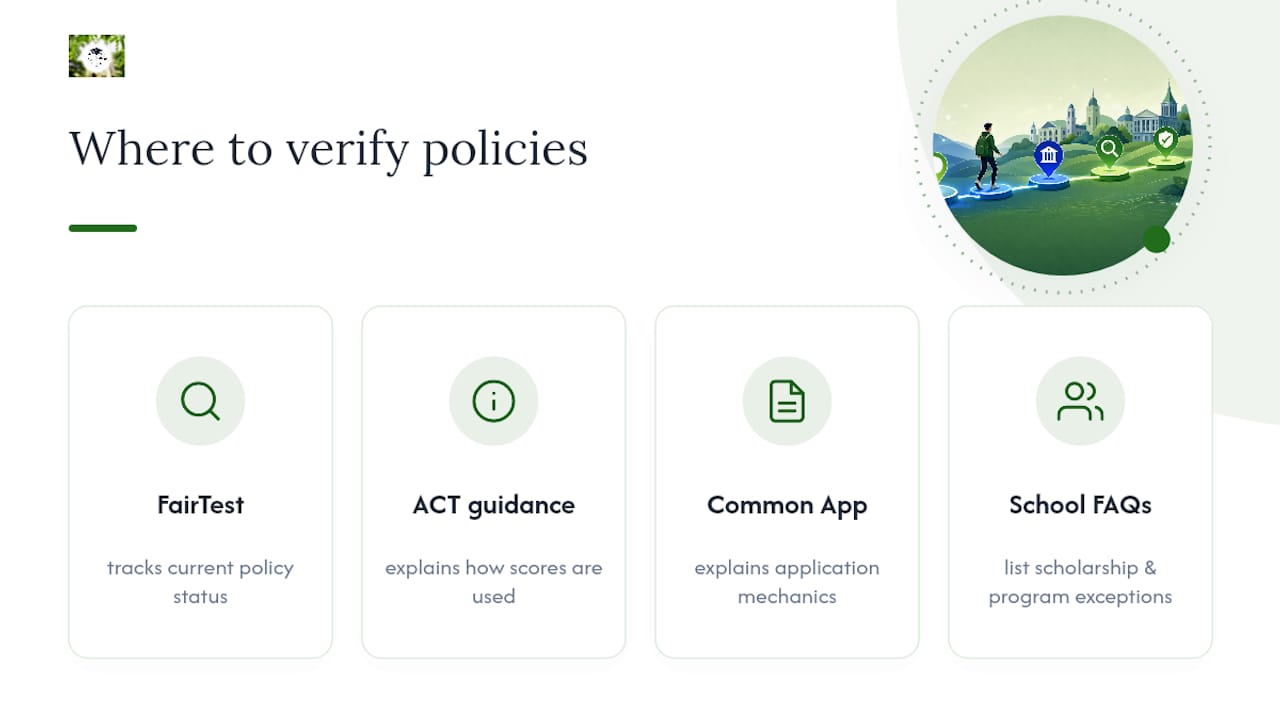
Always confirm details directly rather than relying on secondhand summaries. FairTest tracks current policy status across hundreds of institutions. ACT’s guidance explains how scores get used behind the scenes. The Common App site walks through application mechanics, and individual school FAQ pages, like Mizzou’s and Cincinnati’s, spell out scholarship and program exceptions.
Sources
FAQ
Is Applying Test-Optional a Good Idea?
It’s a good idea when your SAT or ACT score falls below a school’s mid-50th percentile range and the rest of your application, especially course rigor and essays, is strong enough to stand on its own.
Will Colleges Still Be Test-Optional in 2026?
Most will.
Is an 860 SAT Score Considered Low?
A score well below the mid-50th percentile range at nearly every four-year college that publishes admissions data is a strong candidate for withholding at test-optional schools rather than submitting.
What Was Bill Clinton’s SAT Score?
Public records on Bill Clinton’s exact SAT score aren’t reliably documented, and it has no bearing on how today’s test-optional policies work, so it’s not useful information for building your application strategy.
Do Test-Optional Schools Assume a Missing Score Is Bad?
No. University FAQs, including Cincinnati’s, state directly that applications reviewed without scores go through the same holistic process and that reviewers don’t assume an omitted score is a weak one.
Recommended
Comments