Deadlines (Nov 9, Jan 5): Amherst Admissions 2026–27 and 5 Steps

Amherst admissions runs on two rounds: Early Decision, due November 9, 2026, and Regular Decision, due January 5, 2027. The college is test-optional and need-blind, and every file goes through holistic review, meaning transcript rigor, essays, and recommendations carry more weight than any single number. Get those three right, and the rest of the application becomes a matter of logistics, not luck.
TL;DR:
Applicants should focus on demonstrating academic rigor, strong essays, and compelling recommendations, as Amherst reviews files holistically and values consistency.
Deadlines for Early Decision are November 9, 2026, and decisions are issued in December, while Regular Decision is due January 5, 2027, with decisions in late March.
The application process involves multiple components including official transcripts, teacher recommendations, mid-year reports, and optional supplementary materials, all from official sources.
Amherst guarantees full financial aid to admitted students, including international applicants, and encourages fee-waivers for eligible students through various programs.
International applicants must demonstrate English proficiency, and visa arrangements should begin early after admission due to variable processing times.
Table of Contents
Transfer Applicants: Eligibility, Deadlines, and Credit Rules
After You Apply: Tracking Status and Understanding Decisions
How to Write Essays and Secure Recommendations That Stand Out
Top College Coach’s Perspective on Supporting Amherst Applicants
How Top College Coach Helps You Build an Amherst-Ready Application
Deadlines, Application Rounds, and Which Platform to Use
Applying Early Decision at Amherst means committing to enroll if admitted, and the calendar rewards students who plan early rather than scramble in October.
Early Decision: Deadline November 9, 2026. Decisions arrive in early to mid December.
Regular Decision: Deadline January 5, 2027. Decisions arrive by late March.
Amherst accepts three application platforms, so pick whichever your school already uses:
The Common Application
Coalition with Scoir
QuestBridge, for students applying through the QuestBridge National College Match
Each platform carries Amherst’s own writing supplement, and financial-aid materials are due on a schedule tied to your round, not a single fixed date. If you’re deciding between binding and nonbinding options, Early Action vs. Early Decision: How to Choose breaks down the trade-offs before you commit. Start requesting letters of recommendation by early fall, and flag your counselor early if you’re applying ED, since mid-year grade reports and rec letters both need lead time that a November 9 deadline doesn’t leave much room for.
What Amherst Looks For in an Applicant
Academic rigor sits at the top of Amherst’s priority list, followed closely by the strength of essays, recommendations, and extracurricular involvement. Every application gets read by at least two admissions deans before it moves to committee, which means a compelling, consistent narrative matters more than any single flashy credential.
By the numbers: Amherst’s Class of 2028 profile publishes mean SAT and ACT ranges for admitted students alongside the share of the class that’s international, giving applicants a real benchmark rather than a guess.
Amherst weighs several factors together rather than ranking them in isolation:
Rigor of your secondary school curriculum and your GPA trajectory within it
Letters of recommendation from teachers and your counselor
Personal essays and the required Amherst writing supplement
Extracurricular depth, particularly sustained commitment over four years
Standardized test scores, submitted only if you choose to
Testing is optional, but many international applicants still need to demonstrate English proficiency through TOEFL, IELTS, or the Duolingo English Test. Read the class profile as a compass, not a cutoff. If your GPA and course rigor land near the middle of the published range, a sharp essay and a strong counselor letter can do real work to round out the picture.
Application Components: A Step-by-Step Checklist
A complete Amherst file has more moving pieces than most students expect, and missing one late in the process is the single most avoidable stumbling block.
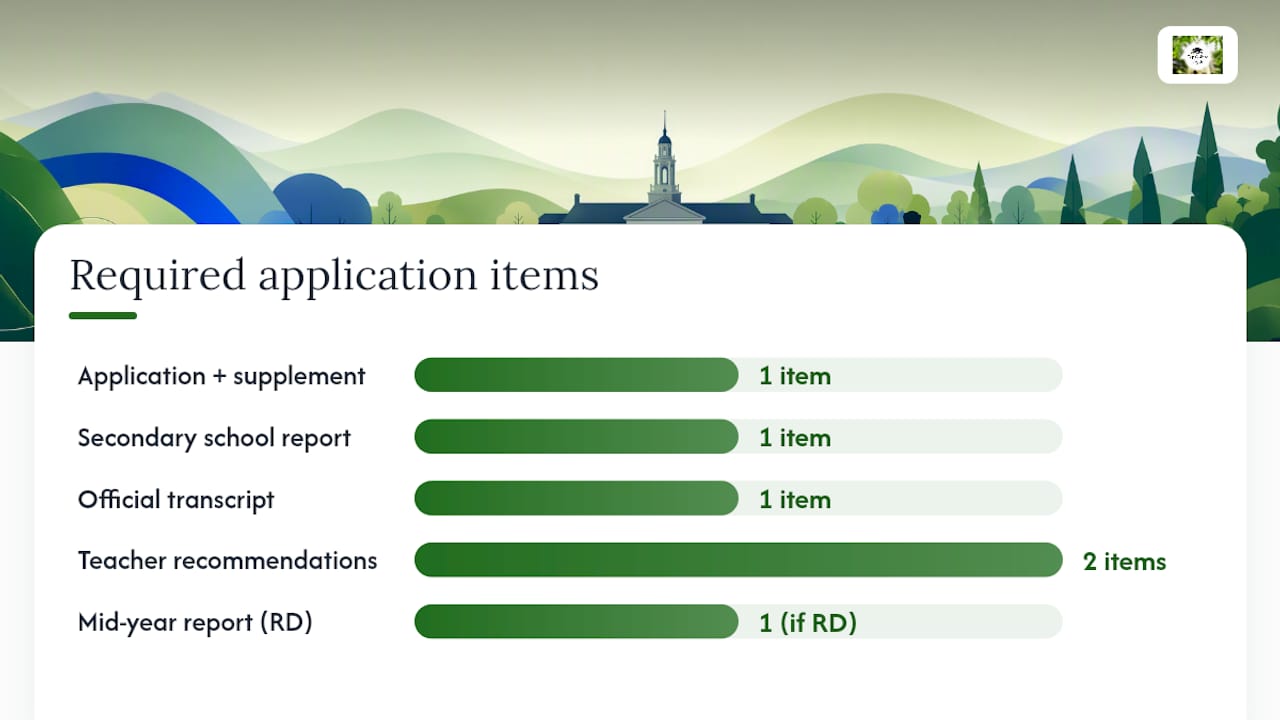
Submit the Common App, Coalition, or QuestBridge application with Amherst’s writing supplement.
Confirm your counselor has submitted the secondary school report and official transcript.
Confirm two teacher recommendations have been submitted through the platform your school uses.
Submit a mid-year report once fall semester grades are finalized, if applying Regular Decision.
Add optional supplements, like an arts portfolio or graded analytical essay, only if they genuinely strengthen your file.
Amherst is explicit that official documents must come from school officials, not from the applicant. A transcript you scan and upload yourself will typically get rejected as unofficial, even if it’s accurate.
Pro Tip: Set a shared tracking sheet with your counselor and recommenders two months before your deadline, listing who submits what and by when. Then check the Application Status Portal weekly during the final month, not just the day before it’s due, since a missing rec is far easier to fix in October than on November 8.
Financial Aid, Fees, and Fee-Waiver Options
Amherst admits every applicant need-blind and commits to meeting full demonstrated financial need once a student is admitted, including for international students. That policy removes the ability-to-pay question from the review entirely.
The application fee is $75, but waivers are widely available and Amherst actively encourages eligible students to use them:
Fee waivers through the Common Application’s built-in waiver request
Automatic eligibility for QuestBridge applicants
Amherst’s own Quick Pass program, which the college markets specifically to first-generation, low-income, and veteran applicants
If you need help figuring out which waiver route applies to your situation, How to Find College Application Fee Waivers in 2026 walks through eligibility by platform. Aid materials, including the CSS Profile and FAFSA where applicable, are due on a schedule tied to your round, so confirm exact dates directly with Amherst’s financial aid office rather than assuming they match your application deadline.
Transfer Applicants: Eligibility, Deadlines, and Credit Rules
Amherst accepts a modest number of transfer students each year, and the bar is meaningfully competitive: applicants typically need the equivalent of 32 semester hours of transferable liberal-arts coursework, with a GPA in the A- range considered genuinely competitive.
Spring transfer: Deadline November 2, 2026. Decision by mid-December.
Fall transfer: Deadline March 1, 2027. Decision by mid-April.
Required documents include college transcripts and instructor evaluations, not just high school records.
Students who have already earned a bachelor’s degree are generally not eligible to apply as transfers.
Course credit transfers at Amherst’s discretion, department by department, so consult the transfer pages early rather than assuming your existing coursework will map cleanly onto Amherst’s curriculum.
After You Apply: Tracking Status and Understanding Decisions
Once your file is submitted, Amherst gives you secure access to an Application Status Portal and, if you applied for aid, a separate Financial Aid Portal, both of which flag missing documents in real time.
Log in weekly to confirm every required item shows as received.
Understand your outcome: admit, deny, or, for ED applicants, deferral to the Regular Decision pool for reconsideration alongside RD applicants.
If admitted, note your reply deadline and enrollment deposit date, since missing it can forfeit your spot.
If waitlisted, follow Amherst’s specific instructions for confirming continued interest.
Contact the admission office directly if a document shows as missing more than a week after your recommender confirms it was sent.
Once you’re admitted and planning the move to campus, tools like Roomit AI can help you sort out roommate matching before orientation even starts.
Counselor Tips: What Actually Moves the Needle
Pro Tip: Fix your transcript story first. An upward grade trajectory in rigorous courses reads better to Amherst’s deans than a flat 4.0 in easier ones, since Amherst is looking for evidence you’ll thrive in an open curriculum with no required courses.
Submit test scores only if they sit above Amherst’s published mean ranges or add meaningful context, since a mediocre score submitted voluntarily can do more harm than staying test-optional. Use the writing supplement to show genuine intellectual curiosity, because Amherst’s open curriculum rewards students who can articulate why they want the freedom to design their own course of study. Confirm your recommenders and mid-year report are on track by early December, not late in the month.
How Do Interviews Fit Into the Process?
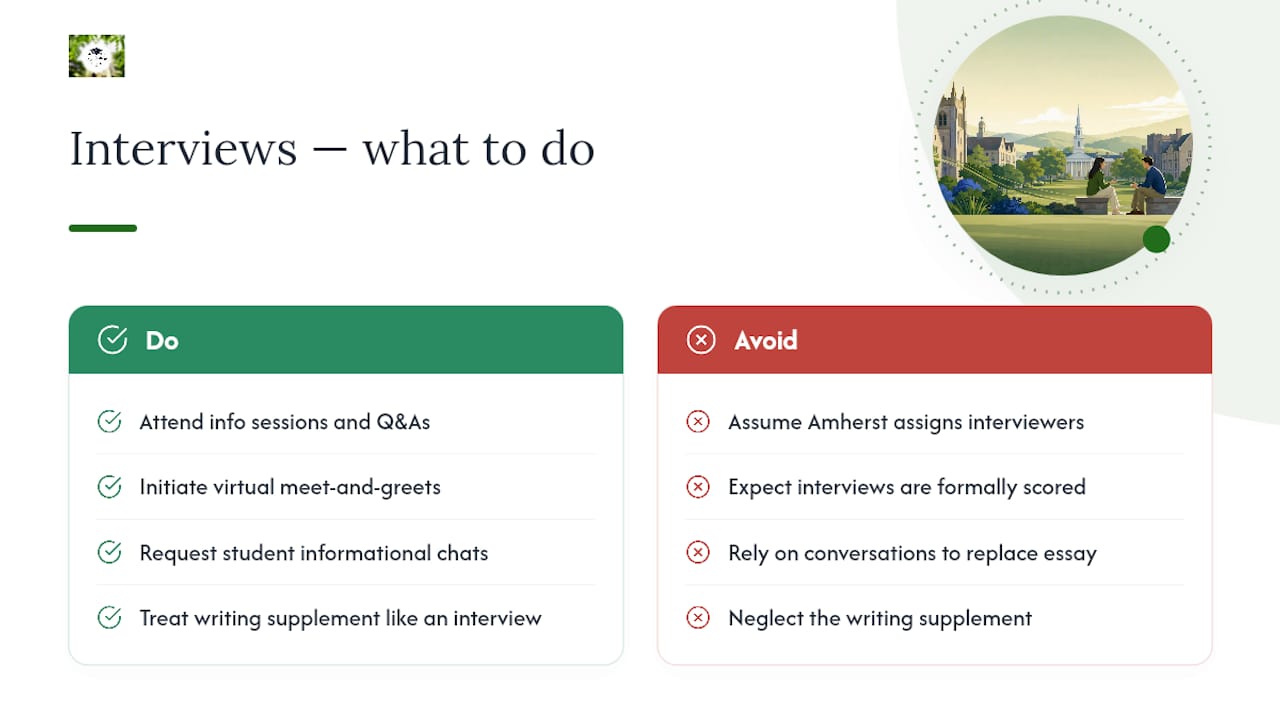
Amherst doesn’t require an admission interview, and there’s no formal alumni or on-campus interview program built into the standard evaluation. That surprises a lot of families used to schools that assign regional alumni interviewers automatically.
What does count is any interview-adjacent contact you initiate. Amherst’s admission staff hosts information sessions, group Q&A calls, and virtual meet-and-greets throughout the fall, and attending these can occasionally translate into a genuine, informal conversation with a staff member or current student. Some students also request informational chats with current Amherst students through official college channels, which can sharpen how they write about the school in their supplement, even though nothing from that conversation gets scored.
Because there’s no formal interview weighing into your evaluation, the writing supplement effectively functions as your interview. It’s the one place where Amherst deans hear your actual voice rather than reading about you secondhand through a recommender or counselor. Treat that essay with the same seriousness you’d bring to a face-to-face conversation with an admission dean, because in a real sense, it is one.
Special Programs: QuestBridge and Access Initiatives
Amherst partners with QuestBridge as a full application platform, not a side program, and QuestBridge Match applicants who are selected as finalists and matched to Amherst receive an offer of admission with a full four-year scholarship covering tuition, room, and board. That makes QuestBridge one of the more direct paths to Amherst for high-achieving, low-income students.
Beyond QuestBridge, Amherst’s Quick Pass program broadens fee-waiver eligibility well past the standard income thresholds most colleges use, explicitly reaching out to first-generation, low-income, and veteran applicants. The college also runs targeted outreach and fly-in programs for prospective students from underrepresented backgrounds, giving admitted and prospective students a chance to experience campus before committing to apply or enroll.
If any of these categories describe your situation, don’t treat them as afterthoughts buried in the application. Mention relevant context directly in your application where it’s genuinely relevant to your story, since Amherst’s holistic review is built to weigh circumstance alongside achievement, not just achievement in isolation.
How to Write Essays and Secure Recommendations That Stand Out
Amherst’s writing supplement rewards specificity over polish. A crisp, honest paragraph about one real intellectual interest beats a broad, safe essay trying to cover five extracurriculars in 250 words.
Because Amherst runs an open curriculum with no required courses, deans are reading essays partly to gauge whether you’re genuinely curious enough to design your own academic path. Essays that name a specific unresolved question you want to chase, rather than restating your résumé, tend to land better with readers who see thousands of files a cycle.
For recommendations, the strongest letters come from teachers who taught you in an academically rigorous course and can speak to specific classroom moments, not just general enthusiasm. Give your recommenders context: a short note about what you’re hoping to study and one or two specific projects or discussions you’d want them to mention. Ask early, ideally before Labor Day if you’re applying ED, so your teacher isn’t writing a rushed letter in late October.
What International Applicants Need to Know
Amherst reviews international applicants through the same holistic process used for domestic students, with one meaningful addition: many international applicants must demonstrate English proficiency through TOEFL, IELTS, or the Duolingo English Test unless they qualify for an exemption.
Need-blind admission and the commitment to meet full demonstrated need extend to international applicants, which sets Amherst apart from many peer schools that consider ability to pay for students outside the U.S. That policy matters enormously for families weighing whether Amherst is even financially realistic to apply to in the first place.
International applicants should start visa planning conversations early once admitted, since F-1 visa processing timelines vary significantly by country and can take longer than students expect during peak season. Amherst’s international student support office typically provides guidance on visa documentation, arrival logistics, and orientation once a student accepts an offer, but the process of gathering financial documentation for the I-20 form should start as soon as an admission and aid offer arrives, not after the enrollment deposit deadline.
Campus Visits and Virtual Events
Amherst offers guided campus tours and information sessions for prospective students who can visit in person, typically running on a regular schedule during the fall and spring. For families who can’t make the trip to western Massachusetts, Amherst also runs virtual information sessions and panel discussions covering academics, financial aid, and student life throughout the application cycle.
Visiting isn’t required and won’t factor into your evaluation the way it does at schools that formally track demonstrated interest. Still, a campus visit or a virtual session can sharpen how specifically you write about Amherst in your supplement, since generic praise for “small class sizes” reads very differently from a detail about a specific course, professor, or program you learned about firsthand. If timing or budget rules out a visit, watching a recorded information session and reading the course catalog closely can accomplish much of the same thing.
Top College Coach’s Perspective on Supporting Amherst Applicants
Families come to us mid-process more often than at the very start, usually once a deadline feels close and the essay still isn’t working. Individualized planning matters here because Amherst’s open curriculum rewards a genuinely specific story, not a template. A first conversation with us typically maps your existing timeline, flags what’s missing, and identifies where your essay needs the most work.
— Randy Pryor
How Top College Coach Helps You Build an Amherst-Ready Application
Amherst’s holistic review rewards a coherent story told well, and that’s exactly where an outside, experienced eye tends to matter most. An outside, experienced eye tends to matter most in building a competitive application, with mentoring and application review helping ensure essays and activity lists receive careful scrutiny.
Our services map cleanly onto the checklist above: Early High School Planning for freshmen and sophomores building the transcript rigor Amherst prioritizes, Junior Year Preparation for testing and activity strategy, The College List for figuring out where Amherst fits among your targets, and The Application & Beyond for essay coaching and final review before you hit submit. A first consultation typically covers your current timeline, an honest read on your transcript and activities, and a plan for the months between now and your deadline. Visit our FAQ page to see how our packages work, or head to our homepage to request a consultation and get a specific plan for your Amherst application.
FAQ
Is Amherst or Williams Harder to Get Into?
Both schools are among the most selective liberal-arts colleges in the country, and their acceptance rates typically land within a similarly narrow range each cycle. Rather than chasing which school is marginally harder, focus on Amherst’s own published Class of 2028 profile to gauge your fit against its actual admitted-student data.
Is It Difficult to Get Into Amherst?
Yes. Amherst is one of the most selective colleges in the country, and its holistic review means strong grades alone don’t guarantee admission. Success depends on pairing rigorous coursework with a compelling essay and strong recommendations, not any single metric in isolation.
What GPA Do You Need to Get Into Amherst?
Amherst doesn’t publish a minimum GPA, but admitted students overwhelmingly come from the top of their high school class with consistently rigorous coursework. Course difficulty and grade trajectory matter as much as the raw number itself.
What Is Amherst’s Acceptance Rate?
Amherst’s exact acceptance rate shifts slightly from year to year, but the college has consistently ranked among the most selective liberal-arts institutions in the country. Current entering-class statistics, including selectivity context, are published in the Class of 2028 Admission and Enrollment Profile.
Does Top College Coach Help Specifically With Amherst Applications?
Yes. Top College Coach offers Early High School Planning, Junior Year Preparation, The College List, and The Application & Beyond, all of which apply directly to building a competitive Amherst file. Current pricing and package details are available on the Top College Coach FAQ page.
Recommended
Comments